
Skip to primary content

infophile

Curating news and resources for the library and information services community.

infophile

Main menu

  • About
    • About
    • Netspeed 2014 Presentation
    • Contact
  • Resources
    • 32 Makerspace and Arduino Resources
    • Assistive Tech and Implantable Wearables
    • Coding
    • Death and the Digital Afterlife
    • Emotional Intelligence
    • Interactive Maps
    • Librarianship Job Postings & Resources
    • Music Discovery
    • Tech News Sources
    • Typography and Type Design
  • Cool Tools
  • Topics
    • Digital Content
    • Education
    • Librarianship
      • Books
      • Libraries
      • Reading
    • Mentoring
      • Psychology
    • MLIS
    • Research
    • Resources
    • Technology
      • Innovation
      • Tech News Sources
      • GTA Technology Topics, Tips & Tricks
  • Top Posts
    • Top 100 Posts
    • Spam Text Messages
    • 17 Free Live Webinars for Librarians, April 2013
    • Coloring Books
    • 10 Useful Spreadsheet Templates To Organize Your Life
    • Students & Technology Infographic
    • Libraries of the Future Infographic
    • Vintage Children’s Book Leaves Nothing To The Imagination
    • Creative Commons Licenses Explained Infographic
    • Skills You Need, Salary You Can Expect as a Data Scientist
    • List of Summer Reading Lists [2015]
    • 21 Books From The Last 5 Years For Women
    • 53 Books You Won’t Be Able To Put Down
    • Happy Ever After: 100 Swoon-Worthy Romances
    • 275 Free Resume Templates
    • 1150 Free Courses
  • Summer Reading 2016

Post navigation

← Previous Next →

Take A Graphic Stroll Through Your Own Personal Meta Data | Co.Exist

Posted on July 15, 2013 by infophile

With the recent reveal that the NSA has been monitoring Americans’ email “meta-data,” the term has suddenly transformed from an obscure, techy vocabulary word into something on the tip of the average cable-news watcher’s tongue. Email meta-data is, of course, information about an email (like who sent it and when it was sent) as opposed to the content of the email itself. But if it isn’t clear what that means exactly, a recent visualization project by researchers at the MIT Media Lab called Immersion provides “a people-centric view of your email life” by providing an interactive tool to dive into your own meta-data.

via Take A Graphic Stroll Through Your Own Personal Meta Data | Co.Exist: World changing ideas and innovation.

immersion: a people-centric view of your email life. You will need to login via a Gmail account. You can also check out the demo.

Immersion will only display interactions between your personal contacts in a visualization map. It will not actually display more specific metadata than this.
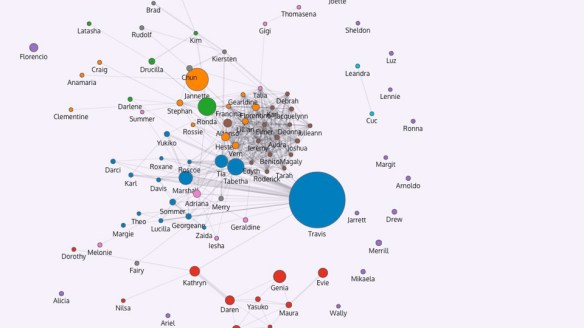
immersion

Share:

  • Click to share on Facebook (Opens in new window) Facebook
  • Click to share on X (Opens in new window) X
  • Click to share on LinkedIn (Opens in new window) LinkedIn
  • Click to share on Tumblr (Opens in new window) Tumblr
  • Click to share on Pinterest (Opens in new window) Pinterest
  • Click to share on Reddit (Opens in new window) Reddit
  • Click to email a link to a friend (Opens in new window) Email
  • Click to print (Opens in new window) Print
Like Loading...

Related

This entry was posted in Technology and tagged data, data visualization, metadata, online privacy, privacy, technology by infophile. Bookmark the permalink.

Tag Cloud

  • apps
  • art
  • authors
  • books
  • business
  • careers
  • children
  • coding
  • collections
  • community
  • creativity
  • culture
  • data
  • design
  • devices
  • digital
  • digital content
  • eBooks
  • education
  • employment
  • film
  • free
  • future
  • gadgets
  • gaming
  • gender
  • genres
  • Google
  • health
  • historical
  • history
  • human interest
  • images
  • infographics
  • information
  • innovation
  • intellectual freedom
  • interactive
  • Internet
  • learning
  • librarians
  • librarianship
  • libraries
  • literature
  • mentoring
  • MLIS
  • mobile
  • news
  • online
  • online learning
  • presentations
  • psychology
  • publishers
  • publishing
  • reading
  • recommendations
  • research
  • resources
  • science
  • search
  • self-improvement
  • social
  • social media
  • social networking
  • software
  • students
  • technology
  • tools
  • trends
  • users
  • videos
  • web services
  • websites
  • women
  • youth
Blog at WordPress.com.
Privacy & Cookies: This site uses cookies. By continuing to use this website, you agree to their use.
To find out more, including how to control cookies, see here: Cookie Policy
  • Reblog
  • Subscribe Subscribed
    • infophile
    • Join 704 other subscribers
    • Already have a WordPress.com account? Log in now.
    • infophile
    • Subscribe Subscribed
    • Sign up
    • Log in
    • Copy shortlink
    • Report this content
    • View post in Reader
    • Manage subscriptions
    • Collapse this bar
%d