
Keep Your Precious Data Safe by Storing Passwords in Your Subconscious | Gizmodo


Do you ever fear that, one day, data-hungry bandits will tie you to a chair and make you surrender your Facebook password? It’s not an unreasonable fear, actually. Christopher Nolan made a gripping documentary about this very scenario. But, thanks to a new method developed by scientists from Stanford and Northwestern, you may never have to worry about remembering a password ever again.

The technique depends on so-called “procedural memories,” the things stored in your brain that you access unconsciously. For example, you ride a bike or play a guitar without thinking about it. These memories are actually stored deep in the part of your brain that handles motor control and habit-forming, as opposed to explicit memories which are stored in the frontal cortex, among other places. However, you can train yourself to access procedural memories when you need them.

Read More: Keep Your Precious Data Safe by Storing Passwords in Your Subconscious | Gizmodo.
Recent Pew Research Links


Broadband Adoption: The Next Mile | Statement of Aaron Smith (Senior Researcher, Pew Research) | Pew Internet

The New Library Patron from Pew Research Center’s Internet & American Life Project
Lee Rainie, Director of the Pew Research Center’s Internet & American Life Project, will discuss the Project’s new research about library patrons and non-patrons: who they are, what their information needs are, what kind of technology they use, and how libraries can meet the varying needs of their patrons.

Photo and Video Sharing Grow Online | Pew Internet
A new study by the Pew Research Center’s Internet Project shows that 54% of internet users have posted original photos or videos to websites and 47% share photos or videos they found elsewhere online. Also: AFP: Smart phones boost photo, video sharing: study and from TIME: One Stat that Explains Why Instagram Is Adding Ads.

Tablet and E-reader Ownership Update | Pew Internet
The number of Americans ages 16 and older who own tablet computers has grown to 35%, and the share who have e-reading devices like Kindles and Nooks has grown to 24%. Overall, the number of people who have a tablet or an e-book reader among those 16 and older now stands at 43%.

1 in 7 Americans is offline. Why? It’s complicated | Kathryn Zickuhr, Pew Research | CNBC

Pew Data on News Consumption: Millennials Lead the Shift to Web Use | ContentBlogger

Mobile Health in Context: How Information is Woven Into Our Lives from Pew Research Center’s Internet & American Life Project

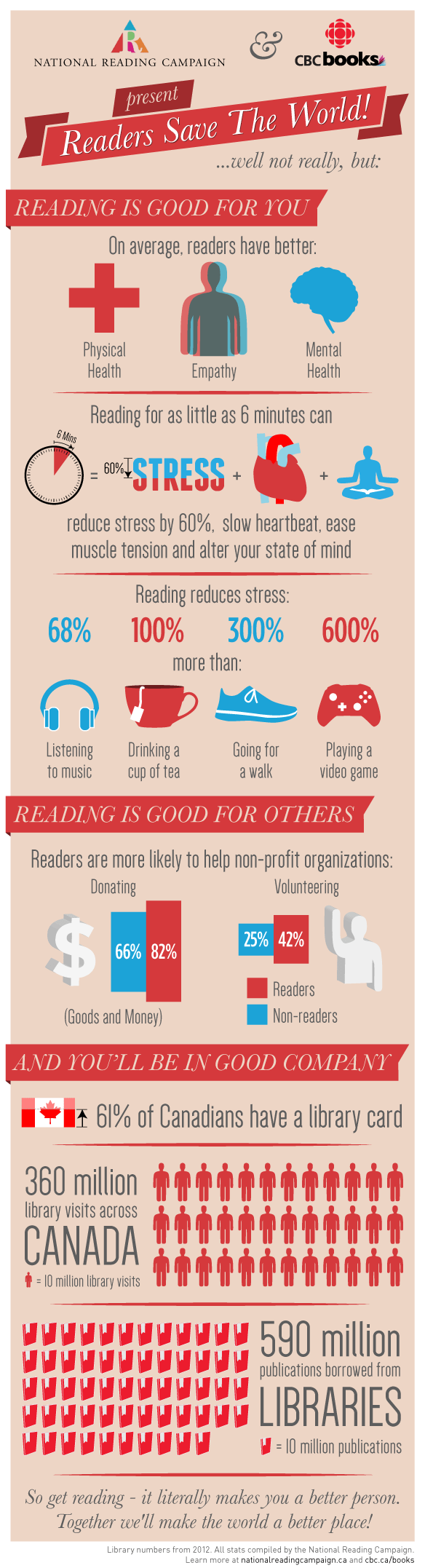
Infographic: Readers can save the world | CBC Radio


Readers Save The World

via Infographic: Readers can save the world | CBC Books | CBC Radio.

E-patients and their hunt for health information | Pew Research Center


Lee Rainie, Director of the Pew Internet Project, described the Project’s research on how patients and caregivers seek health information in the digital age and how people fit librarians into their general information needs as well as their specific health needs.


The Science Behind What Naps Do For Your Brain–And Why You Should Have One Today | Fast Company


Studies of napping have shown improvement in cognitive function, creative thinking, and memory performance. Ready, set . . . Snooze.

The full story: The Science Behind What Naps Do For Your Brain–And Why You Should Have One Today | Fast Company | Business + Innovation.

Do books have the power to heal? | Macleans.ca


Most of Ella Berthoud’s patients are young professionals: cosmopolitan careerists in their 30s or 40s. Some are burdened with anxiety. Some feel adrift in their mid-lives. Many are approaching rites of passage: a first child, retirement, a gap year in India, the death of a spouse. But others have more singular afflictions. One patient was hooked on chick lit, and “terrified of reading anything more demanding.” A young couple was eager to rekindle a fizzling romance. Berthoud—a London-based “bibliotherapist”—has heard it all. In each case, the prescription is the same: Read a book.

via Do books have the power to heal? | Macleans.ca.

The post also includes a transcript of today’s (September 10, 2013) live chat with Ella Berthoud.

Run-n-Read keeps e-book text steady while you’re on the treadmill | Engadget


Weartrons may help those athletic readers maintain their focus with its upcoming Run-n-Read peripheral. The clip-on device detects its wearer’s movements and compensates for them on a host Android or iOS device, keeping e-book text steady in the midst of a treadmill run. Owners can also tap the Run-n-Read to turn pages, and the gadget doubles as a pedometer in between reading sessions.

via Run-n-Read keeps e-book text steady while you’re on the treadmill | Engadget

See the Weartrons Run-n-Read crowdfunding campaign.

Kelly McGonigal: How to make stress your friend | TED.com


Stress. It makes your heart pound, your breathing quicken and your forehead sweat. But while stress has been made into a public health enemy, new research suggests that stress may only be bad for you if you believe that to be the case. Psychologist Kelly McGonigal urges us to see stress as a positive, and introduces us to an unsung mechanism for stress reduction: reaching out to others.

via Kelly McGonigal: How to make stress your friend | TED.com.

Scientists Use Videogames to Improve Older Brains | WSJ


In the future, your doctor may prescribe you a videogame.

In a groundbreaking new study at the University of California, San Francisco, scientists found that older adults improved cognitive controls such as multitasking and the ability to sustain attention by playing a specially designed videogame — and that the effects can be long lasting.

The study, to be published in the scientific journal Nature on Thursday, is part of a broader effort to understand whether specially designed videogames can help treat neurological disorders, such as attention-deficit hyperactivity disorder and even depression. There is growing evidence, researchers say, that videogames could eventually become therapies on par, or used in tandem, with ingestible medications.

See the full story: Scientists Use Videogames to Improve Older Brains | Digits | WSJ.

How Is Information Technology Changing Healthcare? [INFOGRAPHIC] | Mashable


It’s not such a surprise these days when you visit your doctor’s office and your physician uses an iPad to take notes and store your medical records electronically. It makes sense, since managing modern-day medical information involves a great deal of effort and resources.

This tech shift has spurred the field of “health informatics,” which describes the intersection of healthcare, information technology and business. The infographic below — by the University of Illinois at Chicago’s (UIC) Online Masters of Health Informatics program — breaks down and describes health informatics and the mashup of technology and healthcare.

via How Is Information Technology Changing Healthcare? [INFOGRAPHIC] | Mashable

Healthcare & IT