Look Inside the Extremely Rare Codex Seraphinianus, the Weirdest Encyclopedia Ever | Wired.com


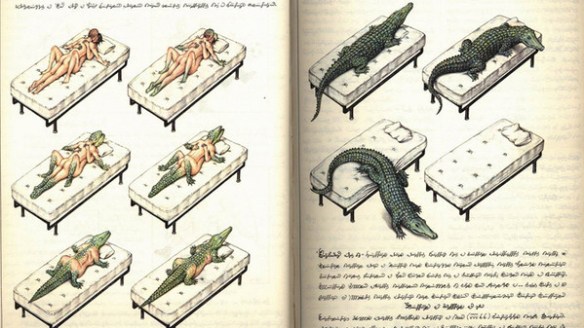
A couple having sex metamorphoses into a crocodile. Fish eyes from some weird creature float on the surface of the sea, staring at me. A man is riding his own coffin. Text accompanies these surreal images, handwritten, seemingly ancient but totally unintelligible. I’ve just stepped into the bizarre universe of Codex Seraphinianus, the weirdest encyclopedia in the world.

Like a guide to an alien world, Codex Seraphinianus is 300 pages of descriptions and explanations for an imaginary existence, all in its own unique (and unreadable) alphabet, complete with thousands of drawings and graphs. Issued for the first time in 1981 by publisher Franco Maria Ricci, it has been a collector’s favorite for years, before witnessing a sudden rise in popularity thanks to a growing fandom on the Internet. Now a new-and-improved edition from Italian publisher Rizzoli is about to hit bookshelves on Oct. 29, with 3,000 pre-ordered copies already sold out. The Codex attracts a new generation of fans, people who grew up surfing the net and eager to explore the exciting and relentless world outside, as bizarre as it is depicted in the book.

Look Inside the Extremely Rare Codex Seraphinianus, the Weirdest Encyclopedia Ever | Underwire | Wired.com

via Look Inside the Extremely Rare Codex Seraphinianus, the Weirdest Encyclopedia Ever | Underwire | Wired.com.

“The Book Thief” Wants You To Imagine A World Without Words, Starting With The New York Times | Co.Create


As visuals go, it’s not the most mind-blowing advertisement you’ve ever seen–but the image of two consecutive blank pages of the New York Times, purchased to promote Fox’s upcoming film The Book Thief, is striking nonetheless.

Read:  “The Book Thief” Wants You To Imagine A World Without Words, Starting With The New York Times | Co.Create | creativity + culture + commerce.

Book News Links: Life Changing Books, 20 Ranked YA Heroines, NY Times Keeps Hyphen in E-Book, Syria Publishing, Hotel Libraries, Children’s Books Illustrations, Beckham Book Signing


32 Books That Will Actually Change Your Life | BuzzFeed
And all you have to do is read them!

20 Classic YA Literature Heroines, Ranked | Flavorwire

E-Book Keeps Hyphen in NY Times Style Guide Refresh | Galley Cat
The word “e-book” will remain hyphenated at The New York Times, according to the publisher’s latest version of its style guide which was updated this week. However, according to the new rules, “e-mail” will now be spelled “email” on The Times’ news pages and online sites. The AP Style guide dropped the hyphen in the word back in 2011.

Publishing is Another Victim of Syria’s Civil War | Publishing Perspectives

9 Hotel Libraries (And Library Hotels) That Bring Books To Life | HuffPost

The Best Illustrations From All Your Favorite Children’s Books | FastCompany
Paddington Bear to Peter Pan, a new exhibit at the British Library celebrates our most nostalgic picturebooks.

‘Global digital book signing’ for Beckham | The Bookseller
David Beckham will hold a “groundbreaking” global digital book signing event on 30th October, for the launch of his latest book David Beckham (Headline).

DPLA Awarded $1 Million Grant From Gates Foundation to Train Public Librarians | LJ INFOdocket


The Digital Public Library of America (DPLA) announced today that it has received a $990,195 grant from the Bill & Melinda Gates Foundation to build upon its network of library professionals and organizations to pilot a national-scale training system for public librarians. Under the grant, the DPLA will collaborate with its service “hubs”—regional digital library partners located in states and regions in the United States—to build curricular resources and implement hands-on training programs that develop digital skills and capacity within the staffs of public libraries.

Read: DPLA Awarded $1 Million Grant From Gates Foundation to Train Public Librarians | LJ INFOdocket.

The Decline of Wikipedia: Even As More People Than Ever Rely on It, Fewer People Create It | MIT Technology Review


Snip: Wikipedia and its stated ambition to “compile the sum of all human knowledge” are in trouble. The volunteer workforce that built the project’s flagship, the English-language Wikipedia—and must defend it against vandalism, hoaxes, and manipulation—has shrunk by more than a third since 2007 and is still shrinking. Those participants left seem incapable of fixing the flaws that keep Wikipedia from becoming a high-quality encyclopedia by any standard, including the project’s own.

via The Decline of Wikipedia: Even As More People Than Ever Rely on It, Fewer People Create It | MIT Technology Review

8 myths about wearable tech | CNET News


Wearable devices are predominantly technical fascinations at the moment, but they have widespread market potential — if misconceptions can be set straight.

The 8 myths discussed:

  1. Wearable devices are just another form factor for smartphones.
  2. Consumers will quickly embrace wearable tech.
  3. Wearable devices are standalone products.
  4. The wearable market is new.
  5. The wearable market will remain a niche.
  6. First to market is a can’t-miss winning formula.
  7. Power consumption and batteries will not be big issues.
  8. Wearable devices are secure.

Read: 8 myths about wearable tech | Business Tech – CNET News.

Evgeny Morozov on Why Our Privacy Problem is a Democracy Problem in Disguise | MIT Technology Review


As Web companies and government agencies analyze ever more information about our lives, it’s tempting to respond by passing new privacy laws or creating mechanisms that pay us for our data. Instead, we need a civic solution, because democracy is at risk.

Snip: “When all citizens demand their rights but are unaware of their responsibilities, the political questions that have defined democratic life over centuries—How should we live together? What is in the public interest, and how do I balance my own interest with it?—are subsumed into legal, economic, or administrative domains. “The political” and “the public” no longer register as domains at all; laws, markets, and technologies displace debate and contestation as preferred, less messy solutions.

But a democracy without engaged citizens doesn’t sound much like a democracy—and might not survive as one.”

A lengthy but thought provoking read on the right to privacy and democracy. Read: Evgeny Morozov on Why Our Privacy Problem is a Democracy Problem in Disguise | MIT Technology Review.


The Globe and Mail Reports on “The University Library of the Future” | Stephen’s Lighthouse


Read: The Globe and Mail Reports on “The University Library of the Future” | Stephen’s Lighthouse.

How Professors Are Using Social Media (INFOGRAPHIC) | HuffPost


Article in Full

Professors aren’t so different from the regular populace when it comes to their views on social media.

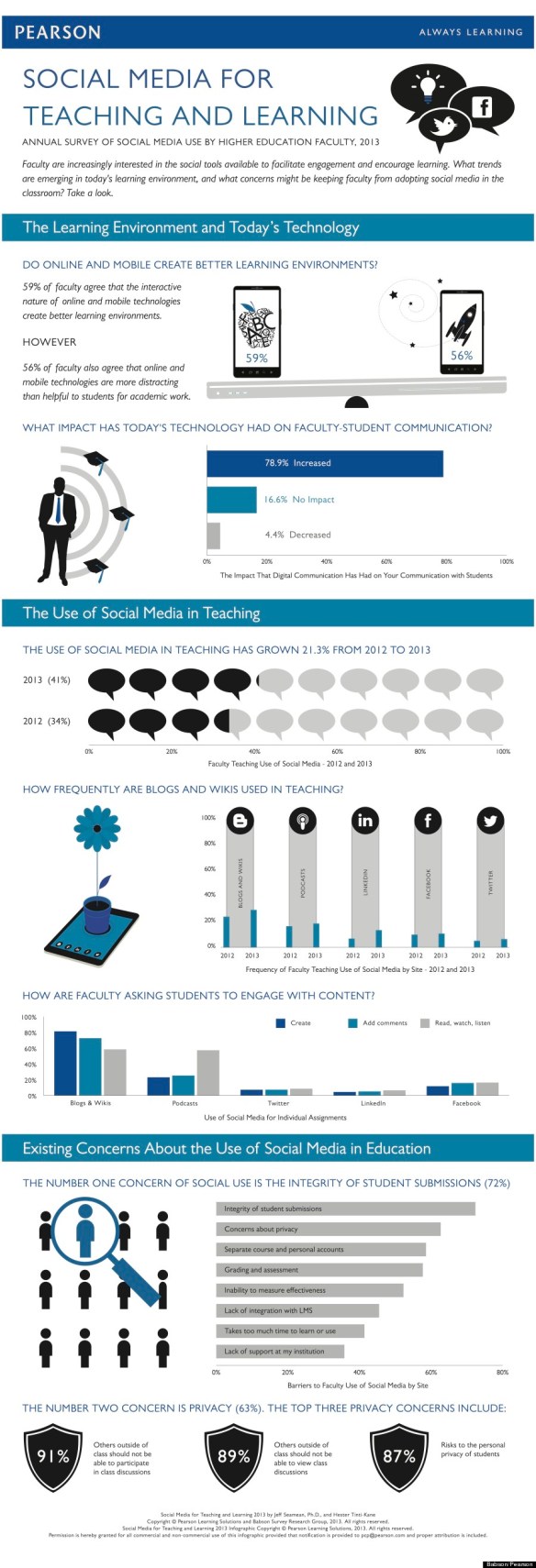
Just over 70 percent used social media in their personal lives, a survey released last week by Babson Survey Research Group andPearson found. This figure mirrors usage among the general population, according to the Pew Research Center.

Babson and Pearson surveyed 8,000 faculty members from all disciplines in higher education for their report, “Social Media for Teaching and Learning.”

Faculty personally choose to use Facebook more than any other type of social media outlet, according to the report, but were more likely to use blogs and wikis for classroom assignments.

Less than half of faculty — 41 percent — use social media as a tool in class, but that’s up from 33.8 percent in last year’s survey.

“Faculty are not only expanding their use of social media, but also becoming more sophisticated in their use,” Jeff Seaman, co-director of the Babson Survey Research Group, said in a statement. “We see steady growth in adoption year over year; however, there are still great concerns that we hear from every age group, and that holds educators back from full adoption in their teaching.”

Faculty cited “integrity of student submissions” and privacy as their main concerns with social media use. Privacy was a large concern among previous surveys of the general population as well.

Social Media for Teaching and Learning

Leaders Needed at Rural Libraries, by Natalie Binder | Letters to a Young Librarian


Leaders Needed at Rural Libraries, by Natalie Binder | Letters to a Young Librarian

Post in Full

You’ve always wanted to work in a public library. You believe in service, citizenship, and community. You value relationships; when you imagined being a librarian, you imagined participating in local government and getting to know your patrons by name. You want to make a big impact—not just in your career, but in people’s lives. You want to be a generalist, not a specialist. You want to have a great quality of life on a librarian’s salary. And when you started library school, you wanted to be a traditional, book-based, community librarian, but it seems like those jobs are either disappearing or impossible to get.
If that sounds like you, you may be a rural librarian at heart—which is great news, because rural libraries need you. These jobs rarely appear on listservs or job boards, but the “graying” of the profession is very real in rural libraries. Many rural libraries have a long-serving librarian (or staff) who will be retiring soon. And since rural libraries are often quite small, you can quickly rise to an influential leadership role and have a strong say in how these small libraries meet the challenges of the future.
I’ve worked in a rural library since before library school—four years this month—and I love my job. Every day I go to work knowing that I will make an impact on someone’s life. Every day something terrific, exciting, or funny happens at my library, and though I am not in administration, I always feel like my contributions and ideas are appreciated and valued. There are many other benefits to rural librarianship. While salaries are generally low, a dollar goes much further in rural communities than it does in urban or academic communities, and affordable housing is rarely an issue. You can probably afford to live much closer to a beach, farm, or lovely national park than you imagine. If the library is adequately staffed, working conditions are also good. Rural libraries enjoy strong community support, and small staffs often work together to ensure flex time is available for things like childcare and family events. Rural libraries are usually quite safe—while no public library is conflict-free, your patrons are more likely to bring you homegrown vegetables than complaints.
Best of all, rural libraries serve as true community centers, where far-flung and diverse groups can come together. A rural library often serves as a small town’s largest meeting room, its only Internet hotspot, the only local, affordable entertainment for adults and children, and an access point for badly needed social services. My library serves as the physical “office” for employment services, child welfare and legal aid.
Of course, no type of library is for everyone. Rural libraries are generalist libraries. As a rural librarian you will frequently be called to do things your master’s degree never prepared you for, from running a farmer’s market to repairing a child’s shoe. If you’re interested in doing something quite specialized or academic, it’s probably best to begin your job search elsewhere. If you need to be surrounded by other young academics, or enjoy a lot of social activities, then you probably won’t enjoy the quiet and isolation of a rural community. If you’re married, it can be a challenge for your spouse to find work in town.
Finally, in small towns there is little division between your personal life and your work life. Your patrons, co-workers, Friends group, Board of Directors, and government leaders are also your friends and neighbors. Sometimes it feels like you’re never off the job! For this reason, it’s very important to move slowly, get community buy-in, and be prepared to backtrack on big changes. That can be a challenge if you’re fresh out of library school and eager to change the world.
I have seen too many “new directors” leave or lose their rural jobs because of avoidable conflicts among stakeholders. It’s great to have vision and ambition, but if you’re more combative than cooperative, you’ll have a hard time achieving your goals in a small town. Even if your library seems like a mess that you were hired to fix (or “bring up to date”), plan to spend a full year or more listening and learning before you try to change the system. When you become a librarian at a rural library, you’re also joining small, stable team of prominent citizens and community leaders whose support you’ll need for years or even decades. Make those relationships a priority, and always take the long view in any conflict.
If that sounds like a challenge you’re up to, then you can begin your rural job hunt locally. No matter where you live, you’re probably not far from a small library system. Check county job boards, or see if there’s a volunteer position available. Ask if you can shadow a librarian or staff member for a day or two. These jobs are not usually widely advertised. Take your time and get to know the rural libraries and communities around you. Even if you decide to look elsewhere for a permanent job, you’ll be in for a fun, rewarding and educational experience.

Natalie Binder is a librarian at a small library in rural Florida. She is a graduate of Florida State University’s College of Communication and Information. She is also the founder and moderator of #libchat, a Twitter chat for librarians and library school students. She can be found on Twitter @nvbinder.