As visuals go, it’s not the most mind-blowing advertisement you’ve ever seen–but the image of two consecutive blank pages of the New York Times, purchased to promote Fox’s upcoming film The Book Thief, is striking nonetheless.

As visuals go, it’s not the most mind-blowing advertisement you’ve ever seen–but the image of two consecutive blank pages of the New York Times, purchased to promote Fox’s upcoming film The Book Thief, is striking nonetheless.
32 Books That Will Actually Change Your Life | BuzzFeed
And all you have to do is read them!
20 Classic YA Literature Heroines, Ranked | Flavorwire
E-Book Keeps Hyphen in NY Times Style Guide Refresh | Galley Cat
The word “e-book” will remain hyphenated at The New York Times, according to the publisher’s latest version of its style guide which was updated this week. However, according to the new rules, “e-mail” will now be spelled “email” on The Times’ news pages and online sites. The AP Style guide dropped the hyphen in the word back in 2011.
Publishing is Another Victim of Syria’s Civil War | Publishing Perspectives
9 Hotel Libraries (And Library Hotels) That Bring Books To Life | HuffPost
The Best Illustrations From All Your Favorite Children’s Books | FastCompany
Paddington Bear to Peter Pan, a new exhibit at the British Library celebrates our most nostalgic picturebooks.
‘Global digital book signing’ for Beckham | The Bookseller
David Beckham will hold a “groundbreaking” global digital book signing event on 30th October, for the launch of his latest book David Beckham (Headline).
The Digital Public Library of America (DPLA) announced today that it has received a $990,195 grant from the Bill & Melinda Gates Foundation to build upon its network of library professionals and organizations to pilot a national-scale training system for public librarians. Under the grant, the DPLA will collaborate with its service “hubs”—regional digital library partners located in states and regions in the United States—to build curricular resources and implement hands-on training programs that develop digital skills and capacity within the staffs of public libraries.
Read: DPLA Awarded $1 Million Grant From Gates Foundation to Train Public Librarians | LJ INFOdocket.
Article in Full
Professors aren’t so different from the regular populace when it comes to their views on social media.
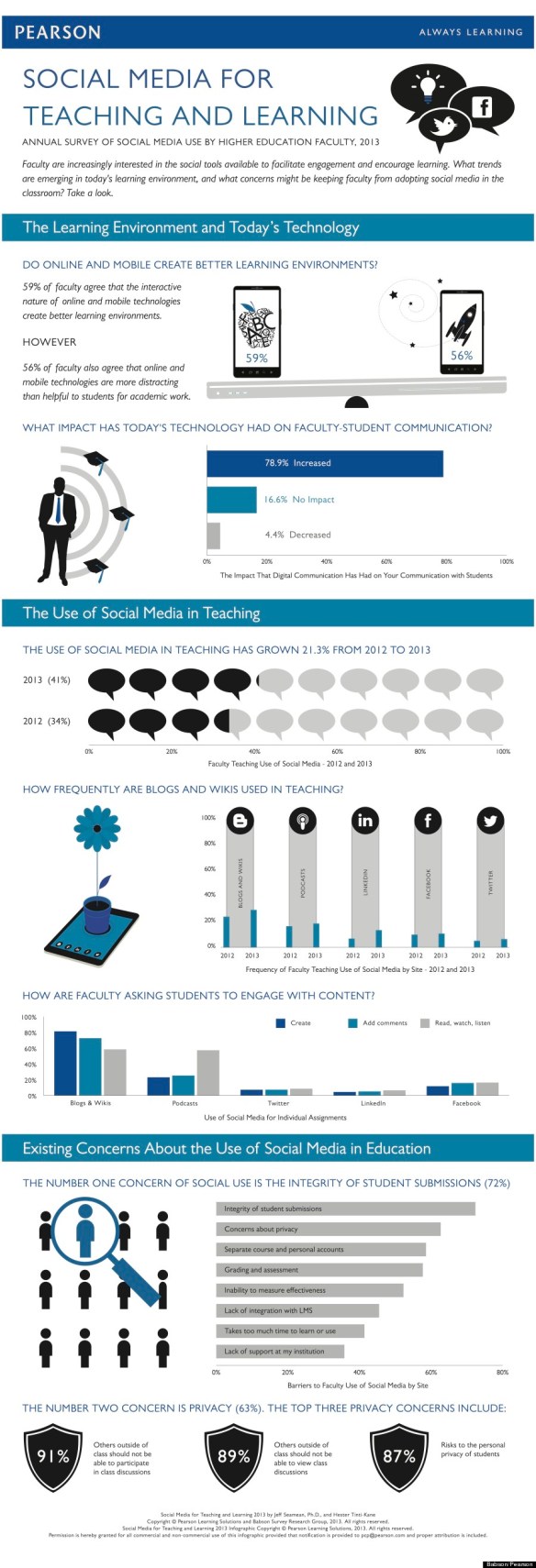
Just over 70 percent used social media in their personal lives, a survey released last week by Babson Survey Research Group andPearson found. This figure mirrors usage among the general population, according to the Pew Research Center.
Babson and Pearson surveyed 8,000 faculty members from all disciplines in higher education for their report, “Social Media for Teaching and Learning.”
Faculty personally choose to use Facebook more than any other type of social media outlet, according to the report, but were more likely to use blogs and wikis for classroom assignments.
Less than half of faculty — 41 percent — use social media as a tool in class, but that’s up from 33.8 percent in last year’s survey.
“Faculty are not only expanding their use of social media, but also becoming more sophisticated in their use,” Jeff Seaman, co-director of the Babson Survey Research Group, said in a statement. “We see steady growth in adoption year over year; however, there are still great concerns that we hear from every age group, and that holds educators back from full adoption in their teaching.”
Faculty cited “integrity of student submissions” and privacy as their main concerns with social media use. Privacy was a large concern among previous surveys of the general population as well.
Leaders Needed at Rural Libraries, by Natalie Binder | Letters to a Young Librarian
Post in Full
The maker culture is a thriving movement amongst all types of people who want to create and design their own objects, crafts, or computer code. This DIY community is using state-of-the-art technology such as 3D printers to design and craft their own 3D objects. This introductory guide will give you an overview of today’s maker movement, resources for getting started, 3D printer reviews, links to actual project designs and instructions, maker publications, events, and directories, videos about 3D printing and maker culture, and an article list of resources about libraries and makerspaces.
Resources categorized into the following sections:
Read: An All-in-One Guide to the Maker Culture and 3D Printing | Ellyssa Kroski | OEDB.org.
Arizona Education Dept. Liked It Better When These Books Were Banned | HuffPost
The Arizona Education Department is objecting to the Tucson school board’s decision to rescind a classroom ban on seven books once used to teach a controversial Mexican American Studies course.
Hell Hath No Fury Like a Superfan Scorned | BookRiot
The hype for Veronica Roth’s Allegiant (published October 22, 2013) has been huge. When it released, it immediately became the #1 selling book in Amazon’s Kindle store, outselling the final book of the Hunger Games trilogy nearly 5 to 1 . To me, the really fascinating data is the initial customer review response to the book. At the time of this writing (the day after the release), the book had 278 customer reviews, with 138 reviews being one-star reviews, and another 33 reviews ranked as two-star reviews. Drama, drama.
Here Is The One Perfect Book For Every Single Myers-Briggs Type | HuffPost
Recommending books is a tricky business. One person’s trashy romance novel is another person’s treasure. Of course, a little background on a person’s reading preferences can come in handy, but sometimes deciphering tastes can seem like an arbitrary and headache-inducing task. Still, we’re willing to bet that like-minded people enjoy similar stories — That’s where Myers-Briggs comes in.
POLL: 28 Percent Of Americans Have Not Read A Book In The Past Year | HuffPost
According to a HuffPost/YouGov poll asking 1,000 U.S. adults about their reading habits, 41 percent of respondents had not read a fiction book in the past year; 42 percent had not read a nonfiction book.
The original post is lengthy but worth the read, as it includes some discussion about censorship and creative user protest on the GoodReads platform.
With 20 million members (a number some have noted is close to the population of Australia) and a reputation as a place where readers meet to trade information and share their excitement about books, the social networking site Goodreads has always appeared to be one of the more idyllic corners of the Internet. The site sold to Amazon for an estimated $190 million this spring, and Goodreads recommendations and data have been integrated into the new Kindle Paperwhite devices, introducing a whole new group of readers to the bookish community.
But if, at a casual glance, the two companies — Goodreads and Amazon — seem to be made for each other, look again. A small but growing faction of longtime, deeply involved Goodreads members are up in arms about recent changes to the site’s enforcement of its policies on what members are permitted to say when reviewing books, and many of them blame the crackdown on the Amazon deal. They’ve staged a protest of sorts, albeit one that’s happening mostly out of the public eye. Their charge is censorship and their accusation is, in the words of one rebel, that Goodreads and Amazon want “to kill the vibrant, creative community that was once here, and replace it with a canned community of automaton book cheerleaders.”
Read the rest of the story: How Amazon and Goodreads could lose their best readers | Salon.com
Wisconsin’s public university system will start granting some degrees based on testing instead of credits, and letting you use as much of the school as you want for a flat fee. Schools around the country are watching.
 infophile