
What motivates us at work? 7 fascinating studies that give insights – Stephen’s Lighthouse
How social media is changing privacy in medicine | The Search Principle
6 Bookless Libraries | Ellyssa Kroski – OEDB.org
“As space and budget concerns continue to grow, many libraries are opting to forego building their print collections in favor of providing electronic resources. This new trend toward building digital libraries has been developing over the past several years in spite of the controversy over eliminating print materials. Many people have spoken out against bookless libraries, especially with regard to public libraries, stating that the digital divide will keep many from using library resources and as well as the fact that many publishers won’t sell their publications to libraries in eBook format.” See the full article: 6 Bookless Libraries | Ellyssa Kroski – OEDB.org.
Why 3D Printing Is Overhyped (I Should Know, I Do It For a Living) | Gizmodo
“The main issue lies with raised expectations, build quality, price and usability. So here we go, my list of reasons 3D printing isn’t all you think it’s cracked up to be.”
via Why 3D Printing Is Overhyped (I Should Know, I Do It For a Living) | Gizmodo.
The issues discussed include:
- People’s expectations
- The name
- Strength
- Surface finish
- Cost
- Speed
- Usability
- Machine range
- Materials
8 Objects That Signal a New Industrial Revolution | Gizmodo
Are we on the verge of a third industrial revolution? The editors at The Economist certainly think so. But while rapid prototyping and the open source movement have been around for decades now, we had yet to see anyone take a truly comprehensive look at the transformation in manufacturing. That is, until the New Museum’s latest show, Adhocracy, came along.
Adhocracy is, in the word of its curator, Domus editor Joseph Grima, “an exhibition about people who make things.”
The objects vary, but the ethos stays the same: making is no longer the purview of companies which manufacture millions of the same object. It’s the right of individuals, who are manufacturing one or two objects to fit their own unique needs, then passing along their code.
See the full article at Gizmodo: 8 Objects That Signal a New Industrial Revolution.
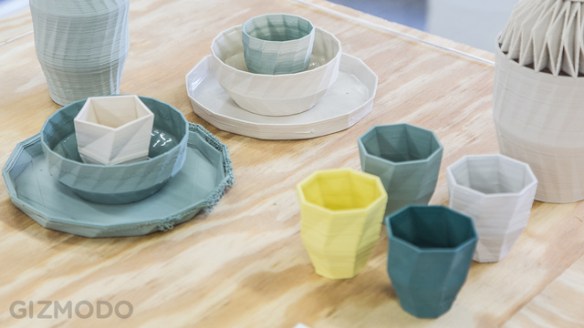 Unfold’s “Stratigraphic Manufactury”
Jaron Lanier: The Internet destroyed the middle class – Salon.com
The article is an interview with the author who challenges our obsession with digital culture.
“Kodak employed 140,000 people. Instagram, 13. A digital visionary says the Web kills jobs, wealth — even democracy.”
“His book continues his war on digital utopianism and his assertion of humanist and individualistic values in a hive-mind world. But Lanier still sees potential in digital technology: He just wants it reoriented away from its main role so far, which involves “spying” on citizens, creating a winner-take-all society, eroding professions and, in exchange, throwing bonbons to the crowd.”
via Jaron Lanier: The Internet destroyed the middle class – Salon.com.
Research Publications at Facebook
Helping a billion people share requires innovation. At Facebook, we solve technical problems no one else has seen because no one else has built a social network of this size. Working at the intersection of research and engineering to make the world more open and connected is one of the best things about being at Facebook right now.
via Research Publications at Facebook.
Here is just a sample of some of research article titles:
- Self-censorship on Facebook
- Gender, Topic, and Audience Response: An Analysis of User-Generated Content on Facebook
- The Role of Social Networks in Information Diffusion
You may also like:
Check Out Facebook’s Nerdy Library Of Its Research Papers | TechCrunch
The Big Library Read Experiment | Sourcebooks.com
A unique pilot program to research book discovery and generate data on libraries supporting authors.
Sourcebooks and OverDrive are partnering on a pilot program that will allow library patrons worldwide the opportunity to read New York Times bestselling author Michael Malone’s acclaimed novel “The Four Corners of the Sky” in ebook format. The Big Library Read is a no cost program in which libraries worldwide promote from their lending catalog a single ebook to their patrons. In addition to creating a global “library book club,” it’s designed to generate data about the positive exposure and sales influence library ebook catalogs provide to authors and publishers. See the full article at Library eBooks: The Role of Libraries in the Book Discovery Process | Sourcebooks.com.
You may also like:
OverDrive and Sourcebooks to Launch Ambitious Ebook Data Experiment | The Digital Shift
How a Mentor Can Accelerate Your Career | Mashable
At the beginning of your professional career, everything in front of you can appear daunting. During these formative years, you are deciding what you want to do, who you want to be and where you are going to start. Many of us change our minds about our future career before we hit the workforce, and then there are, of course, job changes throughout your career.
The overwhelming stress of this phase can be alleviated by finding a mentor to give you guidance and help you achieve your career goals. Learning from a successful mentor in your field of interest can elevate both your professional capabilities and confidence better than any Internet search results or well-intentioned parental advice.
See How a Mentor Can Accelerate Your Career | Mashable for the full article.
QR Codes: A Technology Without a User Base? | Information Space
There is an ongoing debate on whether QR codes are dying, or are still of value to marketers. Recent statistics from eMarketer.com show that 39% of US citizens between 18-24 have used QR scans in magazines, 38% in mail, 35% on posters, and 21% on websites. But these statistics are based on people scanning a QR code at least once. These statistics may be based heavily on curiosity rather than continual usage.
[The author] lists reasons why QR codes could be on a steady decline, what they’re competing with, and some examples of creative ways to use them.
via QR Codes: A Technology Without a User Base? | Information Space
 infophile