
How Daydreaming Can Actually Make You Smarter | HuffPost


Psychology was my undergrad major. I have always been fascinated by theories of intelligence, cognitive development and memory. I’m one of those people who like to take personality and IQ tests. I believe in the value of reading to increase our emotional development and improve communication skills. Its great to see new research challenging our preconceived notions of intelligence.

Daydreaming gets a pretty bad rap. It’s often equated with laziness, and we tend to write off people with wandering minds as being absent-minded “space cadets” who can’t get their heads out of the clouds.

Though we all spend close to 50 percent of our waking lives in a state of mind-wandering, according to one estimate, some research casts daydreaming in a negative light. A 2010 Harvard study linked spacing out with unhappiness, concluding that “a wandering mind is an unhappy mind.” But could these unconscious thinking processes actually play a pivotal role in the achievement of personal goals?

In a radical new theory of human intelligence, one cognitive psychologist argues that having your head in the clouds might actually help people to better engage with the pursuits that are most personally meaningful to them. According to Scott Barry Kaufman, NYU psychology professor and author of Ungifted: Intelligence Redefined, we need a new definition of intelligence — one that factors in our deepest dreams and desires.

Read the full story: How Daydreaming Can Actually Make You Smarter | HuffPost

You may also like:  The Case for Preserving the Pleasure of Deep Reading | MindShift | The Modern MLIS
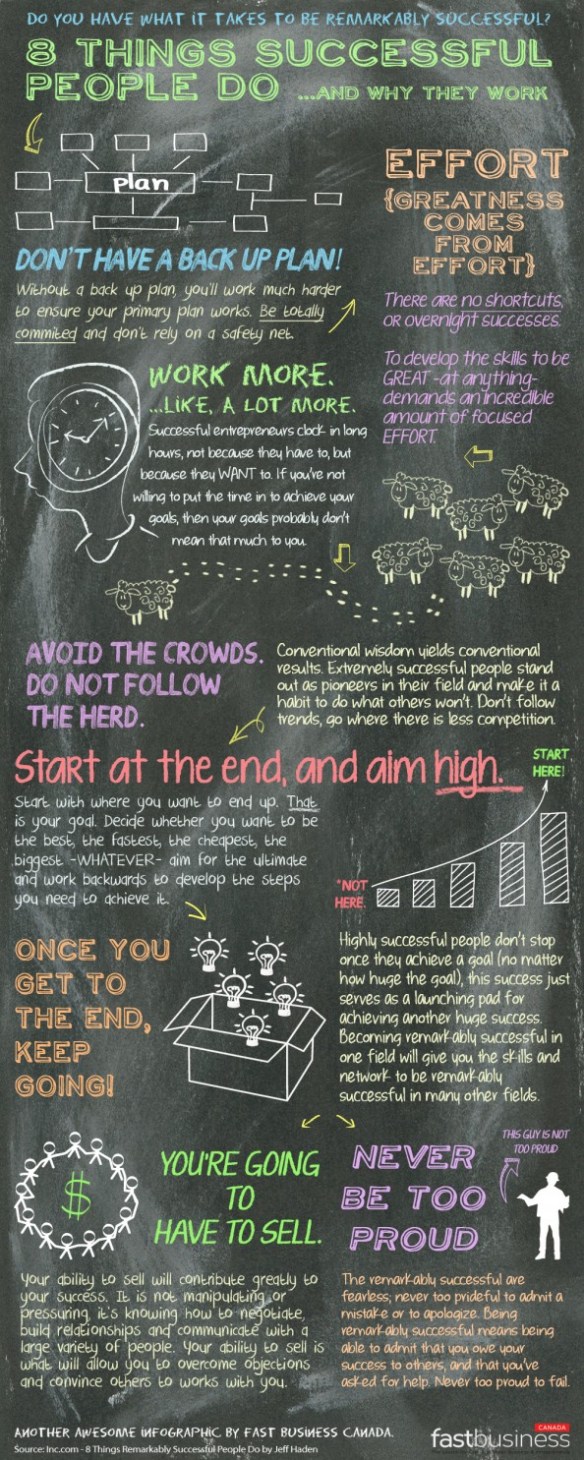
8 things successful people do, and why they work [Infographic] | Visual.ly


8 things successful people do, and why they work  [Infographic] | Visual.ly

8 things successful people do

7 Tips for Creating a Social Workplace | Mashable


Each year, reports on employee dissatisfaction show workplace issues cause workers to feel stressed and undervalued. According to a survey by the American Psychological Association, employee dissatisfaction is often related to employer issues. 43% cite lack of opportunities for growth and advancement. 43% say a heavy workload leads to stress. 40% point to unrealistic job expectations. 39% bemoan long hours.

Creating a more social workplace may be the solution. Opportunities for teamwork and collaboration can help employees stop seeing themselves as individual task-doers and start seeing themselves as valuable team members, leading to a boost in employee morale and, ultimately, motivation and productivity.

Here are seven tips for eliminating employee dissatisfaction and creating a more social workplace:

1. Provide Workplace Perks
2. Offer Opportunities to Collaborate
3. Create Online Communities
4. Allow Growth From Within
5. Recognize Everyone, Not Just Star Players
6. Focus on Outplacement Services
7. Keep in Touch With Worker Needs

Read the full story: 7 Tips for Creating a Social Workplace | Mashable.

Creativity Is Really Just Persistence, And Science Can Prove It | Fast Company


What’s amazing is that advances in science have allowed us to get a better idea as to why better ideas come after jumping into our workflow, rather than waiting for sudden inspiration to strike.

The full story: Creativity Is Really Just Persistence, And Science Can Prove It | Fast Company | Business + Innovation.

Anger Spreads Faster On Social Media Than Any Other Emotion | Fast Company


In a study of 200,000 users of Weibo, the Twitter of China, researchers found messages expressing anger were the most likely to spark other angry messages from friends in your network.

Read: Anger Spreads Faster On Social Media Than Any Other Emotion | Fast Company | Business + Innovation.

Books for Boys and Books for Girls: Problems with Gendered Reading | Book Riot


Interesting opinion piece from Kelly Jensen, a librarian and a blogger.

Snip: “When we buy into these ideas about boys and reading, we also make a statement about girls and reading. We believe they’re automatically readers. They don’t need our support or encouragement to be life-long readers because reading is part and parcel of being a girl.”

Read: Books for Boys and Books for Girls: Problems with Gendered Reading | Book Riot

Do books have the power to heal? | Macleans.ca


Most of Ella Berthoud’s patients are young professionals: cosmopolitan careerists in their 30s or 40s. Some are burdened with anxiety. Some feel adrift in their mid-lives. Many are approaching rites of passage: a first child, retirement, a gap year in India, the death of a spouse. But others have more singular afflictions. One patient was hooked on chick lit, and “terrified of reading anything more demanding.” A young couple was eager to rekindle a fizzling romance. Berthoud—a London-based “bibliotherapist”—has heard it all. In each case, the prescription is the same: Read a book.

via Do books have the power to heal? | Macleans.ca.

The post also includes a transcript of today’s (September 10, 2013) live chat with Ella Berthoud.

People Like Giving More When The Giving Is Social | Co.Exist


There are many, many selfless motivations for giving to a charity or doing a good deed. But being honest, most of us would also admit that these activities also make us feel good about ourselves–perhaps, dare I say it, even increase our overall happiness.

Do-gooders, charities, and even governments, then, might want to listen up to the results of a set of three recent psychology studies that are the first to measure in experiments what forms of “giving” are most likely to give us a warm, fuzzy feeling inside.

The full story: People Like Giving More When The Giving Is Social | Co.Exist | ideas + impact.

Kelly McGonigal: How to make stress your friend | TED.com


Stress. It makes your heart pound, your breathing quicken and your forehead sweat. But while stress has been made into a public health enemy, new research suggests that stress may only be bad for you if you believe that to be the case. Psychologist Kelly McGonigal urges us to see stress as a positive, and introduces us to an unsung mechanism for stress reduction: reaching out to others.

via Kelly McGonigal: How to make stress your friend | TED.com.

The Mistake Smart People Make: Being In Motion Vs. Taking Action | LifeHacker


There is a common mistake that often happens to smart people—in many cases, without you ever realizing it. The mistake has to do with the difference between being in motion and taking action. They sound similar, but they’re not the same.

via The Mistake Smart People Make: Being In Motion Vs. Taking Action | LifeHacker.