American Library Association Defends Banned Mexican American Studies Courses | Mashable


Librarians do not approve of Arizona’s battle against Mexican American Studies.

A group of 10 educational organizations, including the American Library Association, filed an amicus brief Monday in support of the lawsuit against Arizona Superintendent of Public Instruction John Huppenthal for quashing a controversial Mexican American Studies curriculum in Tucson. Some 48 teachers from across the country filed a second amicus brief defending the banned courses.

The educators argue that in passing legislation aimed at shutting down a progressive Mexican American Studies program, Arizona Republicans were guided by political goals rather than pedagogical ones.

Read: American Library Association Defends Banned Mexican American Studies Courses | Mashable.

Tradecraft Launches A School For Teaching Non-Technical Skills To Tech Workers | TechCrunch


For many companies in Silicon Valley, it’s fairly easy to find, train, and evaluate technical talent — for the most part, it’s easy to determine and quantify how well a person codes. But evaluating and training non-technical personnel is something many struggle with. To help change this, a new school called Tradecraft has emerged to help teach those seeking UX, growth, and sales positions the skills they need to succeed in the tech world.

Tradecraft was founded by Russ Klusas and Misha Chellam, who believe it (or something like it) is necessary to teach necessary skills to non-technical tech workers.

Read: Tradecraft Launches A School For Teaching Non-Technical Skills To Tech Workers | TechCrunch.

From Scratch to Tynker: Tools to Teach Kids How to Code | The Digital Shift


Learning to code is a popular topic in educational circles these days. For good reason. When young people code their own apps, games, stories, or websites they have a chance to think critically, troubleshoot, problem solve, and collaborate. It’s a way to create something real that can be seen and used by lots of different people.

Of course, not all teachers or library staff are proficient coders. But, we don’t have to be. There are several apps and Web-based tools that make it possible to learn, with kids, the basics of coding. These also give young people the chance to try things out on their own and even teach adults how to create with code.

Sceencast tutorials for Daisy the Dinosaur, Hopscotch, Scratch and Tynker. Read: From Scratch to Tynker: Tools to Teach Kids How to Code | The Digital Shift.

5 Reasons to Teach Kids To Code [Infographic] | Kodable


5 Reasons to Teach Kids To Code | Kodable

5 reasons to tech kids to code

General Assembly Launches Dash, A Tool For Coding Newbies | TechCrunch


As General Assembly moves away from co-working and focuses more heavily on educating entrepreneurs and startups, the company is releasing a brand new tool to the public. It’s called Dash, and it’s an interactive online program that helps teach people how to code through a series of interactive storyline-based tutorials.

via General Assembly Launches Dash, A Tool For Coding Newbies | TechCrunch.

You may also like: Dash: Learning To Code by Building Websites | Information Space

Screw Teaching Your Kids–Get This Robot Instead | Co.Labs


Gupta set out to find a way to teach very young children the basics of coding–sequences of instructions, subroutines, events, conditional statements–in a playful way. Today Play-i launched a crowdfunding campaign to raise $250,000 to manufacture two kid-friendly robots called Bo and Yana, which teach high-level programming concepts to children as as young as five.

Read more: Screw Teaching Your Kids–Get This Robot Instead ⚙ Co.Labs ⚙ code + community.

How Professors Are Using Social Media (INFOGRAPHIC) | HuffPost


Article in Full

Professors aren’t so different from the regular populace when it comes to their views on social media.

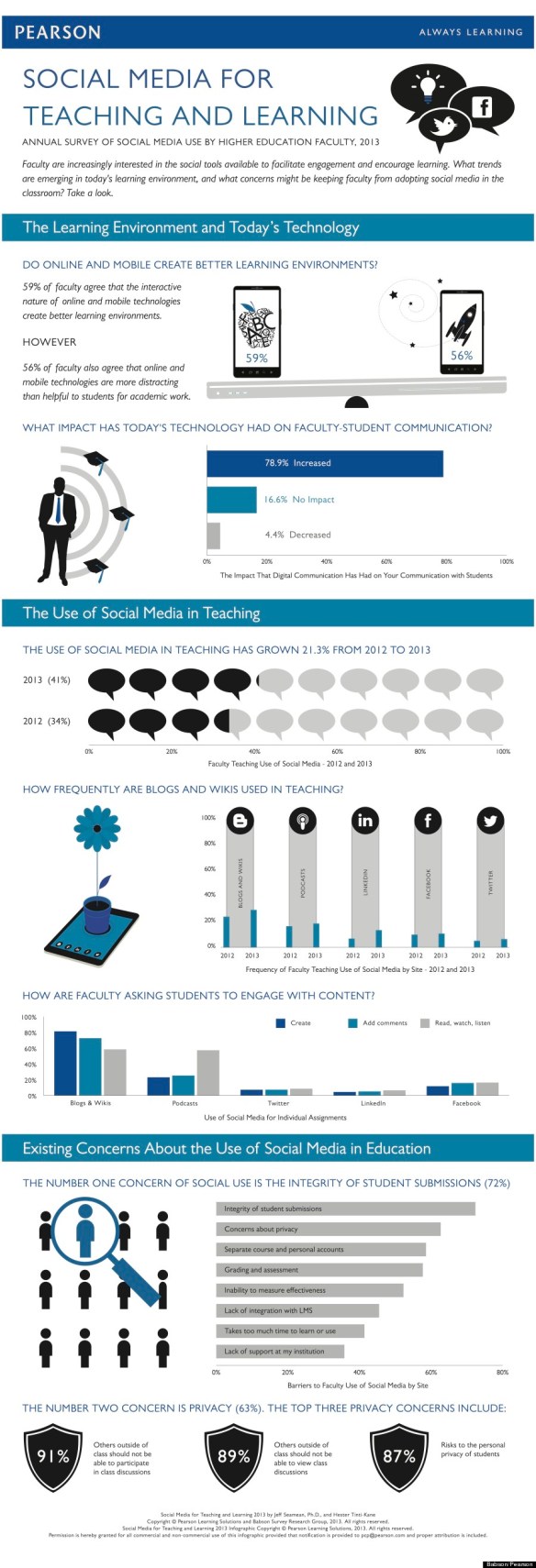
Just over 70 percent used social media in their personal lives, a survey released last week by Babson Survey Research Group andPearson found. This figure mirrors usage among the general population, according to the Pew Research Center.

Babson and Pearson surveyed 8,000 faculty members from all disciplines in higher education for their report, “Social Media for Teaching and Learning.”

Faculty personally choose to use Facebook more than any other type of social media outlet, according to the report, but were more likely to use blogs and wikis for classroom assignments.

Less than half of faculty — 41 percent — use social media as a tool in class, but that’s up from 33.8 percent in last year’s survey.

“Faculty are not only expanding their use of social media, but also becoming more sophisticated in their use,” Jeff Seaman, co-director of the Babson Survey Research Group, said in a statement. “We see steady growth in adoption year over year; however, there are still great concerns that we hear from every age group, and that holds educators back from full adoption in their teaching.”

Faculty cited “integrity of student submissions” and privacy as their main concerns with social media use. Privacy was a large concern among previous surveys of the general population as well.

Social Media for Teaching and Learning

Why Kids Need to Tinker to Learn | MindShift


The Maker Movement has inspired progressive educators to bring more hands-on learning and tinkering into classrooms, and educator Gary Stager would like to see formal schooling be influenced by the Maker Movement, which has inspired young learners to tinker, to learn by doing, and take agency for their learning.

Read: Why Kids Need to Tinker to Learn | MindShift.

How a Radical New Teaching Method Could Unleash a Generation of Geniuses | Wired.com


Snip: That’s why a new breed of educators, inspired by everything from the Internet to evolutionary psychology, neuroscience, and AI, are inventing radical new ways for children to learn, grow, and thrive. To them, knowledge isn’t a commodity that’s delivered from teacher to student but something that emerges from the students’ own curiosity-fueled exploration. Teachers provide prompts, not answers, and then they step aside so students can teach themselves and one another. They are creating ways for children to discover their passion—and uncovering a generation of geniuses in the process.

Read: How a Radical New Teaching Method Could Unleash a Generation of Geniuses | Wired Business | Wired.com.

Education in the 21st Century [Infographic] | TopMastersInEducation.com


Education

Source: TopMastersInEducation.com

via Education in the 21st Century.