
Snip: Wikipedia and its stated ambition to “compile the sum of all human knowledge” are in trouble. The volunteer workforce that built the project’s flagship, the English-language Wikipedia—and must defend it against vandalism, hoaxes, and manipulation—has shrunk by more than a third since 2007 and is still shrinking. Those participants left seem incapable of fixing the flaws that keep Wikipedia from becoming a high-quality encyclopedia by any standard, including the project’s own.
Tag Archives: web services
How Amazon and Goodreads could lose their best readers | Salon.com
Aside
The original post is lengthy but worth the read, as it includes some discussion about censorship and creative user protest on the GoodReads platform.
With 20 million members (a number some have noted is close to the population of Australia) and a reputation as a place where readers meet to trade information and share their excitement about books, the social networking site Goodreads has always appeared to be one of the more idyllic corners of the Internet. The site sold to Amazon for an estimated $190 million this spring, and Goodreads recommendations and data have been integrated into the new Kindle Paperwhite devices, introducing a whole new group of readers to the bookish community.
But if, at a casual glance, the two companies — Goodreads and Amazon — seem to be made for each other, look again. A small but growing faction of longtime, deeply involved Goodreads members are up in arms about recent changes to the site’s enforcement of its policies on what members are permitted to say when reviewing books, and many of them blame the crackdown on the Amazon deal. They’ve staged a protest of sorts, albeit one that’s happening mostly out of the public eye. Their charge is censorship and their accusation is, in the words of one rebel, that Goodreads and Amazon want “to kill the vibrant, creative community that was once here, and replace it with a canned community of automaton book cheerleaders.”
Read the rest of the story: How Amazon and Goodreads could lose their best readers | Salon.com
Handwriting support hits Gmail, Google Docs | CNET News
Gmail and Google Docs now can handle handwriting input in dozens of languages, even if you don’t have a touch screen. Read: Handwriting support hits Gmail, Google Docs | Internet & Media – CNET News.
Five Best Language Learning Tools | LifeHacker
Learning a new language is difficult, which is why there’s a huge market for tools and apps to help you do it. Some of them are really helpful and help you get up to speed quickly, others are a money sink. This week we’re looking at five of the best, based on your nominations.
Discussed:
- Anki
- Memrise
- Duolingo
- Pimsleur Method
- Livemocha
Can E-Books Save The Neighborhood Bookstore? | Co.Labs
A startup called Zola Books has paired with the popular novelist Audrey Niffenegger, author of The Time Traveler’s Wife, to try to save brick-and-mortar shops.
Read: Can E-Books Save The Neighborhood Bookstore? | Co.Labs ⚙ code + community.
The Beginner’s Guide to HootSuite | Mashable
Juggling multiple social media accounts across several networks can get hectic, especially when there’s a fine line between a manageable number of browser tabs and a terrible guessing game.
Self-respecting social media addicts should test the many management tools available, and they will find HootSuite to be among the best to streamline sharing for work and play. Users can conserve precious tab space by connecting their Twitter, Facebook, Google+ (pages only), LinkedIn, Foursquare, WordPress and Mixi accounts under the HootSuite umbrella, and take advantage of the convenient scheduling feature.
How to get started: The Beginner’s Guide to HootSuite | Mashable.
Kobo and WH Smith overreact to the porn titles in their catalogs | Dear Author
RELATED: WH Smith takes website offline after porn e-book scandal | BBC News
Here’s another perspective of the situation from Dear Author.
Full Article
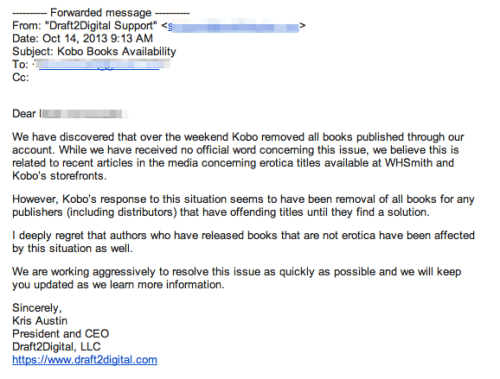
Yesterday, Kobo pulled all the content from the distributor Draft 2 Digital in response to the complaints retailers were receiving about the incest and beastiality books being self published. Authors refer to this content as Psuedo Incest because it is really about step brothers and step fathers, not blood relatives, but because Daddy PI was showing up in the children’s literature section, WH Smith went to the drastic step of shutting down its website (which is likely costing them thousands, if not hundreds of thousands of dollars a day) and Kobo pulled all the D2D content. Much of the D2D content is not “porn” but YA, sweet romance, and the like.
Part of the problem is that authors who are writing PI stuff will relabel their content in order to get around the filters. I think the extreme reaction is due to a few authors trying to mess with the system and reducing the efficacy of filters. For instance, authors would change the title of their book to get through the filter but the cover would have a different title – one that is disallowed. Authors would use the names of famous authors in their tags or descriptions so that the books would show up when someone was searching for other things. I can’t tell you how irksome it was that one author’s porn books kept showing up when I was trying to compile a new release list for “Forever Romance.”
Other authors were putting up excerpts in the description area that were full on sex scenes.
At Kobo, their search function is even worse. Search a middle grade author name and a bunch of porn titles show up because Kobo can’t get its search feature to work correctly.
What is clear is that Direct 2 Digital uses no filters unlike Smashwords. None of the Smashwords titles were taken down but the ones from D2D were, likely because D2D had no way of filtering out the questionable content.
There’s been a great deal of panic and accusations flying but the actions appear to be taken primarily by Kobo and WH Smith. For now, it appears the following is true:
- Kobo is removing self published content in addition to the Draft 2 Digital stuff. If a book was part of an indie consortium that Kobo doesn’t like, then the whole consortium’s books were removed. No update as to when this will be resolved.
- No content has been removed from any reader’s Kindle. Lots of readers seem to be in a tizzy about this but I have seen zero evidence of this. – Indie authors have been whispering this into indie bloggers’ ears and it was all over facebook last night. Removing content from the store (or in Amazon’s case, putting the content into draft status) is not the same thing as taking stuff away from your Kindle account. Amazon won’t even remove plagiarized crap from your Kindle account. Seriously I had to restrain myself from using allcaps all over the Internet yesterday and it wasn’t easy.
- Amazon is not going to war against self published erotica. Given that the dino porn is still up as is tons of other porn, the evidence is strongly against any war against indies and/or erotica. What they don’t want is a bunch of in your face incest, rape and child porn stuff showing up in regular searches but when authors keep trying to futz with the filter, the banhammer comes down hard and broad. They appear to be putting any erotica author’s work into draft if it contains “sister, brother, child, babysitter, daddy, mother” and the like. The author will then have to go back to Amazon and republish the work. Some authors reported that working within hours while others were still being vetted.
- Amazon is going through and putting authors’ titles to “draft” status which means that the content isn’t deleted, but rather it can’t be purchased until Amazon determines that the content doesn’t violate its anti porn clause (which it selectively enforces).
- Authors having their content removed is a bigger deal than readers having their content removed. Or do Kobo and other retailers not have the right to enforce their content policies just like Goodreads? Or is somehow constraining commercial speech and the sale of porn more concerning than critical speech?
Anyway, I digress. Enough people complained and media sat up and now the retailers are doing something. Does this mean that the content is never coming back? Doubtful. Right now it means that Amazon and Kobo are vetting content that they pulled which is likely going to take a really long time.
via Tuesday News: Kobo and WH Smith overreact to the porn titles in their catalogs | Dear Author
5 Best Read-It-Later Apps | Mashable
Read-it-later apps have enjoyed a huge jump in popularity as of late, and for good reason — they allow us to prioritize our time, and choose when and where we want to catch up on the latest Miley Cyrus news. That way, we can at least have a semblance of control over some aspect of our lives.
Check out some of the most popular read-it-later apps. Each has its own downloadable bookmarklet for web browsing, and follows the dual-purpose trend of not only being a read-it-later app, but a read-it-later-in-a-prettier-way app.
Apps reviewed:
- Instapaper
- Readability
- Evernote Clearly
- ReadKit
GitHub For Beginners: Commit, Push And Go [PART 2 of 2] | ReadWrite
In Part 1 of this two-part GitHub tutorial, we examined the main uses for GitHub and began the process of signing up for a GitHub account and creating our own local repository for code. Now that these steps have been accomplished, let’s add the first part of your project now by making your first commit to GitHub.
Read: GitHub For Beginners: Commit, Push And Go [PART 2 of 2] | ReadWrite
Related: GitHub For Beginners: Don’t Get Scared, Get Started [PART 1 of 2] | ReadWrite
Adobe Gets Hacked, Product Source Code And Data For 2.9M Customers Likely Accessed | TechCrunch
Now this is interesting and worrying. Source code being accessed is a very big deal, especially the company being Adobe. Subversive response to the move to subscription-based cloud services perhaps?? Hijacking code to exploit vulnerabilities…insert viruses…gain access to even more data. Very worrisome.
Article in Full from TechCrunch
“Uh oh — Adobe has just disclosed that one of their servers has been hacked.
While their investigations are still ongoing, Adobe has shared a few details on what they believe could have been accessed and obtained in the hack — and it’s a big one.
From what Adobe has shared so far, it sounds like the hackers had access to encrypted data for as many as 2.9 million customers. While Adobe stresses that the data is encrypted and that they “do not believe the attackers removed decrypted credit or debit card numbers”, that data — encrypted or not — is definitely not something they want out in the wild.
Adobe has yet to disclose how that data was encrypted, so it’s currently unclear just how secure it is.
Meanwhile, it also appears that the hackers may have been able to access the source code for at least three of Adobe’s products: Acrobat, ColdFusion, and ColdFusion Builder. This goes hand in hand with a report from Brian Krebs this morning, who noted that he and a fellow researcher had discovered at least 40GB of Adobe source code available on a hacking group’s private server.
Beyond the obvious business implications of having your otherwise locked down source code floating around in the wild, there are potentially massive security concerns here. Once you’ve got the source code for an application in hand, it becomes much easier to dig up the stealthy lil’ security screw ups that might otherwise go unnoticed. Combine this new potential for big zero-day exploits with the many, many millions of Adobe Acrobat (Adobe’s official PDF reader) installs around the world, and this all starts to get pretty worrisome.”
via Adobe Gets Hacked, Product Source Code And Data For 2.9M Customers Likely Accessed | TechCrunch.
 infophile