Russian President Vladimir Putin is not f*cking around.
The president signed a new law on Monday that will prohibit cursing in music, books, movies and at entertainment events throughout the country as of July 1. Existing books, CDs and hard copies of movies that contain curse words provide a warning label about the obscene language. Anyone who breaks the law is subject to a fine.
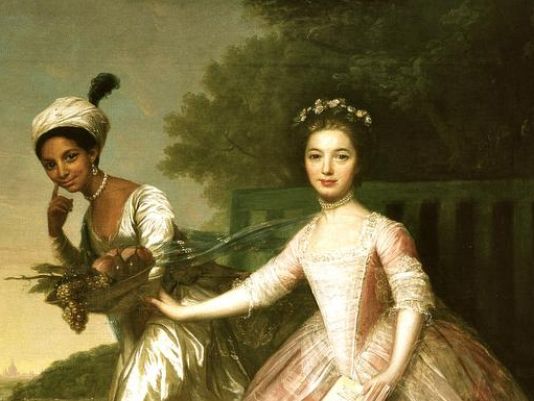
Wandering the grand halls of Scone Palace in Scotland you might stumble on a pretty portrait of two beautiful women in 18th-century clothes, seemingly affectionate sisters. Not so unusual — except one of the “sisters” is black.
Who is that, you might well wonder, as did Misan Sagay, then a young British college student of Nigerian descent, long accustomed to being the only black face in most British rooms. She stopped short upon spotting the painting while touring the palace near her university.
“I was stunned. And taken aback,” says Sagay, now in her 40s and a screenwriter (Their Eyes Were Watching God). The castle brochure named only the white woman in the portrait, Lady Elizabeth Murray. When she returned a few years later, Sagay says, there was more information on the label, naming the black woman as Dido, “the housekeeper’s daughter.”
“So the silent black woman had a name,” says Sagay. “But I looked at the portrait and the way they were touching, and thought, ‘I don’t buy this. There is more to this than meets the eye.’ ”
Indeed there was. Sagay dove into drafty palace archives to learn more, and years later the result is Belle, written on spec by Sagay, directed by Amma Asante, a British woman of Ghananian descent, and starring Gugu Mbatha-Raw,a British woman of South African descent.
Back in 2010, when Dana Saxon decided that she wanted to trace her family’s lineage, her expectations were low. “I thought, for people who survived slavery, there’d be little public information,” she says. What happened next “blew her mind”–and led to the creation of Ancestors Unknown, an international nonprofit that is bringing the past to the most impressionable among us: young students.
Saxon discovered that public archives had not completely ignored the existence of the enslaved, who legally were considered the same as property. While putting together the puzzle of her family’s past, she had an epiphany: “There were so many ancestors waiting to be discovered, waiting to be appreciated for what they did to help get us to where we are today,” she says. Knowing that most school curriculums do not include the names and contributions of people from the African Diaspora, she “wanted to find a way to help young people place themselves and their ancestors in the larger context of history.”
The Mission of Ancestors Unknown… “To inspire the personal and academic success of students throughout the world by introducing them to their unknown ancestors.”
Paper books were supposed to be dead by now. For years, information theorists, marketers, and early adopters have told us their demise was imminent. Ikea even redesigned a bookshelf to hold something other than books. Yet in a world of screen ubiquity, many people still prefer to do their serious reading on paper.
Count me among them. When I need to read deeply—when I want to lose myself in a story or an intellectual journey, when focus and comprehension are paramount—I still turn to paper. Something just feels fundamentally richer about reading on it. And researchers are starting to think there’s something to this feeling.
The Getty Research Institute has just added more than 77,000 high-resolution images to the Open Content Program from two of its most often-used collections.
The largest part of the new open content release—more than 72,000 photographs—comes from the collection Foto Arte Minore: Max Hutzel photographs of art and architecture in Italy. Foto Arte Minore represents the life’s work of photographer and scholar Max Hutzel (1911–1988), who photographed the art and architecture of Italy for 30 years. In recent years, the interdisciplinary use of these photographs has exposed their historiographic significance and their unrealized research potential.


 infophile