Value of Libraries Megapost | Stephen’s Lighthouse


I have been pulling together all of my posts on studies and reports on the value of public libraries for my work with the Federation of Ontario Public Libraries.  I thought I might as well post it here too. I’m sure I’ve got some dupes in here but c’est la vie!  Hope you find it useful!  There are many useful talking points and proofs in this research.

See the very mega megapost: Value of Libraries Megapost | Stephen’s Lighthouse.

Alabama Legislator Bill Holtzclaw Calls On Schools To Ban Toni Morrison Book | Huffington Post


An Alabama legislator who does not support efforts to repeal the sweeping U.S. education initiative known as the Common Core Standards says he believes the reading list issued in conjunction with the standards needs to be revised.

State Senator Bill Holtzclaw (R-Madison) told Alabama Media Group this week that he believes The Bluest Eye, by Toni Morrison, should be banned from high school libraries, despite the fact that this book is on the Common Core Standard’s recommended reading list for 11th-graders. 

See the full story: Alabama Legislator Bill Holtzclaw Calls On Schools To Ban Toni Morrison Book | Huffington Post.

Infographic: What Does Your Handwriting Say About You? | Co.Design


What does your handwriting say about you?

Infographic: What Does Your Handwriting Say About You? | Co.Design: business + innovation + design.

The Smithsonian Just Added a Chunk of Code to Its Permanent Collection | Gizmodo


Great to see an organization swoop in, so to speak, to preserve a defunct application, then go a step further and open the source code to developers. Hope to see this happen more often.

The Smithsonian’s Cooper-Hewitt design museum in New York just acquired the source code to an iPad app called Planetary from its now-defunct developer. Code is officially art now.

Planetary, as you can see in the video above, is basically a fancy music visualizer. The app’s source code was donated to the Cooper-Hewitt, which promptly open-sourced the code in hopes that people will use its visualization methods for other applications. Beyond the original lines of code, the museum has made a commitment to preserving the offshoots of the open-source project, and to nurturing their development. Planetary’s source has also been printed out in machine-readable OCR-A font on archival stock. Apparently, posterity demands a physical paper record that’s a little less fleeting than a digital archive.

See the full story: The Smithsonian Just Added a Chunk of Code to Its Permanent Collection | Gizmodo.

How Selfies Are Re-Energizing The New York Public Library | Co.Exist


The photos look like they could have been taken at a bar, a bat mitzvah, or one of those swanky media parties with sponsored vodka. But they weren’t. These photobooth shots were snapped at the New York Public Library as part of a new social media initiative to engage more with the library’s selfie-loving patrons, and the live photostream is making our hearts melt.

How Selfies Are Re-Energizing The New York Public Library | Co.Exist | ideas + impact

See the full story: How Selfies Are Re-Energizing The New York Public Library | Co.Exist | ideas + impact.

Libraries Meeting Community Needs: Offering Tools, Fishing Rods, Telescopes for Patrons to Borrow


A library card may get you more than you think
The library has evolved and checks out more than just books. Patrons also may borrow things like clippers and fishing rods. NBC’s John Yang reports. 

See the news video clip here from NBC News.

Shanghai Metro offers passengers books to borrow | chinadaily.com.cn


Shanghai’s Metro Line 2 is turning a new page with a library taking literally an online approach.

Passengers will be able to select a book at one station, and return it to any of the other stations with customized bookshelves.

Readers do not have to pay a deposit or any rent for the books and magazines they take. Instead, they are encouraged to donate 1 yuan (16 US cents) to charity at the bookshelf.

“Now you can read a real book, rather than staring at the cellphone through the metro ride,” said Zou

Shuxian, a spokeswoman for the Aizhi bookstore, which initiated the project jointly with Hujiang.com and Shanghai Metro Line 2.

“This will encourage more people to read on the Metro and improve the atmosphere of the whole city,” said Chen Kuang, a spokesman with Shanghai No 2 Metro Co Ltd.

The Chinese Academy of Press and Publication released a survey recently that said the general public between the ages of 18 to 70 read 4.39 books in 2012, much fewer than in Western countries.

The program announced its official kickoff on Aug 18, after a trial operation over a period of months.

It has been a resounding success with office workers. Waiting lines have developed during rush hour.

“Most people returned the books after reading, and many left a coin for our charity initiative,” said a staff member for Aizhi at the Nanjing Road West Station.

“Even if some books are not returned, we believe the overall benefit is worthwhile,” another staff member surnamed Li said.

All the books have green tape on the cover to inform people about the program. “Also to remind people it is borrowed and should be returned,” Li said.

Hujiang.com, an online education provider, and Aizhi, a bookstore chain, joined hands to launch the project last year. It called on people to donate their used books to the 20 Aizhi bookstores at the metro stations.

The program allows Hujiang to publicize its educational program.

The public offered more than 100,000 books in eight months. Many were given to schools in less well-off areas. The rest, and magazines, were used for the program.

The trial operation began near office buildings in Zhangjiang, a high-tech park in Shanghai, and then expanded to the Metro.

“We also have a few shops along Metro Lines 3 and 4, and we hope to expand the service,” she said.

“It is a great idea to have books used rather than leaving them to gather dust,” said Yue Tingting, a PR official with Hujiang.

“You can’t force people to read by regulations, but it is sensible to encourage people to read,” said Huang Yuning, head of the literature department at Shanghai Translation Publishing House.

The digital age has seen book sales decline, but this shows there may be a twist in the tale, said Feng Tao, an editor and colleague of Huang.

In order to encourage more people to read, the General Administration of Press and Publication of China plans to issue a guideline promoting reading.

via Shanghai Metro offers passengers books to borrow | Society | chinadaily.com.cn.

40 maps that explain the world | Washington Post


Maps can be a remarkably powerful tool for understanding the world and how it works, but they show only what you ask them to. Some of these are pretty nerdy, but I think they’re no less fascinating and easily understandable. A majority are original to this blog (see our full maps coverage here), with others from a variety of sources.

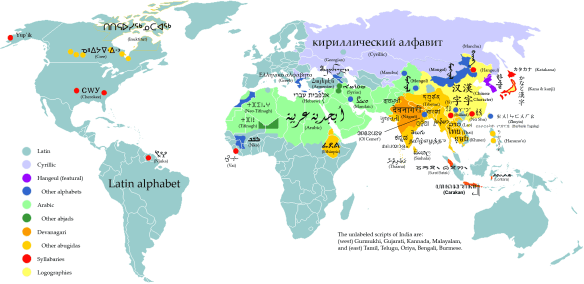
The world's major writing systems

Wikimedia Commons

via 40 maps that explain the world  | Washington Post.

You may also like: 40 Maps They Didn’t Teach You In School | Bored Panda

Links for Recent Pew Research News


Pew: 30% Of U.S. Adults Don’t Have Broadband; 10% Use Smartphones As Sole Internet Access; 20% Have Zilch | TechCrunch – August 26, 2013
Pew Research…releas[ed] the results of a survey that shows how one of the more advanced countries in the world, the U.S., is still not quite there in leading by example: 20% of U.S. adults are still without broadband or smartphones for internet access. And 3% of people in the country still using dial-up connections.

The below link is related the same Pew research results as the article above but provides discussion on a different perspective – the digital divide in America.  See the original Home Broadband 2013 Pew report – August 26, 2013.

Latest Pew Study Shows 70 Percent of U.S. Has Broadband. But Access Is Still Unequal | Wired.com – August 26, 2013
Pew’s results demonstrate that the digital divide is persistent, with close correlations between socioeconomic status and home Internet access. The report is also a reminder that policymakers use the words “high-speed broadband” to include everything other than dialup access, which is far too broad a definition.

Adult Trend Data | Pew Internet 
Latest data about device ownership by American adults up to end-May 2013.

Pew Study: More millennials are living with their parents than ever before | Stephen’s Lighthouse | August 22, 2013
According to a Pew poll, 36 percent of young adults are afflicted with Failure to Launch syndrome.

Teens say they generally rely on themselves to figure out how to manage their privacy online | Stephen’s Lighthouse – August 22, 2013
Teens say they generally rely on themselves to figure out how to manage their privacy online; Still, 70% of teens have at one time sought advice about how to manage their privacy online. See the Pew Internet report from August 15, 2013.

Teens and Mobile Apps Privacy | Pew Internet – August 22, 2013
As teens gain access to mobile devices, they have embraced app downloading. But many teen apps users have taken steps to uninstall or avoid apps over concern about their privacy. Location information is considered especially sensitive to teen girls, as a majority of them have disabled location tracking features on cell phones and in apps because they are worried about others’ access to that information.

Teens Haven’t Abandoned Facebook (Yet) | Pew Internet – August 15, 2013
When we released our “Teens, Social Media and Privacy” report in May, one thread of news coverage focused on teens’ “waning enthusiasm” for Facebook. This theme surfaced during our focus group discussions with teens and stood in contrast to the excitement that was associated with newer platforms like Instagram and Twitter.

Infonista | Alternative Jobs/Career Paths for Former School Librarians


The Wall Street Journal recently ran an article about the high (and increasing) number of public middle and high schools going without professional school librarians in the state of New York. Existing positions were being eliminated, new schools were being created without any librarians on staff. I started a discussion on the LIS Career Options LinkedIn group asking whether this was part of a broader trend across the country. The response: absolutely…

…Since school librarianship is the LIS discipline I know least well, I imagined that there might be many solid transferable skills that individuals could repurpose for new job opportunities. The response: not so much.”

See the full story: Infonista | Alternative Jobs/Career Paths for Former School Librarians.