
Jaron Lanier: The Internet destroyed the middle class – Salon.com


The article is an interview with the author who challenges our obsession with digital culture.

“Kodak employed 140,000 people. Instagram, 13. A digital visionary says the Web kills jobs, wealth — even democracy.”

“His book continues his war on digital utopianism and his assertion of humanist and individualistic values in a hive-mind world. But Lanier still sees potential in digital technology: He just wants it reoriented away from its main role so far, which involves “spying” on citizens, creating a winner-take-all society, eroding professions and, in exchange, throwing bonbons to the crowd.”

via Jaron Lanier: The Internet destroyed the middle class – Salon.com.
Research Publications at Facebook


Helping a billion people share requires innovation. At Facebook, we solve technical problems no one else has seen because no one else has built a social network of this size. Working at the intersection of research and engineering to make the world more open and connected is one of the best things about being at Facebook right now.

via Research Publications at Facebook.

Here is just a sample of some of research article titles:

  • Self-censorship on Facebook
  • Gender, Topic, and Audience Response: An Analysis of User-Generated Content on Facebook
  • The Role of Social Networks in Information Diffusion

You may also like:

Check Out Facebook’s Nerdy Library Of Its Research Papers | TechCrunch

The Big Library Read Experiment | Sourcebooks.com


A unique pilot program to research book discovery and generate data on libraries supporting authors.

Sourcebooks and OverDrive are partnering on a pilot program that will allow library patrons worldwide the opportunity to read New York Times bestselling author Michael Malone’s acclaimed novel “The Four Corners of the Sky” in ebook format. The Big Library Read is a no cost program in which libraries worldwide promote from their lending catalog a single ebook to their patrons. In addition to creating a global “library book club,” it’s designed to generate data about the positive exposure and sales influence library ebook catalogs provide to authors and publishers. See the full article at Library eBooks: The Role of Libraries in the Book Discovery Process | Sourcebooks.com.

You may also like:

OverDrive and Sourcebooks to Launch Ambitious Ebook Data Experiment | The Digital Shift

QR Codes: A Technology Without a User Base? | Information Space


There is an ongoing debate on whether QR codes are dying, or are still of value to marketers. Recent statistics from eMarketer.com show that 39% of US citizens between 18-24 have used QR scans in magazines, 38% in mail, 35% on posters, and 21% on websites. But these statistics are based on people scanning a QR code at least once. These statistics may be based heavily on curiosity rather than continual usage. 

[The author] lists reasons why QR codes could be on a steady decline, what they’re competing with, and some examples of creative ways to use them.

via QR Codes: A Technology Without a User Base? | Information Space

Online Personal Libraries and Book Social Media Sites | Dear Author


Online Personal Libraries and Book Social Media Sites | Dear Author

Reviews:

  1. LibraryThing
  2. Riffle
  3. Bookish
  4. Storyverse
  5. Get Glue
  6. Bookvibe

Advancing the User Experience: presentation by Monica Harris, OPPL « Tame The Web


Advancing the User Experience: presentation by Monica Harris, OPPL « Tame The Web

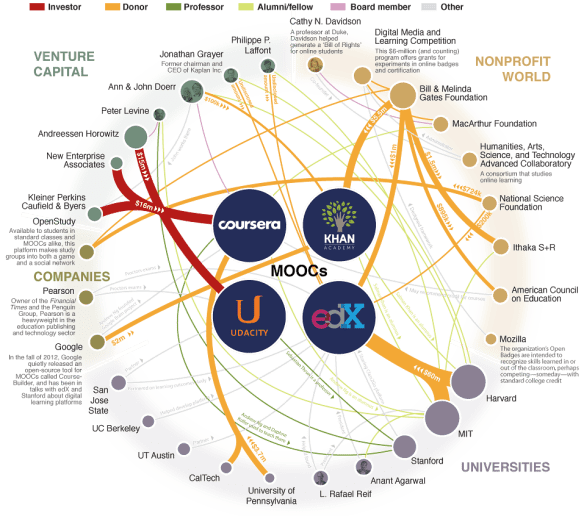
Major Players in the MOOC Universe – The Digital Campus 2013 – The Chronicle of Higher Education


Millions of students have signed up for massive open online courses, and hundreds of universities are offering some form of Web-based curriculum. Most students aren’t paying much for these classes, if they’re paying anything at all. So where is all that knowledge—and all the cash—coming from?  via Major Players in the MOOC Universe – The Digital Campus 2013 – The Chronicle of Higher Education.

MOOCs

Google Framed As Book Stealer Bent On Data Domination In New Documentary | TechCrunch


Google Framed As Book Stealer Bent On Data Domination In New Documentary | TechCrunch

Google and the World Brain

Quotable: “From the second it starts, director Ben Lewis’ opinion is clear: Google Books is as an insidious plot for data domination. See, Google didn’t just want to make a universally accessible library. It wanted to use all the knowledge to improve its search and artificial intelligence projects.”

Inside the Internet Archive’s Real-World Home | Mashable


The Internet Archive is a massive, ambitious effort to digitize the full spectrum of human knowledge. A documentary from Deepspeed Media goes inside the archive to reveal what that looks like in practice. See the full article here: Inside the Internet Archive’s Real-World Home | Mashable.

Don’t Leave College Without These 10 Digital Skills | Mashable


For the full article: Don’t Leave College Without These 10 Digital Skills | Mashable. Here is the list:

  1. Setting Up a Wi-Fi Network
  2. Backing Up to the Cloud
  3. Basic Photo Editing (Photoshop)
  4. Basic Video Editing (Final Cut Pro)
  5. Google Drive and Microsoft Office (Seriously)
  6. HTML and Basic Coding
  7. Setting Up a Website and Domain
  8. Converting File Formats
  9. Online Banking
  10. Branding Yourself

One of the first things I did when I went back to university as a graduate student was to purchase a new laptop and Adobe Creative Suite to take advantage of student pricing. I wonder how expensive 3 and 4 will be now for students, with Adobe moving to a subscription based cloud computing model? Then again there are a lot of free and/or open source solutions available.