UPDATE: Encrypt the Web Report: Who’s Doing What | EFF


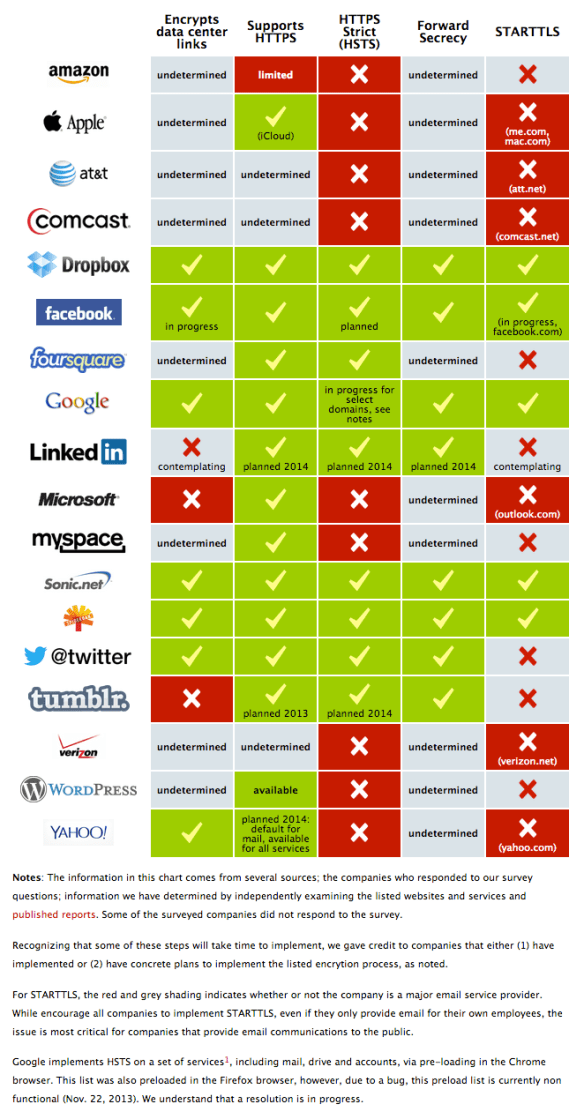
We’ve asked the companies in our Who Has Your Back Program what they are doing to bolster encryption in light of the NSA’s unlawful surveillance of your communications. We’re pleased to see that four companies—Dropbox, Google, SpiderOak and Sonic.net—are implementing five out of five of our best practices for encryption. In addition, we appreciate that Yahoo! just announced several measures it plans to take to increase encryption, including the very critical encryption of data center links, and that Twitter has confirmed that it has encryption of data center links in progress.

Read: UPDATE: Encrypt the Web Report: Who’s Doing What | Electronic Frontier Foundation

UPDATE: Encrypt the Web Report: Who's Doing What | Electronic Frontier Foundation


Oculus Rift-based virtual reality game could help restore 3D vision | Engadget


Many will tell you that video games are bad for your eyes, but James Blaha doesn’t buy that theory. He’s developing a crowdfunded virtual reality title, Diplopia, that could help restore 3D vision. The Breakout variant trains those with crossed eye problems to coordinate their eyes by manipulating contrast; players score well when their brain merges two images into a complete scene. Regular gameplay could noticeably improve eyesight for adults that previously had little hope of recovering their depth perception, Blaha says. The potential solution is relatively cheap, too — gamers use an Oculus Rift as their display, and they can add a Leap Motion controller for a hands-free experience. If you’re eager to help out, you can pledge $20 to get Diplopia, and $400 will bundle the app with an Oculus Rift headset. Check out a video demo of the therapeutic game after the break.

Read: Oculus Rift-based virtual reality game could help restore 3D vision | Engadget

The Future of MOOCs | Ellyssa Kroski | OEDB.org


Great MOOCs resource which includes links for:

  • History of MOOCs
  • Major MOOC Providers
  • MOOC Aggregators
  • MOOCs and Libraries
  • The Future of MOOCs

Read: The Future of MOOCs | Ellyssa Kroski | OEDB.org

Middle Earth comes to life in epic Chrome experiment | Engadget


We’re go out on a limb here and say that the Venn diagram of Engadget fans and Tolkien fans looks something like this. So, we figure you’ll probably want to hear about a brand new Chrome experiment that brings various parts of Middle Earth to life, including the Trollshaw and Dol Guldur. It starts with a pretty simple interactive map, but from there you’re able to dive into several locations and learn about Hobbit lore through text, animations and audio. At the end of each lesson on Tolkien’s fantasy world, you’re challenged to complete a simple mini game that has you causing flowers to bloom or avoiding troll attacks. While the WebGL-powered games are pretty impressive, its the HTML5 audio and animations that are the real eye-candy here — doubly so since they work just as well on a phone or tablet as they do your desktop. As you swipe through slides in the story, camera angles change in coordination with your finger and characters dart across bridges. Honestly, even if you’re part of that tiny sliver in the diagram that can’t stand Tolkien, it’s worth checking out the latest Chrome Experiment, if only to remind yourself of the growing power of the web browser.

Middle Earth comes to life in epic Chrome experiment | Engadget

Tech Trends 2013: Elements of post digital | Deloitte United States


Our Government Has Weaponized the Internet. Here’s How They Did It | Wired.com


The internet backbone — the infrastructure of networks upon which internet traffic travels — went from being a passive infrastructure for communication to an active weapon for attacks.

According to revelations about the QUANTUM program, the NSA can “shoot” (their words) an exploit at any target it desires as his or her traffic passes across the backbone. It appears that the NSA and GCHQ were the first to turn the internet backbone into a weapon; absent Snowdens of their own, other countries may do the same and then say, “It wasn’t us. And even if it was, you started it.”

If the NSA can hack Petrobras, the Russians can justify attacking Exxon/Mobil. If GCHQ can hack Belgacom to enable covert wiretaps, France can do the same to AT&T. If the Canadians target the Brazilian Ministry of Mines and Energy, the Chinese can target the U.S. Department of the Interior. We now live in a world where, if we are lucky, our attackers may be every country our traffic passes through except our own.

Which means the rest of us — and especially any company or individual whose operations are economically or politically significant — are now targets. All cleartext traffic is not just information being sent from sender to receiver, but is a possible attack vector.

Here’s how it works.

Read more: Our Government Has Weaponized the Internet. Here’s How They Did It | Wired Opinion | Wired.com

How to Opt Out of Data Tracking on Your Most-Used Sites | Mashable


Google’s latest updates to its terms of service have left many privacy advocates crying foul. One new feature called “shared endorsements” allows your name and photograph to be used in targeted advertisements on Google property sites.

Google’s support page for shared endorsements claims the feature will allow for more friend-based recommendation of music and restaurants, working much like Facebook’s Sponsored Stories.

Shared endorsements are not unique. Many sites, apps and browsers are using your information in ways you might not entirely comply with if you’d take the time to read their privacy policies. Often, opting out is only a click away, though it may be difficult to find out where exactly to click.

We’ve compiled this list of ways various Internet companies are tracking and using your data — plus, given you the tools to opt out, if you wish.

Reviews how to opt out for:

  • Targeted Advertisements
  • Search History
  • Disable Third-Party Cookie Tracking

Read: How to Opt Out of Data Tracking on Your Most-Used Sites | Mashable

Related:

The Book as App: Multi-Touch Ebooks and Their Future in Libraries | Nicole Hennig


Canada’s parks and historic sites now on Google Street View | CBC News


Google/Parks Canada

The Google Maps team visited Banff National Park and about 70 other Parks Canada sites this past spring and summer, collecting imagery using its Street View cars and on foot using its Trekker backpack technology. (Google/Parks Canada)

Hikes through spectacular national parks such as Banff and tours of historic sites such as the Viking settlement at L’anse au Meadows in Newfoundland are now available on Google Street View.

Google and Parks Canada announced today that more than 70 Parks Canada locations across the country can now be explored online.

“From planning a summer vacation to augmenting classroom lesson plans, the partnership between Parks Canada and Google will better connect Canadians to the amazing places and geography that defines this country,” wrote Parks Canada’s Michael White on the Google Canada blog.

Read: Canada’s parks and historic sites now on Google Street View | Technology & Science | CBC News.

This Sign Language Ring Translates Hand Movements Into Spoken Words | Fast Company


This Sign Language Ring Translates Hand Movements Into Spoken Words | Fast Company | Business + Innovation

A winner of the coveted red dot awards for design concept in 2013, Sign Language Ring is a device that detects sign language motion and “translates” that to voice by emitting audio through a speaker.

Comprising a bracelet and set of detachable rings worn on select fingers, Sign Language Ring was inspired by Buddhist prayer beads, according to its six designers from Asia University. The wearable device can also translate voice to text, transcribing spoken language picked up by a microphone into text that’s displayed on the bracelet’s screen.

Read: This Sign Language Ring Translates Hand Movements Into Spoken Words | Fast Company | Business + Innovation