Read: Leap Motion: Making Gesture Computing A Reality | Information Space

Snip: Wikipedia and its stated ambition to “compile the sum of all human knowledge” are in trouble. The volunteer workforce that built the project’s flagship, the English-language Wikipedia—and must defend it against vandalism, hoaxes, and manipulation—has shrunk by more than a third since 2007 and is still shrinking. Those participants left seem incapable of fixing the flaws that keep Wikipedia from becoming a high-quality encyclopedia by any standard, including the project’s own.
Wearable devices are predominantly technical fascinations at the moment, but they have widespread market potential — if misconceptions can be set straight.
The 8 myths discussed:
Read: 8 myths about wearable tech | Business Tech – CNET News.
As Web companies and government agencies analyze ever more information about our lives, it’s tempting to respond by passing new privacy laws or creating mechanisms that pay us for our data. Instead, we need a civic solution, because democracy is at risk.
Snip: “When all citizens demand their rights but are unaware of their responsibilities, the political questions that have defined democratic life over centuries—How should we live together? What is in the public interest, and how do I balance my own interest with it?—are subsumed into legal, economic, or administrative domains. “The political” and “the public” no longer register as domains at all; laws, markets, and technologies displace debate and contestation as preferred, less messy solutions.
But a democracy without engaged citizens doesn’t sound much like a democracy—and might not survive as one.”
A lengthy but thought provoking read on the right to privacy and democracy. Read: Evgeny Morozov on Why Our Privacy Problem is a Democracy Problem in Disguise | MIT Technology Review.
Article in Full
Professors aren’t so different from the regular populace when it comes to their views on social media.
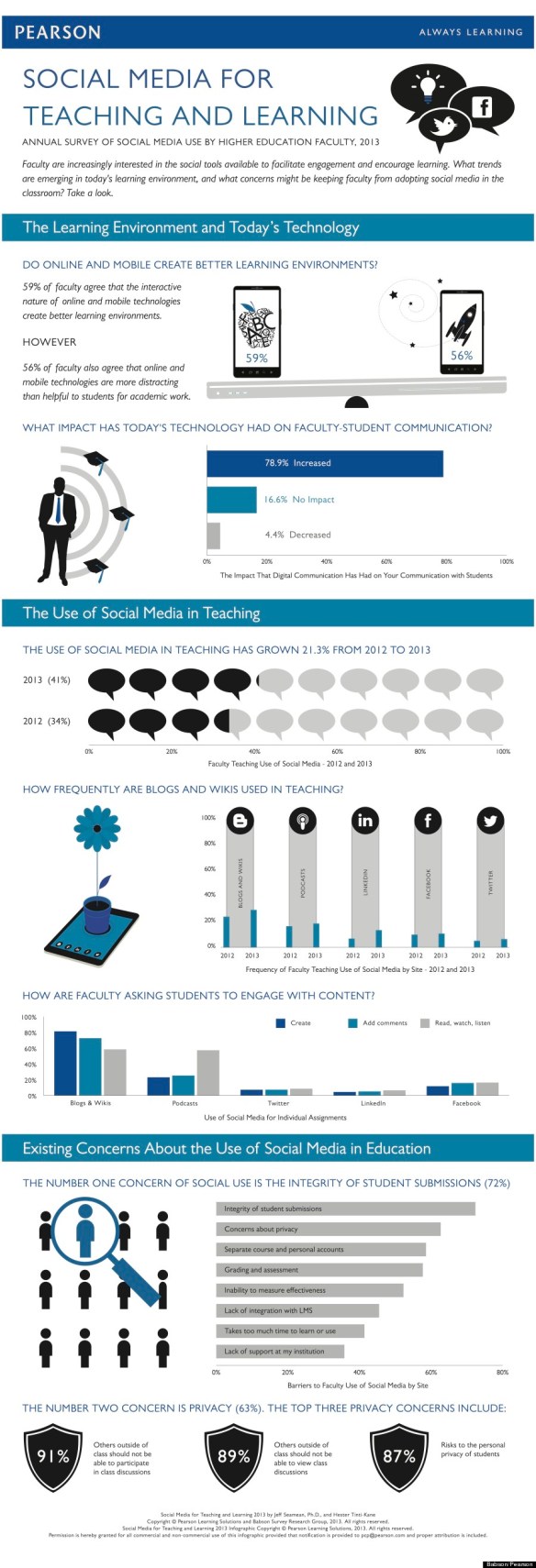
Just over 70 percent used social media in their personal lives, a survey released last week by Babson Survey Research Group andPearson found. This figure mirrors usage among the general population, according to the Pew Research Center.
Babson and Pearson surveyed 8,000 faculty members from all disciplines in higher education for their report, “Social Media for Teaching and Learning.”
Faculty personally choose to use Facebook more than any other type of social media outlet, according to the report, but were more likely to use blogs and wikis for classroom assignments.
Less than half of faculty — 41 percent — use social media as a tool in class, but that’s up from 33.8 percent in last year’s survey.
“Faculty are not only expanding their use of social media, but also becoming more sophisticated in their use,” Jeff Seaman, co-director of the Babson Survey Research Group, said in a statement. “We see steady growth in adoption year over year; however, there are still great concerns that we hear from every age group, and that holds educators back from full adoption in their teaching.”
Faculty cited “integrity of student submissions” and privacy as their main concerns with social media use. Privacy was a large concern among previous surveys of the general population as well.
The maker culture is a thriving movement amongst all types of people who want to create and design their own objects, crafts, or computer code. This DIY community is using state-of-the-art technology such as 3D printers to design and craft their own 3D objects. This introductory guide will give you an overview of today’s maker movement, resources for getting started, 3D printer reviews, links to actual project designs and instructions, maker publications, events, and directories, videos about 3D printing and maker culture, and an article list of resources about libraries and makerspaces.
Resources categorized into the following sections:
Read: An All-in-One Guide to the Maker Culture and 3D Printing | Ellyssa Kroski | OEDB.org.
There are five mega trends impacting the IT departments of every company: Mobile, Social, Cloud, Apps and Big Data. In this presentation, Vala Afshar reveals ten startling stats for each mega trend.
At the forefront of the economy, good design is a priority. Here’s how to embrace the next wave of innovation.
The 10 lessons discussed:
Read: 10 Lessons For Design-Driven Success | Co.Design | business + design.
The Maker Movement has inspired progressive educators to bring more hands-on learning and tinkering into classrooms, and educator Gary Stager would like to see formal schooling be influenced by the Maker Movement, which has inspired young learners to tinker, to learn by doing, and take agency for their learning.
 infophile