Are Courses Outdated? MIT Considers Offering ‘Modules’ Instead | The Chronicle of Higher Education


People now buy songs, not albums. They read articles, not newspapers. So why not mix and match learning “modules” rather than lock into 12-week university courses?

READ: Are Courses Outdated? MIT Considers Offering ‘Modules’ Instead | The Chronicle of Higher Education.

Understanding Video Games [Free Course] | University of Alberta


Understanding Video Games is an 11-lesson course teaching a comprehensive overview of analytical theory pertaining to video game media. Video games are a globally entrenched entertainment medium that entertains, informs and challenges us. These games are defined by, and define our modern culture. In this course, students will learn how to study games and engage in informed discussions about them. Ultimately, this course is about understanding the literacy of video games.  Understanding Video Games was created with the help of world renowned video game developer, BioWare Corp, located in Edmonton, Alberta.

Read More: Understanding Video Games | University of Alberta.

When Library School Hands You Lemons | Hack Library School


Originally posted to HLS November 2013.

My library school experience has, I’m sad to say, handed me a bunch of lemons. There are the professors who aren’t as inspiring as I would prefer sorry, the journal articles that look like they weren’t proofread, the classes that are scheduled at times that are inconvenient for everyone. Including the instructor. And then there’s the fact that one of the classes I need for my specialization is offered only in the spring, and this spring it is offered at a time when I cannot take it for religious reasons probably NSFW, which is the biggest lemon of all. Meanwhile, I’m paying a not-insignificant amount for my education, so let’s talk about how to turn these lemons into lemonade.

READ MORE: When Library School Hands You Lemons | hls

SlideRule Searches for the Best Online Courses in Any Category | LifeHacker


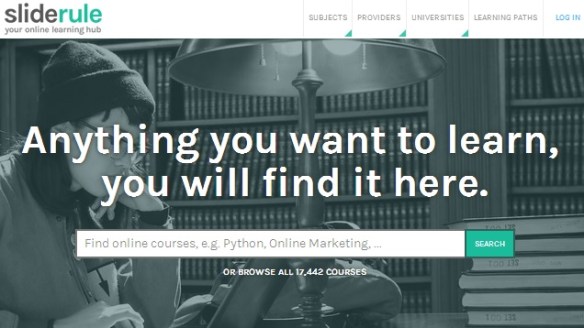
Online classes are a great way to learn new skills. SlideRule makes your search easier by letting you browse and search through over 17,000 online courses. READ: SlideRule Searches for the Best Online Courses in Any Category | LifeHacker

Major Players in the MOOC Universe – The Digital Campus 2013 – The Chronicle of Higher Education


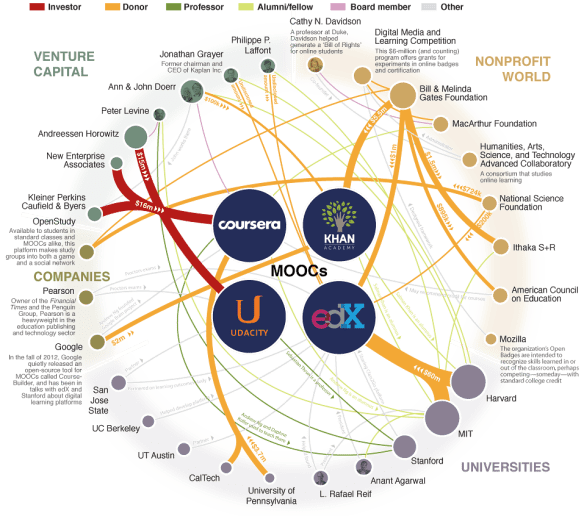
Millions of students have signed up for massive open online courses, and hundreds of universities are offering some form of Web-based curriculum. Most students aren’t paying much for these classes, if they’re paying anything at all. So where is all that knowledge—and all the cash—coming from?  via Major Players in the MOOC Universe – The Digital Campus 2013 – The Chronicle of Higher Education.

MOOCs

Collection of Links: MOOCs


Got MOOC?: Massive open online courses are poised to change the face of education | The Digital Shift
Although it’s clear that there’s a flurry of interest in MOOCs among universities, higher-ed students, the tech industry, and pundits, these free online courses are also likely to have a significant impact on K–12 librarians and other educators. 

From the EDUCAUSE Library on MOOCs, the report What Campus Leaders Need to Know About MOOCs and many more additional resources.

California Universities Aggressively Expand Online Courses, Finds Failure Rates Drop | TechCrunch
The largest university system in America is aggressively expanding its experimental foray into Massive Online Open Learning (MOOCs), based on an unusually promising pilot course. 

The iSchool’s First MOOC: Lessons Learned | Information Space
There is much that still needs to be figured out about MOOCs. 

For Libraries, MOOCs Bring Uncertainty and Opportunity | Wired Campus
A lot of the discussion about massive open online courses has revolved around students and professors. What role can academic librarians play in the phenomenon, and what extra responsibilities do MOOCs create for them?

What Do Librarians Need to Know About MOOCs? | Stephen’s Lighthouse
“The following article appears in the March/April 2013 issue of D-Lib Magazine.”

Chronicle of Higher Education Blog Highlights Key Points from MOOCs and Libraries Event  | Stephen’s Lighthouse
“The “MOOCs and Libraries: Massive Opportunity or Overwhelming Challenge?” event, hosted by OCLC Research and the University of Pennsylvania on 18-19 March, featured thoughtful and provocative presentations about ways libraries are getting involved with massive open online courses (MOOCs), including the challenges and strategic opportunities they are facing.”

MOOCs and Libraries Event | The OCLC Research Channel (YouTube)
Playlist includes videos of the sessions from the “MOOCs and Libraries: Massive Opportunity or Overwhelming Challenge?” event that took place 18-19 March 2013 in which OCLC Research and the University of Pennsylvania Libraries presented thoughtful and provocative presentations about how libraries are already getting involved with MOOCs.  Also see this SlideShare presentation from OCLC: MOOCs & Libraries: Massive Opportunity or Overwhelming Challenge.

10,000 Free Courses Listed in a Massive Open Courses Directory | iLibrarian
The OEDb has just launched a massive Free Online Open Courses Directory organizing nearly 10,000 free courses in the liberal arts and sciences. The courses are available in a variety of formats including full courses, video lectures, audio lectures, text articles, and mixed media.

10 Incredibly Interesting Free Online Courses I’d Like to Take for Fun | iLibrarian
It’s amazing just how many colleges and universities are offering free open education courses that people can take from the convenience of their own computers. I’ve been investigating the offerings at many of these including MIT, University of Notre Dame, UC San Diego and others, and there are many classes that I’d enjoy taking just for fun. Here are ten of my choices, but click into the programs for listings of hundreds more!

Dewey-It-Yourself: How to supplement your library school education | Hack Library School
No matter how great a MLS/MLIS program is there just isn’t enough time and courses to learn everything.

Lynda.com, NYPL Explore New Library-wide Access Model | The Digital Shift
Patrons visiting the New York Public Library’s Science, Industry and Business Library (SIBL) now have free access to the entire catalog of more than 1,500 instructional online training videos offered by Lynda.com.

Emerging Student Patterns in MOOCs: A (Revised) Graphical View | e-Literate
Describes four student patterns emerging from Coursera-style MOOCs.

Massive Open Online Courses: Legal and Policy Issues for Research Libraries | ARL [Brief]
Massive Open Online Courses (MOOCs) raise significant legal and policy questions for research libraries, which are often asked to support the development of MOOC courses.

Beyond the Buzz, Where Are MOOCs Really Going? | Wired Opinion | Wired.com


“Everyone’s going MOOC-crazy these days. From frequent media coverage of online courses and platforms like Coursera, edX, Udacity, and Udemy to discussions about the complexities and business models of online education, the excitement around MOOCs (Massive Open Online Courses) has finally “bubbled” over.”

via Beyond the Buzz, Where Are MOOCs Really Going? | Wired Opinion | Wired.com.

You may also like:

The MOOC Revolution: A Sketchy Deal for Higher Education – DISSENT Magazine

Move Over Harvard And MIT, Stanford Has The Real “Revolution In Education”

Review of Winter 2011 MLIS Courses


Here’s some thoughts on the MLIS courses I took in the winter and spring/summer semesters at the University of Alberta. I ended up taking probably the four most difficult courses in the program in winter 2011.

LIS 505 – Introduction to Research
Oh the cold shivers running up my back at the memories. Suffice to say LIS 505 was a very difficult course and I’m not exaggerating! This is a required course in an MLIS program. Basically you come up with a research question (e.g. quantitative, qualitative or textual) and live with it for 3 months, do a plethora of related assignments and then churn out a 35 page single-spaced research proposal including interview questions, ethics review, hypotheses, recruitment poster, budget, timeline and on and on for final term project. What was both great and not so great were the students from other disciplines enrolled in the course. Most classes in LIS only have LIS students but not LIS 505, as the course is meant to instruct students on how to put together a research proposal and how to conduct research. So external students brought refreshing opinions but those same students hogged the class time in a class filled to over capacity. Luckily, my marathon effort on my final proposal reaped rewards and I got a grade I am happy with.

LIS 532 – Cataloging and Classification
This was the most frustrating course but the most practical and rewarding. We learnt standards in bibliographic description, AACR2 rules, MARC 21 format, LCC, DCC, LCSH. We had five items of varying format such as monograph, serial, DVD, electronic resource, which we learnt the above aspects of cataloging and classification. The detail required and the high level of understanding of rules and standards was exacting and the source of my frustration being a perfectionist. Luckily, we had a wonderfully giving instructor, KDG, who felt our pain but had high expectations of our efforts. Our term project was a 20 page group paper examining LCSH and DDC on a high-level topic (cooking and ethnicity). I would recommend all MLIS students take this fundamental course. I even got to apply what I learnt in my spring practicum work placement!

LIS 533 – Database Design for Information Management
This course at its core was not about building a database in a software program but learning the conceptual, logical and practical design steps when creating and implementing databases. For this course you needed to be able to think abstractly when ER modeling and analytically when developing relational models, creating SQL queries, QBE and using normalization. The term project required you to go through each step of database design, then create the database in Access, as well as forms, SQL queries and QBE. I did well with the analytical aspects to the course but in my mind failed with the more conceptual aspects, the ER modelling. The content of the course was difficult, even for those who have the aptitude for it, so I would not necessarily recommend this course to the majority of MLIS students but would to those that have a special interest in database design.

LIS 538 – Digital Libraries
Digital libraries was my favourite course in the winter term, though a demanding one. It really opened my eyes to all the different layers involved in considering building a digital library, such as funding, preservation, metadata standards, etc. The course really ran the gamut on topics and was very informative. The final project was to create a digital library using the Greenstone application, with an accompanying paper. The course was demanding because Greenstone was very tricky and problematic to use. Many hours I’ll never get back were spent on trial and error experimenting and perfecting my digital library which I called Interpretations of Tea. This course was my best grade so far in the program. I would recommend a digital libraries course to MLIS students but if you are not comfortable with technology you may want to look at other options.

So, as you can see from above, all my final projects were very demanding…and of course they were essentially due all at the same time, along with some other assignments. I had two weeks of stress, poor diet, no exercise, sporadic sleep, mental intensity and then after submitting an assignment 6:00pm on the last Friday of the term, I had to pack up and clean my apartment, then move Saturday back to Calgary and start my practicum work placement on the Monday. The practicum was for 3 weeks and then I finally got a break!

LIS 590 – Practicum
My practicum placement was at a special library for a large Canadian oil & gas company. I got great exposure to reference requests, original and copy cataloguing and I researched embedded librarianship and alternative library models for my final project. I would recommend library and information studies students compete a co-operative work placement or a practicum, as it provides great insight into real world librarianship. The practicum was pass/fail, three-week intensive (100 hours) and although I was not paid it does count toward three credits or a full course in my program.

LIS 598 Information Security
I took this as a one-credit course. We learnt about risk management, information security in the context of threats and vulnerabilities (such as hacking, natural disasters, password management, etc.), critiquing acceptable use policies. I learnt a lot in this course, plus it was timely with all the recent Lulzsec and Anonymous events. A final project was required consisting of four parts (Policy Analysis, Software Evaluation, Future Forecast and Incident Report). The summary may sound dry but the course was eye-opening, as we were shown the techniques and technology that hackers use and we studied risk management documents. I got a great grade in this course as well…and I only wish it had been a three-credit instead of a one-credit, it was that interesting.