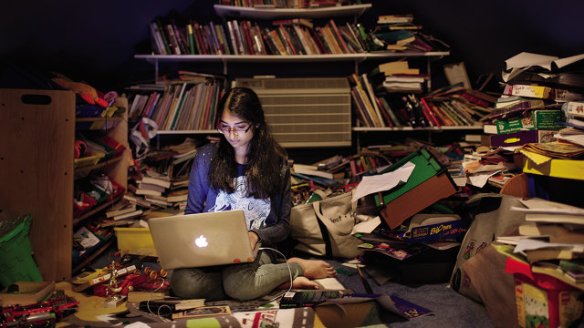
How to attack a woman who works in video gaming | theguardian.com


A culture of hate and suspicion has descended on the games industry, and at the centre of the vortex is a familiar foe: women. Ask Anita Sarkeesian and Zoe Quinn.

READ MORE: How to attack a woman who works in video gaming | Technology | theguardian.com.

Scary. As librarians we have a responsibility to uphold the right to intellectual freedom. For situations such as this, there has to be checks and balances that hold criminal behaviour, such as harassment and death threats, accountable. Brings up all sorts of questions about social media and freedom of speech, anonymity, censorship, privacy and trolling.

Women In Tech: It’s Not Just A Pipeline Problem | TechCrunch


READ: Women In Tech: It’s Not Just A Pipeline Problem | TechCrunch.

Tech sector struggling with gender diversity says key is to involve girls | Toronto Star


Tech companies have long been criticized for their lack of female employees, especially in management and engineering roles. In the last few years, however, the industry has taken note of the gender disparity and it is slowly changing.

READ: Tech sector struggling with gender diversity says key is to involve girls | Toronto Star

Who Wants to Work for a Woman? | Joan C. Williams | HBR


Full Post

The year my husband was born (1953), only 5% of Americans preferred a female boss. That number has climbed to 23%, according to a new Gallup survey. The proportion of people who prefer to work for men fell precipitously, from two-thirds in 1953 to about one-third today.

Perhaps even more important is the sharp rise in Americans who expressed no preference, even when cued to care. Gallup’s question asked, “If you were taking a new job and had your choice of boss, would you prefer a man or a woman?” Only 25% of Americans expressed no preference in 1953 but today it’s 41%. More good news: more people judge their bosses not by their gender, but as people. This is more likely to be true the higher the level of the job. Only 36% of those with high school or less, but 46% of those postgraduate degrees, expressed no preference.

Male privilege, you might say, ain’t what it used to be.

Americans' Preference for Gender of Boss Chart

Once we scratch the surface, though, the news is nastier. Americans who currently work for men are twice as likely to prefer to do so. Only 16% of Republicans prefer a woman boss. American women still face a steep uphill climb, something the pipeline won’t fix: young people (18 to 34) are more likely to want a male boss and less likely to express no preference than Americans aged 35 to 54.

Americans' Preference of Gender of Boss, by Category Chart

Most striking is that a much higher percentage (40%) of women than men (29%) prefer to work for a man. Women also are more likely than men to prefer to work for a woman: 27% of women versus only 18% of men.

Both these statistics are puzzling, but I may have an explanation for each.

Women might prefer to work with women for two reasons. They might, first, feel this offers them some protection from gender bias, including sexual harassment. Second, women without college degrees typically are in pink-collar jobs that have a distinctly feminine feel a male boss might disrupt.

How about the women who prefer a male boss? Have they just been burned by Devils Wearing Prada?

They may have experienced workplaces where gender bias pits women against other women, a patternThe New Girls’ Network calls the “Tug of War.” An important 2010 study of legal secretaries by law professor Felice Batlan illustrates this dynamic, as does my own research. Batlan surveyed 142 legal secretaries and found that not one preferred to work for a woman partner (although, importantly, 47% expressed no preference).

Why did many secretaries prefer male bosses? Simple: they aren’t dummies. In most law firms, most people who hold power are men. Women stall out about 10 to 20% of the time in upper-level management in professional fields like business and law, so if you’re aiming to hitch your wagon to a shooting star, men are a better bet. This is one way gender bias pits women against women.

Another is when women stereotype other women. “I just feel that men are more flexible and less emotional than women,” one secretary said, while another described women lawyers as “too emotional and demeaning.” The stereotype that women are too emotional goes back hundreds of years.

But “demeaning”? That’s interesting. Her boss may just be a jerk — some people are — but perhaps she was just busy. While a busy man is busy, a busy woman, all too often, is a bitch. Because high-level jobs are seen as masculine, women need to behave in masculine ways in order to be seen as competent. But if they behave too much like men — watch out.

This no-win situation fuels conflict between women who just want to be one of the guys and those who remain loyal to feminine traditions. “Secretaries are expected to engage in traditionally feminine behavior such as care giving and nurtur[ing], where[as] women attorneys are supposed to engage in what is stereotypically more masculine behavior. Given these very different expectations and performances of gender that occur in the same space, the potential for conflict is enormous,” Batlan concludes. Indeed, many professionals find themselves expected to do what Pamela Bettis and Natalie G. Adams, in an unpublished paper, call “nice work”: being attentive and approachable in ways that are often time-consuming and compulsory for women but optional for men.

Conflict also erupts due to Prove-It-Again problems: women managers have to provide more evidence of competence as men in order to be seen as equally competent. This pattern again pits women against their bosses. “It would seem as if female associates/partners feel they have something to prove to everyone,” noted one secretary. “Females are harder on their female assistants, more detail-oriented, and they have to try harder to prove themselves, so they put that on you,” said another.

But it’s not just female assistants who voice concerns about their bosses.

The interviewees for my forthcoming book What Works for Women at Work, co-written with my daughter Rachel Dempsey, illustrate yet another dynamic: some admins make demands on female bosses that they don’t make on men. And like many types of gender bias, this one’s inflected by race. One black scientist I interviewed felt her relationship with white administrative assistants was strained because, she said, she didn’t share their habit of bonding by sharing personal information (what Deborah Tannen called “troubles talk”). Black admins “just do not expect me to want to know anything about their personal business,” she said with some relief.

Women bosses also often feel that admins prioritize men’s work. One scientist I interviewed noted that administrative staff took longer to complete work given by women than men. Another agreed: “My stuff won’t get done first.” “They say the bosses are too demanding,” said a third, recalling a conversation with admins who worked with her. She had responded, “Well, the boss that you had before was equally demanding. The guy that you were working under was equally demanding.” The admins’ reaction: “Yeah, but that’s different.” Again, the secretaries know which side the butter’s on. And the female scientists I interviewed typically felt less powerful than their male counterparts.

As usual, gender dynamics are far from simple. The Gallup study confirms the eternal story: when it comes to gender flux, the glass is half full — employees now are more comfortable with female leaders and are more likely to simply treat people as people, leaving traditional gender stereotypes behind. But the glass is also resounding, maddeningly, persistently half empty. I read the evidence that more women than men prefer to work for women as evidence of persistent gender bias. And I read the evidence that more women than men prefer to work for men the same way.

Who Wants to Work for a Woman? | Joan C. Williams | Harvard Business Review

A Girl Who Codes | Fast Company


A Girl Who Codes | Fast Company | Business + Innovation

Computing has always been a boys’ club. How 18-year-old nikita rau–and other young women like her–are finally changing that.

Read: A Girl Who Codes | Fast Company | Business + Innovation.

11 Indispensable Life Lessons Every Woman Can Learn From Anne Of Green Gables | HuffPo


Anne of Green Gables

Awesome, super popular post on HuffPo!!

Like all great children’s book heroines, Anne Shirley is just a bit odd. Okay, she’s very odd. Her crazy imagination and flowery diction differentiate her from most children you’re likely to meet, and despite a certain recent edition’s cover art, her hair is defiantly red. But somehow, her kooky adventures have spoken to generations of children, including me. Though in some ways L.M. Montgomery’s lesser-known heroine Emily Starr was more relatable to me as a kid — shy, withdrawn, bookish, and driven by professional ambition — lighthearted Anne is almost universally irresistible.

Anne is fearless. Anne is unpredictable. Anne is funny, though often unintentionally. Anne is smart, but not snobbish. Anne is so warm and caring you can feel it through the page. (And, cards on the table, her love interest Gilbert was my first literary crush.) Watching her grow up, stumbling from adventure to misadventure, was never dull. What’s more, it managed to teach young readers all about life without ever seeming preachy. Anne isn’t a model girl, but she’s figuring it out. Just like we all were at her age. Here are 11 of the most important lessons Anne Shirley taught me about life, love, and growing up.

Read: 11 Indispensable Life Lessons Every Woman Can Learn From Anne Of Green Gables | HuffPo.

Gender in Tech Librarianship | Roy Tennant | The Digital Shift


One of the avenues by which this issue could be improved would be to hire more women into library tech positions in the first place. In my experience there is definitely a barrier to getting hired into these positions, or even interviewed. I was the only graduate in my cohort with a focus in information technology and it was lonely. Whenever I introduce myself to others in my field and I say I specialize in tech, I usually see the same expression, a little confused, a little flabbergasted. Its disheartening. On the flip side, patrons are hugely appreciative of someone they can connect with who can help them with computer literacy and device support.

I’m glad women in librarianship who specialize in tech have professionals in our field like Sarah Houghton and Ellyssa Kroski to, if not wave the banner for our gender, then at least illustrate definitively how intelligent, skilled and multifaceted women can be in library tech. Raising awareness is of utmost importance and this is why I’m lending my own comment to this story. 

Gender in Tech Librarianship | Roy Tennant | The Digital Shift.

Certainly I’ve written about this issue before, and I will keep writing about it until there are no more reasons to do so. But the reason why I’m writing about the issue of gender imbalance in library tech is because I was recently at the Internet Librarian Conference in Monterey, CA, where my esteemed professional colleague and completely famous Sarah Houghton, “Librarian in Black” had organized a panel on this very topic.

The panelists all gave a brief statement from their own experience and perspective (a mix of both women and men), then a microphone was carried around the room for the attendees to provide their own perspectives and stories. And the stories of harassment, put-downs, insults, marginalization, and worse, just rolled right in.

Unfortunately, I was surprised. Surprised because these were not the kind of subtle kinds of discrimination that I knew went on and that I try to prevent or alleviate. For example, packing a speaking panel with men, which happens all to often and a reason for which I have refused to participate at times. No, these stories were much more obvious, egregious, and, in some cases, breathtaking — and not in a good way.

At the end of the program I left depressed. Depressed that such things were happening on a regular basis — not yesterday, not a long time ago, but today. Depressed because since I’d never witnessed anything near what many of the stories related, I was mystified about how I could help prevent them.

But at least getting this out in the open is a start. The unfortunate thing is that those who really needed to be there most likely weren’t, nor will they ever be. So it’s up to us who were in the room, or would have been had they had the chance, to work harder to make all of our workplaces welcoming to all. Until that day arrives, we will soldier on.

At this conference we had the opportunity to have the necessary information sharing. Perhaps at the next one (and ongoing throughout the year in virtual form) we could share some strategies for making things better. That’s a program I could get behind.

Pakistani schools ban teenage activist Malala’s book from libraries | The Globe and Mail


Officials say they have banned teenage education activist Malala Yousafzai’s book from private schools across Pakistan, calling her a tool of the West.

Malala attracted global attention last year when the Taliban shot her in the head northwest Pakistan for criticizing the group. She released a memoir in October, “I Am Malala,” that was co-written with British journalist Christina Lamb.

Adeeb Javedani, president of the All Pakistan Private Schools Management Association, said Sunday his group banned Malala’s book from the libraries of its 40,000 affiliated schools. He said Malala was representing the West, not Pakistan.

Malala has become an international hero for opposing the Taliban and standing up for girls’ education. But conspiracy theories have flourished in Pakistan that her shooting was staged to create a hero for the West.

via Pakistani schools ban teenage activist Malala’s book from libraries | The Globe and Mail.

FAU Student Says He Was Denied A Laptop Because He’s Gay | HuffPost Books


Full Post

An openly gay student at Florida Atlantic University believes a campus librarian denied him the use of a laptop due to his sexuality.

Abdul Asquith attempted on Oct. 23 to check out a laptop at the Wimberly Library on the Boca Raton, Fla. campus. The laptop checkout requires valid university-issued identification, but when Asquith showed his FAU ID, the librarian refused him.

Asquith said the librarian looked at the ID and remarked, “You sound, look and act like a girl and in this ID is a man, therefore I’m not giving you a laptop.”

Asquith was “appalled,” “embarrassed” and “distraught,” he said. He was finally able to obtain a laptop after speaking with several librarians.

“Because he acts a certain way, he can’t possibly be this? It shouldn’t even be like that,” Samantha Lemessy, who witnessed the incident, told WPTV.

“People need to start speaking out and addressing this every time this happens,” Asquit added.

FAU spokesperson Lisa Metcalf confirmed in a statement to The Huffington Post Monday that the student was initially denied his request.

“The situation was quickly corrected and an FAU administrator issued an immediate in-person apology,” Metcalf said. “The University takes allegations of discrimination seriously and continues to investigate the incident.”

For FAU, a public university in Florida, it adds to a growing pile of controversies over the past year.

Another FAU employee with unpopular views, tenured professor James Tracy, claimed the Sandy Hook Elementary massacre and the Boston Marathon bombings were likely staged.

An FAU professor also began receiving threats after a student took offense to a classexercise in the spring where pupils were asked to write “Jesus” on a piece of paper and step on it. And early in 2013, the university received heated backlash after agreeing to name their stadium after a controversial for-profit prison group. One student protester said the university’s president clipped them with her car at one demonstration in March. The deal was eventually scrapped and the president resigned.

Read: FAU Student Says He Was Denied A Laptop Because He’s Gay | HuffPost Books

The Best (and Worst) Countries to Be a Woman | Harvard Business Review


The Best (and Worst) Countries to Be a Woman | Sarah Green | Harvard Business Review

Article in Full

The World Economic Forum has just come out with their latest data on global gender equality, and the short version could well be this old Beatles lyric: “I’ve got to admit it’s getting better. A little better, all the time. (It can’t get more worse.)”

I talked with Saadia Zahidi, a Senior Director at the WEF and their Head of Gender Parity and Human Capital. Yes, it’s getting better. Out of the 110 countries they’ve been tracking since 2006, 95 have improved and just 14 have fallen behind (a single country, Sweden, has remained the same). But that’s partly because in some places, there was nowhere to go but up.

And not everyone has improved at the same rates, or for the same reasons.

For instance, in Latin America, several countries surged ahead as more women were elected to political office. That was a trend in Europe, too – much of the improvement in Europe’s scores was due not to women’s increased workforce participation, but instead to the increasingly female face of public leadership. Although those numbers are still very low overall, increasingly women are being appointed (and somewhat more rarely, elected) to public office. “Looking at eight years worth of data, a lot of the changes are coming from the political end of the spectrum, and to some extent the economic one. So much of the [workforce] talent is now female, you would expect the changes to be on the economic front but that’s not what’s happening,” said Zahidi.

And sometimes equality is just another word for poverty. For instance, look at Malawi. They’re one of three sub-Saharan countries where women outstrip men in the workforce, with 85% of women working compared with 80% of men. (The other two are Mozambique and Burundi.) These are low-skilled, low-income professions — just 1% of each gender attends college, and Malawi is one of the world’s poorest countries. This is a bleak contextual picture… and yet Malawi is number one in the world in terms of women’s participation in the labor force.

Then there’s the Philippines. They’re ranked fifth in the world on gender parity because even though they rank 16th the world in terms of the percentage of women working, “the quality of women’s participation is high,” says Zahidi. Women make up 53% of senior leaders, the wage gap is relatively low, and they’ve had a female head of state for 16 out of the last 50 years – which, among other factors, makes them 10th in the world in terms of women’s political empowerment. They’ve also largely closed the gap on health and education. They, too, are a reminder that the WEF’s data tracks gender gaps – not development.

But there are a few lessons to be learned from the wealthy Nordic countries at the top of the heap. “The distance between them and the countries that follow them is starting to grow larger because of the efforts they’ve made,” says Zahidi, crediting their progressive policies on parental leave and childcare as examples of the infrastructure that makes it easier for women to participate in the workforce. When the WEF began doing this survey eight years ago, no countries were cracking the 80% mark in terms of women’s parity with men (where a perfect score is 100%). Now, some countries at the top of the list are up to 86%.

“Change can be much faster – or much slower – depending on the actions taken by leaders.”

I asked Zahidi about the across-the-board improvements. Were countries and companies learning from one another? Or were they each proceeding on their own? “This is not something that there’s generally been a lot of exchange on,” she conceded, “But one of the the things the World Economic Forum is trying to do is create that exchange.” They’ve developed a repository of best practices detailing how other companies and countries have overcome their gender gaps. Nowhere are women fully equal across all the realms the WEF tracks — health, education, the economy, and politics.

“To accelerate change, you need to have that sharing of information between companies,” she says. “Thus far, [progress] may not have been based on information exchange but it will have to be in the future — if we want to avoid reinventing the wheel.”

Where does your own country fit in? Take a look at the graphic below. The thick in the background shows the overall equality score – the 2006 score is in gray, and the 2013 improvement is indicated in light blue. (Countries that worsened or stayed the same are only in gray; countries that were not tracked in 2006 are only blue.) The narrow, darker blue line in the foreground indicates how much the country’s relative ranking has changed in the last seven years. Some countries have surged ahead, pushing other countries down on the list.

Gender_Parity_365_R