50 year after JFK’s death, new website asks people to share their stories about his legacy | The Washington Post


There’s no shortage of places for people to share memories of where they were 50 years ago when they found out John F. Kennedy had been assassinated. But a website debuting Monday aims to take the focus from past to future by asking people of all ages — even those who weren’t alive when Kennedy died — to share their thoughts about how he has inspired them.

The website is part of the JFK Library and Museum’s commemoration of the 50th anniversary of JFK’s death, which is Friday. The museum also plans a new exhibit of never-before-displayed items from his three-day state funeral, including the flag that draped his casket and notes written by first lady Jacqueline Kennedy.

Visitors to the “An Idea Lives On” site can explore an interactive video that includes NASA Commander Chris Cassidy, former Massachusetts Gov. Michael Dukakis, comedian Conan O’Brien, Freedom Rider Charles Person and others talking about Kennedy’s lasting impact.

Read more: 50 year after JFK’s death, new website asks people to share their stories about his legacy | The Washington Post.

Making Your Library Promotion Pop | April Aultman Becker


30 Library Stories You May Have Missed in October | Ellyssa Kroski | OEDB.org


October was chock-full of library-related articles and blog posts which were both educational and entertaining.  My two favorite resources for the month would have to be the article illustrating 37 Ways To Proudly Wear Your Love Of Books,  as well as the informative and thought-provoking article by Brian Mathews,  Seven things to think about as wearable computing emerges.  Here are all 30 of the library stories you may have missed out on last month.

Read: 30 Library Stories You May Have Missed in October | Ellyssa Kroski | OEDB.org.

Tinkers, Printers & Makers: Makerspaces in the Library | The Travelin’ Librarian


Interested in creating a Makerspace in your library? This program will discuss what a Makerspace is, how libraries of all types create and share Makerspaces with library customers and the community and feedback from users. Libraries are a much needed and often used third space, which are ideal for community Makerspaces to collaborate and encourage creativity among all users. There will be gadgets, hands-on demos and group discussion on the nuts & bolts necessary for Makerspace in the library as well as what products should be found in successful Makerspaces. Gordon Wyant will share how his library successfully wrote a grant for a 3D printer, and Michael Sauers will demo a range of new gadgets including a Raspberry Pi and LibraryBox.

Presenters: Marcia Dority Baker, University of Nebraska College of Law Library, Lincoln; Michael Sauers, Nebraska Library Commission; Gordon Wyant, Bellevue Public Library.

via Tinkers, Printers & Makers: Makerspaces in the Library | The Travelin’ Librarian

Related:

Book this librarian | The Hindu


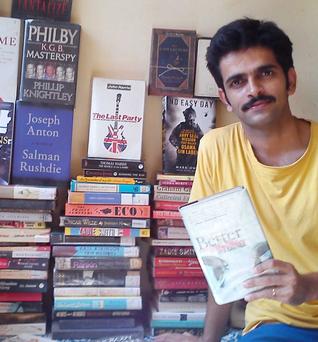
Pushpendra Pandya

Pushpendra Pandya, a resident of Vasai in Mumbai, works six days a week as a copywriter. On Sundays, though, he hires a cab and travels to different localities in the city, collecting books from those who have either no need for them, or no space to keep them.

Last month he started a crowd-sourced library, and has since built a collection of 1200 titles with help from friends and strangers. The idea for the library came to Pandya in March last year when he started a book sharing arrangement with friends.“Just like we would share notes in college after bunking class to cover up, we started swapping books. I thought it could be taken to a larger audience,” says Pandya, who calls himself an old-fashioned book lover. “In spite of being in such a crowded city, people feel lonely here. You need some company sometimes, and books have been the greatest company for me so far.

Read the rest of the story: Book this librarian | The Hindu.

Mystery of 18th century music book| This Is Guernsey


Mystery book

Full Post

Historians are trying to trace the mysterious author of an 18th century music album that has been discovered in a library archive.

The untitled, leather-bound songbook was found by an archivist sorting through a catalogue of collections in the Watt Library in Greenock, Inverclyde.

The inside cover is signed by a Hugh Cameron and dated 1709 and it also contains poems, a book list and a series of religious writings.

The music, such as A Trumpet Air and Auld Robin Gray, were not written by Cameron but copied from a book of popular Scottish music. Cameron’s book has been described as an early example of a music album – a copy of music that can be performed by the owner at their leisure.

An expert from the Royal Conservatoire of Scotland has studied the unusual find and hopes to find out more about the person who wrote it.

Karen McAulay, music librarian at the Conservatoire, said: “A lot of the pieces in the manuscript have been copied out of one particular book.

“There was a publisher in Glasgow called Aird around that time and they published a series of books with fiddle tunes, mainly from Scotland but some from other countries as well, and when you go through this book you find that quite a lot of the tunes are from that one single volume (of the Aird book).

“These days you can quickly copy down with a photocopier or buy an album, but hundreds of years ago what you did was write your favourite tunes out and that’s exactly what this gentleman has done.”

The book is now going on display in the McLean Museum inside the library alongside other items from the archive, such as the Greenock Autograph Book which contains letters from Charles Dickens and Charles Darwin.

Library archivist Neil Dickson discovered the songbook last month when he was preparing the new display for Inverclyde Council.

He said: “The only reason it was found was because I was cataloguing the records which had previously never been catalogued before. We discovered the songbook and straight away I realised it was something special.

“It’s very unique and I always feel privileged to be doing the job I am and to make discoveries like this, because it’s essentially history that’s been untouched and it’s our job to explore and make it available, and hopefully we can find out more about the book and Hugh Cameron.”

Little else is known about the author and the library hope local people will be interested in the story.

Ms McAulay has researched Mr Cameron but has been unable to pinpoint exactly where he was from.

She said: “My guess is that he was possibly a schoolmaster. I found out that there were several Hugh Camerons who were schoolmasters at that time, one in Perthshire, and it could have been him, but I can’t be sure.

“What I can say is that he wasn’t a Church of Scotland minister because he was not in the minister listings for that time.

“The book is dated 1709 and the handwriting of the signature is very young but the handwriting of the lists of books is more mature so that would have been when the same person was a bit older. It may be something he’s added to over his life or it may be that a relative or someone else also used the book.”

The display is part of a nationwide Explore Your Archive campaign which aims to get people interested in local history.

Mr Dickson said: “Archives are very important, it’s essentially raw history.

“They’re usually the only resources we have for getting a detailed description of people’s life and society from the 17th century onwards.

“By searching through our archives in Inverclyde we’ve found some very, very special items and hopefully they can give people an insight in to the history of the area.”

via Mystery of 18th century music book | This Is Guernsey.
Books, libraries, and the changing digital landscape | Pew Research Center


How libraries are dealing with the changing technological environment, as well as the larger context of Americans’ reading and library habits, and what they expect from libraries in the future.

Gender in Tech Librarianship | Roy Tennant | The Digital Shift


One of the avenues by which this issue could be improved would be to hire more women into library tech positions in the first place. In my experience there is definitely a barrier to getting hired into these positions, or even interviewed. I was the only graduate in my cohort with a focus in information technology and it was lonely. Whenever I introduce myself to others in my field and I say I specialize in tech, I usually see the same expression, a little confused, a little flabbergasted. Its disheartening. On the flip side, patrons are hugely appreciative of someone they can connect with who can help them with computer literacy and device support.

I’m glad women in librarianship who specialize in tech have professionals in our field like Sarah Houghton and Ellyssa Kroski to, if not wave the banner for our gender, then at least illustrate definitively how intelligent, skilled and multifaceted women can be in library tech. Raising awareness is of utmost importance and this is why I’m lending my own comment to this story. 

Gender in Tech Librarianship | Roy Tennant | The Digital Shift.

Certainly I’ve written about this issue before, and I will keep writing about it until there are no more reasons to do so. But the reason why I’m writing about the issue of gender imbalance in library tech is because I was recently at the Internet Librarian Conference in Monterey, CA, where my esteemed professional colleague and completely famous Sarah Houghton, “Librarian in Black” had organized a panel on this very topic.

The panelists all gave a brief statement from their own experience and perspective (a mix of both women and men), then a microphone was carried around the room for the attendees to provide their own perspectives and stories. And the stories of harassment, put-downs, insults, marginalization, and worse, just rolled right in.

Unfortunately, I was surprised. Surprised because these were not the kind of subtle kinds of discrimination that I knew went on and that I try to prevent or alleviate. For example, packing a speaking panel with men, which happens all to often and a reason for which I have refused to participate at times. No, these stories were much more obvious, egregious, and, in some cases, breathtaking — and not in a good way.

At the end of the program I left depressed. Depressed that such things were happening on a regular basis — not yesterday, not a long time ago, but today. Depressed because since I’d never witnessed anything near what many of the stories related, I was mystified about how I could help prevent them.

But at least getting this out in the open is a start. The unfortunate thing is that those who really needed to be there most likely weren’t, nor will they ever be. So it’s up to us who were in the room, or would have been had they had the chance, to work harder to make all of our workplaces welcoming to all. Until that day arrives, we will soldier on.

At this conference we had the opportunity to have the necessary information sharing. Perhaps at the next one (and ongoing throughout the year in virtual form) we could share some strategies for making things better. That’s a program I could get behind.

News: Education & Technology, Librarianship


Education & Technology

The LA Times Trolls Innocent Teachers | TechCrunch
The once-respectable LA Times is leveraging its dwindling platform to attack individual teachers under the guise of data transparency. The editorial board won a court case allowing them to use a highly contentious, self-designed algorithm to rank the best and worst teachers in the Los Angeles Unified School District. Neither the suicide of one of the shamed teachers, nor the widespread criticism of the statistical methods have aroused the editorial board’s better judgment.

Google Earth Tour Builder lets you tell stories through maps | Engadget
Google has used Earth and Maps to tell tales of unfolding tragedies and soldiers fighting for our country. Now its opening up those tools to the public, allowing users to build what they’re calling “Tours” through Google Earth. Tour Builder was released in honor of Veterans Day and it allows users to create narratives tied to points on a map. More Google news: Google Quick Actions Let Users Act on Emails Without Opening Them | MashableYour Face and Name Will Appear in Google Ads Starting Today | Gizmodo and Apple maps: how Google lost when everyone thought it had won | theguardian

Librarianship

Community Is Key to Successful Library Maker Spaces | The Digital Shift


The most important resource for creating a successful library maker space—whether in a school or public library—is one’s own community, according to librarians Justin HoenkeAmy Koester, and Michelle Cooper. Strong relationships and community involvement, not big budgets and high-tech gadgetry, are key to reaching children and teens, the trio of makers say.

The experts shared details of their programming for kids and their top maker strategies during “The Community Joins In: Library Maker Spaces,” a midday session of The Digital Shift: Reinventing Libraries (#TDS13) webcast on October 16, moderated by Hoenke, the new teen librarian at the Chattanooga (TN) Public Library and 2013 Library Journal Mover &  Shaker. And since the event, the trio has created a Pinterest page filled with maker space advice, links, and takeaways.

Read more: Community Is Key to Successful Library Maker Spaces | The Digital Shift.

You may also like: