News: Libraries & Librarians; Education & Technology


Libraries, Librarians

Former Assistant Librarian Fired for Reporting Sex Act In Children’s Section of Town Library | KOB4

Who needs a librarian when you have Google? | Sandusky Register

Tough Report on Job Placement & Salary Information for Librarians | Galleycat

Oklahoma’s Pioneer Library System Launches 24-Hour Vending Library | The Digital Shift

Education, Technology

Academics urge peers to self-publish research | The Bookseller

ResearchGate: “Forget About Revenue Until The Network Is Valuable Enough To Command It” | TechCrunch

Coursera teams up with State Department on series of MOOC-based ‘learning hubs’ around the world | Engadget

Our sources are reliable. | Wikipedia news from The Millions

Web inventor’s open data organisation announces new global network | theguardian. US, Canada, Russia and France among 13 to sign agreements with Open Data Institute co-founded by Sir Tim Berners-Lee

Facebook Admits Teen Use May Be Declining | Mashable

Can You Use Electronic Devices On Airplanes During Takeoff and Landing? Soon, Yes! | TeleRead. Did you know Amazon ran the technical analysis of whether we have to shut down Kindles on planes | Washington Post. One more airline story: Airline Lost Your Luggage? Let Your Phone Find It | Mashable

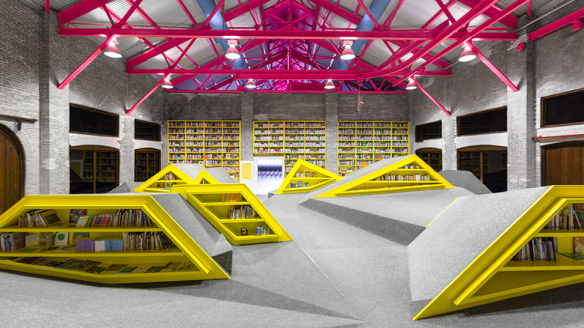
A Mountain Range of Shelves Turns This Kids’ Library Into a Playground | Gizmodo


Learning to read is a massive adventure in itself, but discovering the library—a magical place where the stories are plentiful and the books are free—is downright mind-blowing. In an effort to match the fun between the pages, the Mexican branding studio Anagrama transformed the interior of a local heritage site into Niños Conarte, a geometric mountain range of literature.

See all the pics: A Mountain Range of Shelves Turns This Kids’ Library Into a Playground | Gizmodo.

Creature Feature: The Original Frankenstein Text Is Now Readable Online | Gizmodo


Full Post

In the pantheon of classic horror, Mary Shelley’s Frankenstein ranks as one of the first, and most memorable, monster tales ever told. And while it’s easy enough to pick up a new copy of the spine-tingling 1818 narrative from pretty much any bookstore, it’s now possible to pore over the original, hand-penned manuscript online.

New York Public Library teamed up with the University of Maryland’s Institute for Technology in the Humanities to digitize Shelley’s two surviving notebooks containing most of the work—complete with edits by Percy Bysshe Shelley, her poet husband. Making this almost 200-year-old text click-accessible for a modern audience is only the first step for the Shelley-Godwin Archive, which hopes to digitize the entire oeuvre of the ultra-writerly family of Percy, Mary, and her parents, William Godwin and Mary Wollstonecraft.

There’s a pretty extensive how-to on the best ways to navigate the site, which fittingly launched this All Hallows Eve and is currently in beta mode. Have a look around at what genius looked like in the most truly terrifying time of them all: pre-word processing. [New York Times ArtsBeat]

Frankenstein
Image: Shelley, M. (1817). “Frankenstein—Draft Notebook B,”
in The Shelley-Godwin Archive, c. 57, fol. 29v.

via Creature Feature: The Original Frankenstein Text Is Now Readable Online | Gizmodo.

Recent Pew Research Links


Broadband Adoption: The Next Mile | Statement of Aaron Smith (Senior Researcher, Pew Research) | Pew Internet

The New Library Patron from Pew Research Center’s Internet & American Life Project
Lee Rainie, Director of the Pew Research Center’s Internet & American Life Project, will discuss the Project’s new research about library patrons and non-patrons: who they are, what their information needs are, what kind of technology they use, and how libraries can meet the varying needs of their patrons.

Photo and Video Sharing Grow Online | Pew Internet
A new study by the Pew Research Center’s Internet Project shows that 54% of internet users have posted original photos or videos to websites and 47% share photos or videos they found elsewhere online. Also: AFP: Smart phones boost photo, video sharing: study and from TIME: One Stat that Explains Why Instagram Is Adding Ads.

Tablet and E-reader Ownership Update | Pew Internet
The number of Americans ages 16 and older who own tablet computers has grown to 35%, and the share who have e-reading devices like Kindles and Nooks has grown to 24%. Overall, the number of people who have a tablet or an e-book reader among those 16 and older now stands at 43%.

1 in 7 Americans is offline. Why? It’s complicated | Kathryn Zickuhr, Pew Research | CNBC

Pew Data on News Consumption: Millennials Lead the Shift to Web Use | ContentBlogger

Mobile Health in Context: How Information is Woven Into Our Lives from Pew Research Center’s Internet & American Life Project

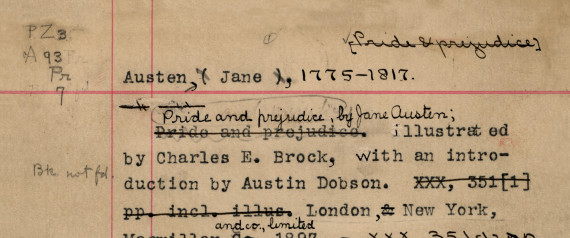
Library Catalog Cards For Classic Books | HuffPost Books


For many of us, a trip to the library these days involves an efficient search on the branch’s site, a hold placed on a hot new release, and a quick pop-in to collect our spoils.

It’s great that so many libraries have gone digital — and some have even gone bookless— because to remain open, remaining relevant is key. Still, it’s hard not to pine for the more quixotic days of dusty shelves and hand-written library catalog cards.

For those of us who romanticize a more tactile library experience, Chronicle Books has created stationary from images of The Library of Congress’s original cards for a number of classic authors. The text of each card interestingly matches the mood often evoked when imagining the author’s era.

See all: Library Catalog Cards For Classic Books (IMAGES) | HuffPost Books

30 Notecards from the Library of Congress | Chronicle Books

Jane Austen

The Internet Archive Opens Its Historical Software Collection To All | Gizmodo, Internet Archive


Full Post

Gamers of a certain age will no doubt scream Oh wow, I remember that! as they click through the Internet Archive’s latest project.

The non-profit organization recently launched the Historical Software Collection, with the mission of making old programs accessible (including plenty of games!) that were originally released for platforms like Atari 2600, Apple II, and Commodore 64.

Software itself isn’t new to the Archive, but it’s spent the past couple of years making these programs playable in-browser. So whether it’s E.T. on Atari 2600 from 1982 or VisiCalc on the Apple II from 1979, there’s no need to download a heap of emulators to try them out.

Archiving video games can present special challenges, as David Gibson at the Library of Congress has explained so well. But the independent Internet Archive claims to have the largest software archive in the world, and it should be interesting to see how the next few years work out for them.

Perhaps one of the greatest challenges they’ll face is copyright. Technically, all of these programs are still covered under copyright law. And I have no doubt that the myriad companies responsible for managing the rights to something like E.T. are figuring out if they should intervene. Hopefully, no one will try to pull these programs. But if they do, it will be just one more example of how desperately broken our current copyright system is. [Internet Archive]

The Internet Archive Opens Its Historical Software Collection To All | Gizmodo

FAU Student Says He Was Denied A Laptop Because He’s Gay | HuffPost Books


Full Post

An openly gay student at Florida Atlantic University believes a campus librarian denied him the use of a laptop due to his sexuality.

Abdul Asquith attempted on Oct. 23 to check out a laptop at the Wimberly Library on the Boca Raton, Fla. campus. The laptop checkout requires valid university-issued identification, but when Asquith showed his FAU ID, the librarian refused him.

Asquith said the librarian looked at the ID and remarked, “You sound, look and act like a girl and in this ID is a man, therefore I’m not giving you a laptop.”

Asquith was “appalled,” “embarrassed” and “distraught,” he said. He was finally able to obtain a laptop after speaking with several librarians.

“Because he acts a certain way, he can’t possibly be this? It shouldn’t even be like that,” Samantha Lemessy, who witnessed the incident, told WPTV.

“People need to start speaking out and addressing this every time this happens,” Asquit added.

FAU spokesperson Lisa Metcalf confirmed in a statement to The Huffington Post Monday that the student was initially denied his request.

“The situation was quickly corrected and an FAU administrator issued an immediate in-person apology,” Metcalf said. “The University takes allegations of discrimination seriously and continues to investigate the incident.”

For FAU, a public university in Florida, it adds to a growing pile of controversies over the past year.

Another FAU employee with unpopular views, tenured professor James Tracy, claimed the Sandy Hook Elementary massacre and the Boston Marathon bombings were likely staged.

An FAU professor also began receiving threats after a student took offense to a classexercise in the spring where pupils were asked to write “Jesus” on a piece of paper and step on it. And early in 2013, the university received heated backlash after agreeing to name their stadium after a controversial for-profit prison group. One student protester said the university’s president clipped them with her car at one demonstration in March. The deal was eventually scrapped and the president resigned.

Read: FAU Student Says He Was Denied A Laptop Because He’s Gay | HuffPost Books

DPLA Awarded $1 Million Grant From Gates Foundation to Train Public Librarians | LJ INFOdocket


The Digital Public Library of America (DPLA) announced today that it has received a $990,195 grant from the Bill & Melinda Gates Foundation to build upon its network of library professionals and organizations to pilot a national-scale training system for public librarians. Under the grant, the DPLA will collaborate with its service “hubs”—regional digital library partners located in states and regions in the United States—to build curricular resources and implement hands-on training programs that develop digital skills and capacity within the staffs of public libraries.

Read: DPLA Awarded $1 Million Grant From Gates Foundation to Train Public Librarians | LJ INFOdocket.

The Globe and Mail Reports on “The University Library of the Future” | Stephen’s Lighthouse


Read: The Globe and Mail Reports on “The University Library of the Future” | Stephen’s Lighthouse.

Leaders Needed at Rural Libraries, by Natalie Binder | Letters to a Young Librarian


Leaders Needed at Rural Libraries, by Natalie Binder | Letters to a Young Librarian

Post in Full

You’ve always wanted to work in a public library. You believe in service, citizenship, and community. You value relationships; when you imagined being a librarian, you imagined participating in local government and getting to know your patrons by name. You want to make a big impact—not just in your career, but in people’s lives. You want to be a generalist, not a specialist. You want to have a great quality of life on a librarian’s salary. And when you started library school, you wanted to be a traditional, book-based, community librarian, but it seems like those jobs are either disappearing or impossible to get.
If that sounds like you, you may be a rural librarian at heart—which is great news, because rural libraries need you. These jobs rarely appear on listservs or job boards, but the “graying” of the profession is very real in rural libraries. Many rural libraries have a long-serving librarian (or staff) who will be retiring soon. And since rural libraries are often quite small, you can quickly rise to an influential leadership role and have a strong say in how these small libraries meet the challenges of the future.
I’ve worked in a rural library since before library school—four years this month—and I love my job. Every day I go to work knowing that I will make an impact on someone’s life. Every day something terrific, exciting, or funny happens at my library, and though I am not in administration, I always feel like my contributions and ideas are appreciated and valued. There are many other benefits to rural librarianship. While salaries are generally low, a dollar goes much further in rural communities than it does in urban or academic communities, and affordable housing is rarely an issue. You can probably afford to live much closer to a beach, farm, or lovely national park than you imagine. If the library is adequately staffed, working conditions are also good. Rural libraries enjoy strong community support, and small staffs often work together to ensure flex time is available for things like childcare and family events. Rural libraries are usually quite safe—while no public library is conflict-free, your patrons are more likely to bring you homegrown vegetables than complaints.
Best of all, rural libraries serve as true community centers, where far-flung and diverse groups can come together. A rural library often serves as a small town’s largest meeting room, its only Internet hotspot, the only local, affordable entertainment for adults and children, and an access point for badly needed social services. My library serves as the physical “office” for employment services, child welfare and legal aid.
Of course, no type of library is for everyone. Rural libraries are generalist libraries. As a rural librarian you will frequently be called to do things your master’s degree never prepared you for, from running a farmer’s market to repairing a child’s shoe. If you’re interested in doing something quite specialized or academic, it’s probably best to begin your job search elsewhere. If you need to be surrounded by other young academics, or enjoy a lot of social activities, then you probably won’t enjoy the quiet and isolation of a rural community. If you’re married, it can be a challenge for your spouse to find work in town.
Finally, in small towns there is little division between your personal life and your work life. Your patrons, co-workers, Friends group, Board of Directors, and government leaders are also your friends and neighbors. Sometimes it feels like you’re never off the job! For this reason, it’s very important to move slowly, get community buy-in, and be prepared to backtrack on big changes. That can be a challenge if you’re fresh out of library school and eager to change the world.
I have seen too many “new directors” leave or lose their rural jobs because of avoidable conflicts among stakeholders. It’s great to have vision and ambition, but if you’re more combative than cooperative, you’ll have a hard time achieving your goals in a small town. Even if your library seems like a mess that you were hired to fix (or “bring up to date”), plan to spend a full year or more listening and learning before you try to change the system. When you become a librarian at a rural library, you’re also joining small, stable team of prominent citizens and community leaders whose support you’ll need for years or even decades. Make those relationships a priority, and always take the long view in any conflict.
If that sounds like a challenge you’re up to, then you can begin your rural job hunt locally. No matter where you live, you’re probably not far from a small library system. Check county job boards, or see if there’s a volunteer position available. Ask if you can shadow a librarian or staff member for a day or two. These jobs are not usually widely advertised. Take your time and get to know the rural libraries and communities around you. Even if you decide to look elsewhere for a permanent job, you’ll be in for a fun, rewarding and educational experience.
Natalie Binder is a librarian at a small library in rural Florida. She is a graduate of Florida State University’s College of Communication and Information. She is also the founder and moderator of #libchat, a Twitter chat for librarians and library school students. She can be found on Twitter @nvbinder.