If We Want More Ada Lovelaces, We Need to Empower Women | Mashable


This week we celebrate Ada Lovelace, a woman from the 1800s who invented computer programming at a time when no one knew what a computer was.

While her contributions are vast, I can’t help but imagine how much she may have impacted society had she been properly educated. And then I begin to think about how important it is to recognize the movements and groups that educate and offer opportunities to women.

Read the full story: If We Want More Ada Lovelaces, We Need to Empower Women | Mashable.

Related: Wiki editing session at Brown University recognizes women in science | Brown University

Technology Adoption by Lower Income Populations | Pew Research Center


Aaron Smith, Senior Researcher at the Pew Research Center’s Internet Project, discusses the Project’s latest research about internet usage, broadband adoption, and the impact of mobile connectivity among lower-income populations.

What the World Would Look Like If Countries Were As Big As Their Online Populations | The Atlantic


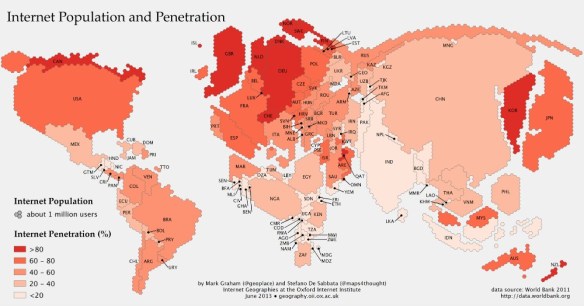
The map, created as part of the Information Geographies project at the Oxford Internet Institute, has two layers of information: the absolute size of the online population by country (rendered in geographical space) and the percent of the overall population that represents (rendered by color). Thus, Canada, with a relatively small number of people takes up little space, but is colored dark red, because more than 80 percent of people are online. China, by contrast, is huge, with more than half a billion people online, but relatively lightly shaded, since more than half the population is not online. Lightly colored countries that have large populations, such as China, India, and Indonesia, are where the Internet will grow the most in the years ahead. (The data come from the World Bank’s 2011 report, which defines Internet users as “people with access to the worldwide network.”)

Internet Population and Penetration

Read: What the World Would Look Like If Countries Were As Big As Their Online Populations | Rebecca J. Rosen | The Atlantic.

What is book bookness 2013 | l.bicknell


Although this presentation is mainly visual images it really makes you think about what books are and what they represent.

Drone’s eye view of Burning Man 2013 | YouTube


via ▶ Drone’s eye view of Burning Man 2013 – YouTube.

You may also like: What is Burning Man? | Burning Man

True-to-life short film about smartphones | The Feed Blog | CBS News


(CBS News) Ever leave home and get that eerie feeling like something is wrong? Like you’ve forgotten something so important that you rewind through every waking moment before realizing your lifeblood, your reason for living, your smartphone is sitting on the kitchen counter? Well take my advice and leave it. After watching “I Forgot My Phone,” a two-minute film about society’s addiction to these devices, written by and starring actress and comedian Charlene deGuzman, you’ll agree with me. Visit Charlene’s YouTube page or check it out above. Just don’t watch it on your phone.

This brilliant short film shows how depressingly easy it is to let our phones distract us from true enjoyment of many of life’s great experiences like birthdays, the beauty of nature, quality time spent with friends, and even marriage proposals. So next time you walk out the front door, try leaving the phone at home.

via True-to-life short film about smartphones | The Feed Blog | CBS News.

Links for Recent Pew Research News


Pew: 30% Of U.S. Adults Don’t Have Broadband; 10% Use Smartphones As Sole Internet Access; 20% Have Zilch | TechCrunch – August 26, 2013
Pew Research…releas[ed] the results of a survey that shows how one of the more advanced countries in the world, the U.S., is still not quite there in leading by example: 20% of U.S. adults are still without broadband or smartphones for internet access. And 3% of people in the country still using dial-up connections.

The below link is related the same Pew research results as the article above but provides discussion on a different perspective – the digital divide in America.  See the original Home Broadband 2013 Pew report – August 26, 2013.

Latest Pew Study Shows 70 Percent of U.S. Has Broadband. But Access Is Still Unequal | Wired.com – August 26, 2013
Pew’s results demonstrate that the digital divide is persistent, with close correlations between socioeconomic status and home Internet access. The report is also a reminder that policymakers use the words “high-speed broadband” to include everything other than dialup access, which is far too broad a definition.

Adult Trend Data | Pew Internet 
Latest data about device ownership by American adults up to end-May 2013.

Pew Study: More millennials are living with their parents than ever before | Stephen’s Lighthouse | August 22, 2013
According to a Pew poll, 36 percent of young adults are afflicted with Failure to Launch syndrome.

Teens say they generally rely on themselves to figure out how to manage their privacy online | Stephen’s Lighthouse – August 22, 2013
Teens say they generally rely on themselves to figure out how to manage their privacy online; Still, 70% of teens have at one time sought advice about how to manage their privacy online. See the Pew Internet report from August 15, 2013.

Teens and Mobile Apps Privacy | Pew Internet – August 22, 2013
As teens gain access to mobile devices, they have embraced app downloading. But many teen apps users have taken steps to uninstall or avoid apps over concern about their privacy. Location information is considered especially sensitive to teen girls, as a majority of them have disabled location tracking features on cell phones and in apps because they are worried about others’ access to that information.

Teens Haven’t Abandoned Facebook (Yet) | Pew Internet – August 15, 2013
When we released our “Teens, Social Media and Privacy” report in May, one thread of news coverage focused on teens’ “waning enthusiasm” for Facebook. This theme surfaced during our focus group discussions with teens and stood in contrast to the excitement that was associated with newer platforms like Instagram and Twitter.

New IFLA Global Trends Report | American Libraries Magazine


It’s designed to assess “the impact of new technology on our global information environment,” said IFLA President Ingrid Parent, introducing the new IFLA Trend Report August 19[, 2013] during the World Library and Information Congress in Singapore.

Commissioned in 2012 and involving social scientists, economists, business leaders, educators, legal experts, and technologists, Riding the Waves or Caught in the Tide? examines “high-level societal trends,” challenging library professionals to be aware that:

  • (1) new technology will both expand and limit who has access to information,
  • (2) online education will transform and disrupt traditional learning,
  • (3) boundaries of data protection and privacy will be redefined,
  • (4) hyper-connected societies will listen to and empower new groups, and
  • (5) the global information economy will be transformed by new technologies.

via New Report Portends Global Societal Trends, as IFLA Continues in Singapore | American Libraries Magazine.

New Report Portends Global Societal Trends, as IFLA Continues in Singapore | American Libraries Magazine