An All-in-One Guide to the Maker Culture and 3D Printing | Ellyssa Kroski | OEDB.org


The maker culture is a thriving movement amongst all types of people who want to create and design their own objects, crafts, or computer code.  This DIY community is using state-of-the-art technology such as 3D printers to design and craft their own 3D objects.  This introductory guide will give you an overview of today’s maker movement, resources for getting started, 3D printer reviews, links to actual project designs and instructions, maker publications, events, and directories, videos about 3D printing and maker culture, and an article list of resources about libraries and makerspaces.

Resources categorized into the following sections:

  • What is the Maker Movement?
  • Getting Started Guides
  • 3D Printers
  • 3D Projects
  • Maker Events
  • Makerspaces Directories
  • Maker Videos
  • Libraries and Makerspaces Resource List

Read: An All-in-One Guide to the Maker Culture and 3D Printing | Ellyssa Kroski | OEDB.org.

Book News Links: AZ Banned Books Objection, Fans Diss Veronica Roth’s Allegiant, Myers-Briggs Book Recommendations, 28% Americans Have Not Read in the Past Year


Arizona Education Dept. Liked It Better When These Books Were Banned | HuffPost
The Arizona Education Department is objecting to the Tucson school board’s decision to rescind a classroom ban on seven books once used to teach a controversial Mexican American Studies course.

Hell Hath No Fury Like a Superfan Scorned | BookRiot
The hype for Veronica Roth’s Allegiant (published October 22, 2013) has been huge. When it released, it immediately became the #1 selling book in Amazon’s Kindle store, outselling the final book of the Hunger Games trilogy nearly 5 to 1 . To me, the really fascinating data is the initial customer review response to the book. At the time of this writing (the day after the release), the book had 278 customer reviews, with 138 reviews being one-star reviews, and another 33 reviews ranked as two-star reviews. Drama, drama.

Here Is The One Perfect Book For Every Single Myers-Briggs Type | HuffPost
Recommending books is a tricky business. One person’s trashy romance novel is another person’s treasure. Of course, a little background on a person’s reading preferences can come in handy, but sometimes deciphering tastes can seem like an arbitrary and headache-inducing task. Still, we’re willing to bet that like-minded people enjoy similar stories — That’s where Myers-Briggs comes in.

POLL: 28 Percent Of Americans Have Not Read A Book In The Past Year | HuffPost
According to a HuffPost/YouGov poll asking 1,000 U.S. adults about their reading habits, 41 percent of respondents had not read a fiction book in the past year; 42 percent had not read a nonfiction book.

50 Powerful Statistics About Tech Mega Trends Affecting Every Business | Vala Afshar


There are five mega trends impacting the IT departments of every company: Mobile, Social, Cloud, Apps and Big Data. In this presentation, Vala Afshar reveals ten startling stats for each mega trend.

10 Lessons For Design-Driven Success | Co.Design


At the forefront of the economy, good design is a priority. Here’s how to embrace the next wave of innovation.

The 10 lessons discussed:

  1. Design starts at the top.
  2. The Apple myth is powerful–and incomplete.
  3. Today’s disaster is tomorrow’s triumph.
  4. One size does not fit all.
  5. Yes, Virginia, penny-wise is pound-foolish.
  6. Design hunger is real.
  7. There’s something new under the sun.
  8. A well-designed product does not equal a well-designed business.
  9. The big picture is a mass of details.
  10. It is still day one.

Read: 10 Lessons For Design-Driven Success | Co.Design | business + design.

The Benefits of Negative Feedback | John Butman | Harvard Business Review


Article in Full 

I recently gave a lunchtime “author’s talk” at Children’s Hospital in Boston and, although I thought the talk went well, somebody in the audience didn’t like it at all. On the evaluation form, the person in question wrote a single word in the comment box: CONFUSING.

Thank you, whoever you are. While everybody else gave me good marks and said nice things, which I appreciated, my critic forced me into self-examination. Was he the only one forthright enough to speak up, or was he the only one not paying enough attention to get it? What was confusing? The ideas? The presentation?

This all got me thinking about feedback. Whenever you go public with an idea — in a book, a talk, a presentation, a video, a graphic — you will inevitably get many kinds of responses. This feedback generally falls into one of three categories: praise, silence, and backlash.

Praise seems quite easy to handle — we all love to be praised, especially when the praise is nonspecific, such as “fascinating!” Go ahead and bask in the praise: It is a reward for your work and a motivation to push forward. But such praise is not necessarily valuable feedback. In order to make use of this praise, you must probe it deeper: What, exactly, was fascinating?

Silence can be difficult to interpret. A few years ago, during a 90-day interim as blogger-in-residence forBzzAgent, a start-up social media marketing firm, I wrote a daily blog about company issues and stories. Some of these posts received zero comments. I assumed my readers were indifferent, disengaged, or actively did not like these particular bits of writing. But, in face-to-face discussions with my audience (there I was, surrounded by them), I discovered that often Internet silence corresponded to deep thinking and reflection done off-line. So, as with praise, the value of silence may require mining: Did I leave you speechless? Or did you just not care?

An idea that advocates any kind of change is likely to receive some amount of negative response. When you’ve invested time, energy, and passion into your idea, this rejection can hurt. Your first impulse may be to lash back, to rebut the rebuttal. But a better response is to let the backlash unfold a bit: It is likely that negative feedback will be the most useful in further developing your idea.

Backlash takes many forms and is unleashed for many reasons, so it’s important to first understand the nature of the criticism, as well as its source. A thoughtful review from a credible source is not the same as a mean-spirited comment online from an anonymous Internet troll. (The latter of which you can ignore.)

If, as with praise and silence, you take a moment (or a night’s sleep) to reflect on the backlash — what kind is it? why is it happening? — you may realize that backlash has its own unique advantages:

  1. It deepens the appreciation of advocates. In light of a contrary opinion, those who initially said your idea was simply “fantastic” may be forced to think about it more deeply, and respond with more detail. I thought X was fantastic, but in light of these comments, I had to reconsider and found that XX… Additionally, backlash can cause those who were silent at first to speak up as advocates of the idea. Only when an idea is challenged, and especially when it is attacked, do people realize just how much they care about it.
  2. It creates new contexts for the idea. Consider backlash against Michael Pollan, the best-selling food expert, whose books include The Omnivore’s Dilemma and, most recently, Cooked. Adam Merberg, in the Berkeley Science Review, suggests Pollan misrepresents and even vilifies science. Tyler Cowen, in Slate, writes that Pollan “neglects the macro perspective of the economist.” And Emily Matchar argues against Pollan’s historic view of women’s role in cooking in her Salon.com article, “Is Michael Pollan a Sexist Pig?” Did Pollan think his ideas through from the point of view of science, economics, and feminism? Maybe, maybe not, but thanks to the backlash he received, the debate about the value of home cooking now embraces those topics. Negative feedback from disparate domains empowers you to articulate your idea more clearly — to incorporate, avoid, or merge it with other areas of thought.
  3. It improves the quality of the argument. Recently in The New Yorker, Adam Gopnik explains how brain science has become an explanation for just about everything (why we eat what we eat, say what we say, etc.), and how people are beginning to push back against it. This backlash may be a case of idea fatigue: People are merely tired of hearing about the brain, to a point of heated annoyance.

Discussion, debate, and positive­­­-negative tussling serve to put an idea through a public testing that makes it stronger and better or, sometimes, rejects it. As the one who has brought the idea forward, it brings you into the conversation in a new way, giving you more license to speak further, create new expressions of your idea, and seek to influence outcomes you care about.

It is no small feat to stimulate genuine conversation about any idea, and to generate criticism, rebuttal, debate — and even attack — suggests that you have touched a nerve, surfaced a tension, or put your finger on an issue that needs discussing.

While the particular comments matter, what matters more is how you use the feedback to gather advocates, interpret your idea in new contexts, and improve its quality for your now broader audience.

So, to the person at the Children’s Hospital talk, please be in touch with a bit more detail. I don’t mind being called confusing, but I need to know exactly how and where and why you think that.

via The Benefits of Negative Feedback | John Butman | Harvard Business Review

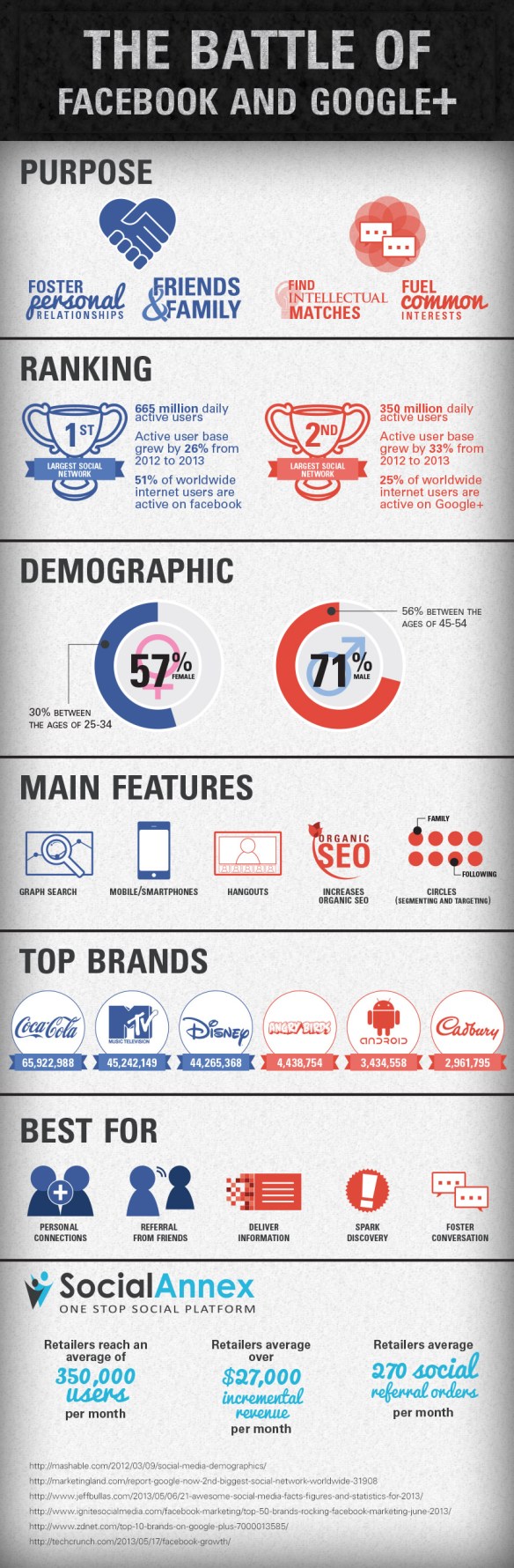
The Battle of Facebook and Google+ [Infographic] | Social Annex

Image


The Battle of Facebook and Google+

Why Kids Need to Tinker to Learn | MindShift


The Maker Movement has inspired progressive educators to bring more hands-on learning and tinkering into classrooms, and educator Gary Stager would like to see formal schooling be influenced by the Maker Movement, which has inspired young learners to tinker, to learn by doing, and take agency for their learning.

Read: Why Kids Need to Tinker to Learn | MindShift.

How Amazon and Goodreads could lose their best readers | Salon.com

Aside


The original post is lengthy but worth the read, as it includes some discussion about censorship and creative user protest on the GoodReads platform.

With 20 million members (a number some have noted is close to the population of Australia) and a reputation as a place where readers meet to trade information and share their excitement about books, the social networking site Goodreads has always appeared to be one of the more idyllic corners of the Internet. The site sold to Amazon for an estimated $190 million this spring, and Goodreads recommendations and data have been integrated into the new Kindle Paperwhite devices, introducing a whole new group of readers to the bookish community.

But if, at a casual glance, the two companies — Goodreads and Amazon — seem to be made for each other, look again. A small but growing faction of longtime, deeply involved Goodreads members are up in arms about recent changes to the site’s enforcement of its policies on what members are permitted to say when reviewing books, and many of them blame the crackdown on the Amazon deal. They’ve staged a protest of sorts, albeit one that’s happening mostly out of the public eye. Their charge is censorship and their accusation is, in the words of one rebel, that Goodreads and Amazon want “to kill the vibrant, creative community that was once here, and replace it with a canned community of automaton book cheerleaders.”

Read the rest of the story: How Amazon and Goodreads could lose their best readers | Salon.com

Apple releases OS X Mavericks for free | CNET News


Mac users can have Apple’s latest Mac operating system, OS X Mavericks, for free, the company announced Tuesday at an event in San Francisco.

“Today we’re going to revolutionize pricing,” Craig Federighi, Apple’s chief of iOS and OS X, said. The software is available today.

Apple introduced the system in June at its developers’ conference. The company touted its extended battery life, tabs, and tags, while demonstrating new features in Safari, Maps, and iBooks.

Federighi reiterated the new features at Tuesday’s event. A 13-inch MacBook Air with Mavericks gets up to an hour more of Web browsing and up to 1.5 hours more iTunes movie playback, he said.

He also explained how the system adjusts its memory based on the task. This allows for optimal quality when you’re running a graphics-heavy program — and speed when you’re not. He also highlighted the iBook app, in which photos and videos can pop out of a textbook, and an iCloud keychain, which syncs payment information for online purchases.

CNET’s Jason Parker said in June that the OS is faster and easier to use, and apps have a cleaner look.

via Apple releases OS X Mavericks for free | CNET News.

An “All You Can Eat” College Degree Could Be The Future Of Higher Education | Co.Exist


Wisconsin’s public university system will start granting some degrees based on testing instead of credits, and letting you use as much of the school as you want for a flat fee. Schools around the country are watching.

Read: An “All You Can Eat” College Degree Could Be The Future Of Higher Education | Co.Exist | ideas + impact.