
“Food deserts” refer to low-income areas where convenience stores are often the only viable food source and fresh produce is a rarity. But nutritious foods aren’t the only thing kids need to thrive and grow. Many of these undernourished kids also live in so-called “book deserts”—areas without easy access to libraries and reading material to nurture their imaginations and development (just think of the 12-year-old boy in Utah who asked his mailman for junk mail to read because he couldn’t get to a library). To combat these problems, creative-thinking librarians and literacy supporters are using inventive solutions to expand access to books and promote a love of reading. READ MORE: Librarians on Bikes Are Delivering Books and WiFi to Kids in “Book Deserts” | GOOD
Author Archives: infophile
Assistive Technology and Implantable Wearables | #assistivetech #implantables #wearables #health #disabilities #tech
Many of us increasingly experiencing technology overload from all the devices, gadgets, products and tools at our fingertips. For individuals with disabilities though, technological advancements are providing opportunities to improve quality of life through innovations in assistive technology. Implantable wearables are also improving quality of life through the ability to seamlessly interact with our environments using devices such as magnets and sensors embedded under the skin. Below is a collection of select stories from around the web about recent advancements in assistive technologies and implantable devices.
Assistive Technology
- How wearable technology is changing the lives of disabled people | Globe & Mail
- 3D-printed robotic prosthetic wins 2015 UK James Dyson Award | CNET
- Boy, nine, fitted with first prosthetic hand that can change grip with gestures | The Guardian
- Watch A Girl Named Isabella Unpack A New 3-D Printed Arm | TechCrunch
- A Lego-Friendly Prosthetic Arm Lets #Kids Build Their Own Attachments | Gizmodo #Lego #disabilities
- A bionic hand in five days: how tech innovation is changing lives | The Guardian
- Amplifying the Power of the Elderly with 3D Printed Assistive Technologies | 3DPrint
- This device transforms any bicycle into a smartphone-powered smart vehicle | Mashable
- I’m a legally blind photographer. Here’s how modern technology makes that possible. | Vox
- Digital pens help spot early signs of brain conditions | Engadget
- Being colorblind is tougher than you think. This tech colors my world | CNET
- The Coming Wave of Bionic Hearing Gadgets | MIT Technology Review
- Can technology make a hearing-centric world more accessible? | The Verge
- Blind Americans can now ‘see’ with a device that uses their tongues | Mashable
- Tongue-controlled wheelchairs could be boon for quadriplegics | Tech Times
- Color-changing helmets could warn you about head injuries | Engadget
- Hacking for those with disabilities | MIT News
- New Stretchy Electronics Will Help Us Stay Healthy And Safe | TechCrunch
- ‘Brain-to-Text’ system converts speech brainwave patterns to text | KurzweilAI
- Disabled people remotely pilot robot in another country with their thoughts | KurzweilAI
- The #Software Stephen Hawking Uses to Talk to the World is now #Free | Engadget #communication #disabilities #tech
- BBC Experiment Lets You Control iPlayer With Your Mind | Engadget #gadgets #disabilities #tech
- #AugmentedReality #AR Goggles Aim to Help Legally Blind See | MIT Technology Review #tech #gadgets #disabilities @TechReview
- New Tablet Case Recognizes Sign Language and Translates It Into Text | WIRED
- 10 Ingenious Inventions for People With Disabilities | Mashable
Implantables
- This Woman Doesn’t Wear Wearables. She Implants Them | WIRED
- From The Designers Of Fitbit, A Digital Tattoo Implanted Under Your Skin | FastCompany
- Injectable Implants Could Help Crack the Brain’s Codes | MIT Technology Review
- Woman Puts Deus Ex On Computer Chip In Her Hand | Kotaku
- Top 10 Implantable Wearables Soon To Be In Your Body | WT Vox
- Top Five Implantable Wearables | Technowize
- Implantable Microchips are the Ultimate Wearable | CE.org
Apps
- 3 lessons from developers who have embraced assistive technology | Mashable
- Be My Eyes Lets You Help A Visually-Impaired Person See Via Their Phone’s Video Camera | TechCrunch
- Google’s new handwriting app wants you to scribble on-screen | CNET
Related
Making Sense of #Data Course | Google #courses #free
Do you work with surveys, demographic information, evaluation data, test scores or observation data? What questions are you looking to answer, and what story are you trying to tell with your data?
This self-paced, online course is intended for anyone who wants to learn more about how to structure, visualize, and manipulate data. This includes students, educators, researchers, journalists, and small business owners.
Prerequisites: Course completion requires an internet-enabled desktop or laptop computer. Course participation requires a Google account. Knowledge of statistics is not required. Basic familiarity with spreadsheets and comfort using a web browser is recommended. Knowledge of statistics and experience with programming are not required. THE COURSE: Making Sense of Data | Google
Freshmen Skipping ‘Fun Home’ for Moral Reasons | The Chronicle #books #diversity #censorship #intellectualfreedom #religion
For some members of the Class of 2019, the choice of “Fun Home” as a summer reading book was anything but fun. Several incoming freshmen decided not to read “Fun Home” because its sexual images and themes conflicted with their personal and religious beliefs. Freshman Brian Grasso posted in the Class of 2019 Facebook page July 26 that he would not read the book “because of the graphic visual depictions of sexuality,” igniting conversation among students. The graphic novel, written by Alison Bechdel, chronicles her relationship with her father and her issues with sexual identity. READ MORE: Freshmen skipping ‘Fun Home’ for moral reasons | The Chronicle.
The 3-D Printed Violin That Could Lead to a New Stradivarius | WIRED #music #3Dprinting #violins
This video of Laurent Bernadac, an engineer and lifelong musician, playing the violin looks and sounds very little like a person playing the violin. For one thing, he’s also using a looper and effects pedals to jam out something funkier and jazzier than you’d expect from an instrument more commonly associated with classical and country. But, more ostensibly, Bernadac is playing something that looks more like an avian skeleton than a stringed instrument. It’s like the ghost of a violin.
It’s a 3Dvarius, a 3-D printed electric violin. It’s based on the renowned Stradivarius violins crafted by the Stradivari family in the late 1600s and early 1700s, but you’d have a hard time sleuthing out the shared DNA between the two machines. It is, as Bernadac says, “a new kind of musical instrument,” one with an algorithmically optimized weight and a digital sound. READ MORE: The 3-D Printed Violin That Could Lead to a New Stradivarius | WIRED.
‘Trashy’ #Books: Garbage Collector Rescues #Reading Material for Colombian #Children | Times Colonist #kids
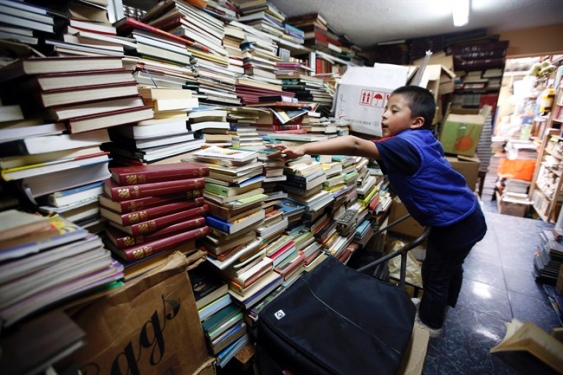
A second-grade education has not stopped garbage collector Jose Gutierrez from bringing the gift of reading to thousands of Colombian children. Gutierrez started rescuing books from the trash almost 20 years ago, when he was driving a garbage truck at night through the capital’s wealthier neighbourhoods. The discarded reading material slowly piled up, and now the ground floor of his small house is a makeshift community library stacked from floor to ceiling with some 20,000 books, ranging from chemistry textbooks to children’s classics. READ MORE: ‘Trashy’ books: garbage collector rescues reading material for Colombian children | Times Colonist.
#Japanese #Bookseller Buys Almost Every Copy Of New #Murakami Book To Protest @Amazon | HuffPost #books #authors
A Japanese bookseller is fighting back against online retail giants like Amazon by buying up a staggering 90 percent of the first printing of a famous Japanese author’s new collection of essays. READ MORE: Japanese Bookseller Buys Almost Every Copy Of New Murakami Book To Protest Amazon | Huffington Post
Where Are The #Women In #Tech? #Coding Bootcamps | Fast Company #diversity #STEM
Only 29% of all employees across the most influential U.S. technology companies—Google, Facebook, Twitter, Microsoft, Apple, Amazon, and Intel—are women. But that includes salespeople, service workers, and communications professionals. Companies that break out gender ratio by role report an an even more drastic disparity. At Twitter, 10% of technical workers are women. At Facebook, it’s 16%.
Computer science programs across the country report a similar dearth of women. As of 2012, the last year for which the National Science Foundation has published data, only about 18% of degrees in the field were obtained by women, the lowest percentage of any STEM discipline. But there is one corner of this pale, male landscape that has less of a gender imbalance than others: coding schools. READ MORE: Where Are The Women In Tech? Coding Bootcamps | Fast Company | Business + Innovation.
Are #Tablets Harming Our Children’s Ability to Read? | Technology | The Guardian #reading #kids #tech #devices
The last few years have seen the biggest change in how young people spend their time since the invention of the television – but is it a good thing? READ MORE: Are tablet computers harming our children’s ability to read? | Technology | The Guardian.
Who Won #ScienceFiction Hugo #Awards, and Why It Matters | WIRED #diversity #books #SciFi
SINCE 1953, TO be nominated for a Hugo Award, among the highest honors in science fiction and fantasy writing, has been a dream come true for authors who love time travel, extraterrestrials and tales of the imagined future. Past winners of the rocket-shaped trophy—nominated and voted on by fans—include people like Isaac Asimov, Arthur C. Clarke, Harlan Ellison, Philip K. Dick, and Robert A. Heinlein. In other words: the Gods of the genre.
But in recent years, as sci-fi has expanded to include storytellers who are women, gays and lesbians, and people of color, the Hugos have changed, too. At the presentation each August, the Gods with the rockets in their hands have been joined by Goddesses and those of other ethnicities and genders and sexual orientations, many of whom want to tell stories about more than just spaceships. READ MORE: Who Won Science Fiction’s Hugo Awards, and Why It Matters | WIRED.
 infophile