
Free e-book: Hanging Out, Messing Around, Geeking Out| Tame The Web


Free e-book: Hanging Out, Messing Around, Geeking Out | Tame The Web

Full title: Hanging Out, Messing Around, Geeking Out: Kids Living and Learning New Media.

From the series forward: This book series is founded upon the working hypothesis that those immersed in new digital tools and networks are engaged in an unprecedented exploration of language, games, social interaction, problem solving, and self-directed activity that leads to diverse forms of learning. These diverse forms of learning are reflected in expressions of identity, how individuals express independence and creativity, and in their ability to learn, exercise judgment, and think systematically.

Direct link to the pdf here.
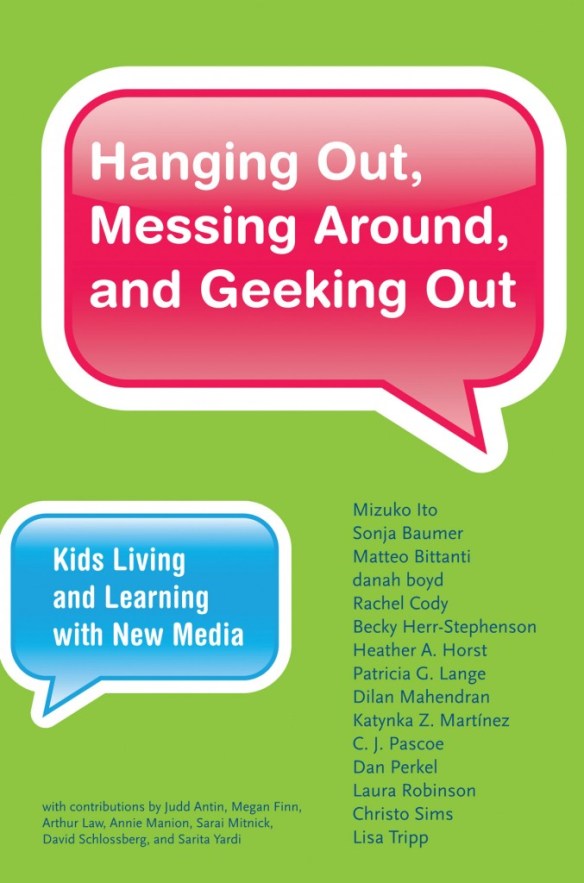
Hanging Out, Messing Around, Geeking Out

The Science Behind How We Learn New Skills | LifeHacker


Learning new skills is one of the best ways to make yourself both marketable and happy, but actually doing so isn’t as easy as it sounds. The science behind how we learn is the foundation for teaching yourself new skills. Here’s what we know about learning a new skill.

See the full article: The Science Behind How We Learn New Skills | LifeHacker.

Five [Six] Free Online Tools to Learn Another Language | Gizmodo


Five [Six] Free Online Tools to Learn Another Language | Gizmodo

  1. LiveMocha
  2. FSI Language Courses
  3. Duolingo
  4. Internet Polyglot
  5. Lang-8

See also: LaMP Teaches You a Foreign Language via Movie and YouTube Subtitles | LifeHacker. LaMP can be installed on Windows computers or accessed online.

Recent Pew Research Center Studies


Pew Study: Technology Aids Students’ Writing Skills Though Challenges Remain | The Digital Shift
Digital technologies are impacting American middle and high school students’ writing in many ways, both good and bad, a new national report from the Pew Research Center shows.

Internet adoption becomes nearly universal among some groups, but others lag behind | Pew Research Center
New data from the latest survey by the Pew Research Center’s Internet Project in the spring shows that 85% of Americans adults use the internet at least occasionally.  Five years ago, in an April 2008 survey, 73% of adults used the internet.  Ten years ago, in May 2003, 63% of adults used the internet.

Personal. Portable. Participatory. Pervasive. from Pew Research Center’s Internet & American Life Project

How Teachers Are Using Technology at Home and in Their Classrooms | Pew Internet
A survey of teachers who instruct American middle and secondary school students finds that digital technologies have become central to their teaching and professionalization. At the same time, the internet, mobile phones, and social media have brought new challenges to teachers, and they report striking differences in access to the latest digital technologies between lower and higher income students and school districts.

Taking Embedded Librarianship To the Next Level | ALA TechSource


Taking Embedded Librarianship To the Next Level | ALA TechSource

A Computer To Teach You Not To Act Like A Computer | Co.Exist


Technology enthusiasts who spend their days playing with computers and robots often have the amount of social graces of the machines they’re programming. So it’s either a brilliant or incredibly off-base intervention that an MIT graduate student has designed computer software to attempt to teach the socially-maladjusted how to be more sociable, via a Siri-like virtual conversation coach.

The program, called My Automated Conversation Coach (MACH), “uses a computer-generated onscreen face, along with facial, speech, and behavior analysis and synthesis software, to simulate face-to-face conversations,” according to a press release. “It then provides users with feedback on their interactions,” for example, how good was their eye contact, which words did they emphasize, how did their voice rise and fall.

via A Computer To Teach You Not To Act Like A Computer | Co.Exist: World changing ideas and innovation.

Coursera under fire in MOOCs licensing row | The Conversation


A prominent member of the open education movement, former Open University Vice-Chancellor Sir John Daniel, has criticised online education provider Coursera for not making its materials available under creative commons licensing.

Coursera is one of the largest providers of MOOCs – Massive Open Online Courses – which allow students to take university courses for free online from anywhere in the world.

Quotable

“While MOOCs have open enrolment, many of the MOOCs offered through commercial partners do not have open licences,” he said.

“It would be a pity if MOOCs were to act as a brake on the open education movement.”

via Coursera under fire in MOOCs licensing row | The Conversation.

See also: Coursera partners with 10 universities for online classes | CNET

Joyce Valenza’s Picks from the Top 25 Websites for Teaching and Learning | The Digital Shift


Teacher librarian Joyce Valenza reflects on the 2013 Best Websites for Teaching & Learning, the highly anticipated list chosen annually by the American Association of School Librarians (AASL).

See the complete post: Joyce Valenza’s Picks from the Top 25 Websites for Teaching and Learning | The Digital Shift.

Ladies Learning to Code (Calgary Edition) – Intro to JavaScript


There is another Ladies Learning to Code event in Calgary. This one is an Introduction to JavaScript. The event costs $54.49, which I think is very reasonable. Register here. The event space is in Hillhurst, an area affected by the #yycflood. As invites were sent yesterday, I’m assuming the location is not damaged.

Ladies Learning to Code (Calgary Edition)

UPDATED: Canadian Province Cracks Down On Coding Schools – ReadWrite


UPDATED: Canadian Coding Camp Bitmaker Labs Is Back In Business | ReadWrite

Learn-to-code programs go up against the status-quo education system. Now at least one code school has learned that it might also be going up against the law.

See the full article: Canadian Province Cracks Down On Coding Schools – ReadWrite.

See also: Canadian Hacker School Goes Dark After Government Probe | WIRED