Google To Launch Play Textbooks In August, Partners With 5 Major Publishing Houses | TechCrunch


Google To Launch Play Textbooks In August, Partners With 5 Major Publishing Houses | TechCrunch

The company has partnered with five major textbook publishers to launch this service. These partners are Pearson, Wiley, Macmillian Higher Education, McGraw-Hill and Cengage Learning. Google says it will have a “comprehensive selection” of textbooks from these publishers in the store that will cover subjects like law, math and accounting, but it did not announce exact numbers.

15 Cool Ways Libraries Can Use Vine to Create Social Videos – OEDB.org


Vine is a new social video application that will let you create and share short and sweet 6-second videos that loop.  This exciting free app is available for both iOS and Android devices.  And libraries have already begun adopting this popular new format.  If you’re wondering what can be accomplished in a 6-second video, here are some ideas for ways libraries can use Vine videos…15 Cool Ways Libraries Can Use Vine to Create Social Videos – OEDB.org.

Amazon vs. your public library | Fortune Tech


I’m posting this but its not really new ‘news’ for libraries.

See the full article: Amazon vs. your public library | Fortune Tech.

Could Amazon (AMZN), tech’s behemoth retailer, really be threatened by the neighborhood library — a centuries-old institution known for musty shelves, high school cram sessions, and “Shhhhhh. Quiet please?” The answer is complex. Much hinges on whether libraries and publishers can iron out differences that have limited the selection of e-books available for lending.

30 Things Librarians Love | BuzzFeed


30 Things Librarians Love | BuzzFeed.

All true!

BookVibe spies on social media to recommend reads | Crave – CNET


A new service scrapes your social network for books worth your time.

via BookVibe spies on social media to recommend reads | Crave – CNET.

BookVibe

A library is not just about books: it’s also a place for the vulnerable | Angela Clarke | Comment is free | guardian.co.uk


Read the full story at the link below. The author’s story underscores the importance of libraries not just to the average person but those with disabilities, health issues and unique needs.

A library is not just about books: it’s also a place for the vulnerable | Angela Clarke | Comment is free | guardian.co.uk.

In April 2013 the genetic condition I suffer from, Ehlers Danlos type III, rendered me immobile. Unable to type, read, watch television, or work, I quickly exhausted my dwindling freelance earnings on spoken word stories. After several weeks of intensive physiotherapy I was allowed to add a gentle stroll to my day. Bored, in pain and lonely, I headed back to the library.

When I saw the aisles full of spoken word CDs, I nearly wept. The man at the information desk assured me I could also order any specific disc I wanted. Having been trapped in my home with little human interaction, chatting with staff about the books was a balm. Embarrassingly, I had to ask how to use the electronic checking-out system. I then had to be issued with a new library card: my original, solidarity-inspired one had never been activated. Shakespeare’s words rang through my head: “O, I have ta’en Too little care of this!’ But the library and its team weren’t concerned by my absence. There was no judgment. I was always welcome.
Jonathan Zittrain: ‘Digital books are under the control of distributors rather than readers’ (Wired UK)


Digital books and other texts are increasingly coming under the control of distributors and other gatekeepers rather than readers and libraries. Though you can read a book through, say, Google Books, or on a Nook or Kindle, it’s laborious to save what you see to your computer and truly make the book your own. With cloud-based services, one “master” copy of the book is always online, but that makes it vulnerable to manipulation or even deletion.

Quotable: “To meet these challenges, libraries should be given an opportunity to escrow copies of publicly available but still all-too-controllable texts. They can compare their own banked copies with what’s currently on offer to the public, looking for changes to the integrity of texts.”

See the full article: Jonathan Zittrain: ‘Digital books are under the control of distributors rather than readers’ (Wired UK).

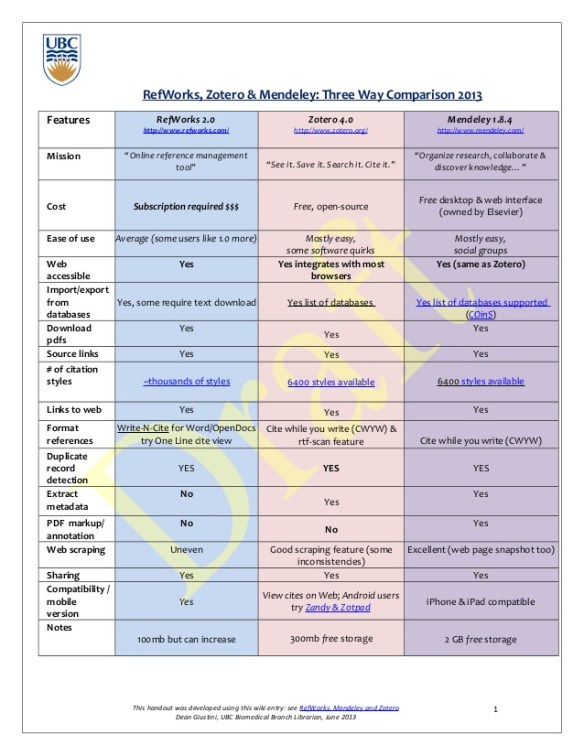
RefWorks, Zotero, Mendeley 3-Way Comparison | The Search Principle


RefWorks, Zotero, Mendeley 3-Way Comparison | The Search Principle: views are my own.

RefWorks, Zotero, Mendeley 3-Way Comparison | The Search Principle: views are my own

The MLIS [Masters Library and Information Science] Sack of Skills…07.19.13 | The Proverbial Lone Wolf


The MLIS [Masters Library and Information Science] Sack of Skills…07.19.13 | The Proverbial Lone Wolf Librarian’s Weblog

Edit Wars Reveal The 10 Most Controversial Topics on Wikipedia | MIT Technology Review


An analysis of the most highly contested articles on Wikipedia reveals the controversies that appear invariant across languages and cultures.

See the full article: Edit Wars Reveal The 10 Most Controversial Topics on Wikipedia | MIT Technology Review. The 10 most controversial topics are:

  1. George W Bush
  2. Anarchism
  3. Muhammad
  4. List of World Wrestling Entertainment, Inc. employees
  5. Global Warming
  6. Circumcision
  7. United States
  8. Jesus
  9. Race and intelligence
  10. Christianity