10 Tricks to Appear Smart in Meetings | The Cooper Review


via 10 Tricks to Appear Smart in Meetings | The Cooper Review

Emotional Intelligence: The Social Skills You Weren’t Taught in School | LifeHacker #EmotionalIntelligence


You’re taught about history, science, and math when you’re growing up. Most of us, however, aren’t taught how to identify or deal with our own emotions, or the emotions of others. These skills can be valuable, but you’ll never get them in a classroom.

Emotional intelligence is a shorthand that psychological researchers use to describe how well individuals can manage their own emotions and react to the emotions of others. People who exhibit emotional intelligence have the less obvious skills necessary to get ahead in life, such as managing conflict resolution, reading and responding to the needs of others, and keeping their own emotions from overflowing and disrupting their lives. In this guide, we’ll look at what emotional intelligence is, and how to develop your own.

READ MORE: Emotional Intelligence: The Social Skills You Weren’t Taught in School | LifeHacker

6 Articles on Creativity and Creative Thinking #creativity #brainstorm #creativethinking


Science Continues To Show Us How To Be More Creative | Will Burns | Forbes
Last year I compiled a list of scientific findings around the topic of creativity…Now, fast forward one year and I’ve discovered even more fascinating scientific studies on creativity. What we are seeing are even more tangible ways to trick ourselves into being more creative by getting ourselves – or, our reality – out of the way.

The Science Of Great Ideas–How to Train Your Creative Brain | Belle Beth Cooper | Fast Company | Business + Innovation
Creativity is a mystery right? Maybe not. Here’s a look at the science of the creative process and how to harness your brain’s power to come up with more great ideas.

How Creativity Works–And How To Harness Its Power | Leo Babauta | Fast Company | Business + Innovation
Creative ideas don’t just come out of the blue. Creativity is often a process of taking existing ideas and remixing them…Creativity is a powerful tool to help anyone, from the parent trying to find new things to inspire his kids, to the small businessperson looking for a new direction, to the writer or artist stuck or feeling uninspired. So in this post, I’ll briefly explain how creativity works (as I’ve observed it), and then share some tips on how to do it.

18 Things Highly Creative People Do Differently | Carolyn Gregoire | Huffington Post
Creativity works in mysterious and often paradoxical ways. Creative thinking is a stable, defining characteristic in some personalities, but it may also change based on situation and context. Inspiration and ideas often arise seemingly out of nowhere and then fail to show up when we most need them, and creative thinking requires complex cognition yet is completely distinct from the thinking process…While there’s no “typical” creative type, there are some tell-tale characteristics and behaviors of highly creative people. Here are 18 things they do differently.

How To Cultivate A Creative Thinking Habit | Jane Porter | Fast Company | Business + Innovation
Creativity isn’t a mythical creature to be caught and tamed. It’s a habit, studies suggest; a way of life that’s built over time.

The Weird, Wonderful Social Network That Puts Your Creativity First | Chris Gayomali | Fast Company | Business + Innovation
For artists, writers, and other creative types, few things mean as much as a blank white page. Its emptiness serves as a frightening reminder that you have yet to create anything of value. Its indifference is something that even gifted geniuses like Roger Ebert had to learn to cope with. But Zach Verdin, the CEO and cofounder of NewHive, views the blank page more optimistically. He sees it as an open-ended symbol of creative possibilities…

Also See on Infophile:
Watch What You Post on Social Media [Infographic] | Jobvite #recruiting #socialmedia


Heads up, Job Seekers: Data from our Social Recruiting Survey makes it clear that recruiters are inspecting your profiles, posts, and tweets. Are you broadcasting something that turns employers off?

Take a look at our new infographic below to learn what types of posts recruiters consider to be red flags. You’ll also see where they’re most likely to look you up, and what profile details matter most. via Jobvite Infographic: Watch What You Post on Social Media.

Monica Lewinsky: ‘Shame is an industry and the currency is clicks’ | Mashable


If anyone knows what it means to be publicly humiliated, it’s Monica Lewinsky. In one of very few major media appearances in more than a decade, Monica Lewinsky took the TED stage on Thursday to champion online compassion. In the years since arguably the biggest sex scandal of our time, Lewinsky has turned her attention to activism, namely the fight against cyberbullying and public shame.

READ MORE: Monica Lewinsky: ‘Shame is an industry and the currency is clicks’ | Mashable

Also see: Imagine walking a mile in someone else’s headline: Monica Lewinsky speaks at TED2015 | TEDBlog

The Five Types Of Mentors You Need | Fast Company


When we talk about mentorship in the workplace, we often focus on finding one person who can help to guide us through the challenges we will face at work. It might be better to think about the set of people you need to have around you to help you succeed.

With that in mind, here are a few people who should be part of your mentoring team. READ MORE: The Five Types Of Mentors You Need | Fast Company | Business + Innovation.

Emotional Intelligence Predicts Job Success: Do You Have It? | Fast Company


Daniel Goleman, the psychologist who coined the term emotional intelligence, talked to the Huffington Post about the many characteristics of emotional intelligence. Lets go over a few here, so that we can know what to train in. READ MORE: Emotional Intelligence Predicts Job Success: Do You Have It? | Fast Company | Business + Innovation.

You may also like:

Poster Sessions – A Beginner’s Guide [Originally Posted December 2013] | Hack Library School


Though June, July and August might seem like ages away, many conferences use January as their deadline for submissions from students.  So today is as good a time as any to talk about a type of submission that can seem foreign to a lot of library students- the poster session. Let’s dive in! READ MORE: Poster Sessions – A Beginner’s Guide | Hack Library School

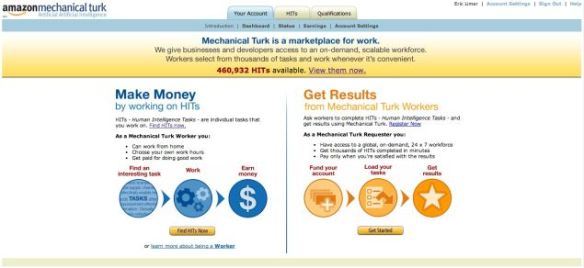
My Brief and Curious Life As a Mechanical Turk | Gizmodo


As accomplished as modern-day computers are, there are some very basic things even the smartest machines have yet to master: tough judgment calls, advanced image recognition, making goofy faces, conducting psychological surveys. These are an assortment of tasks we humans can still claim as our own. Or at least, that we can outsource to other, less fortunate humans. Like me.

In Amazons words, Mechanical Turk is “a marketplace for work that requires human intelligence.” But in reality its even simpler than that description implies: Its a job board where the pay is low and the jobs are dumb. If you have a functional cerebral cortex, an internet connection, and a few minutes to spare, you can pick up a handful of odd jobs—the oddest of jobs—and make a few bucks, pennies, and nickels at a time. But whats it like to be that “human intelligence?” As I found out last year, its weird, fascinating, perplexing, and a little depressing, all at once.

READ MORE:  My Brief and Curious Life As a Mechanical Turk | Gizmodo

How to Make Yourself Work When You Just Don’t Want To | Harvard Business Review


There’s that project you’ve left on the backburner – the one with the deadline that’s growing uncomfortably near.  And there’s the client whose phone call you really should return – the one that does nothing but complain and eat up your valuable time.  Wait, weren’t you going to try to go to the gym more often this year?

Can you imagine how much less guilt, stress, and frustration you would feel if you could somehow just make yourself do the things you don’t want to do when you are actually supposed to do them?  Not to mention how much happier and more effective you would be?

The good news and its very good news is that you can get better about not putting things off, if you use the right strategy.  Figuring out which strategy to use depends on why you are procrastinating in the first place…

READ MORE: How to Make Yourself Work When You Just Don’t Want To | HBR