Oyster Brings ‘Netflix for E-Books’ App to iPad, Opens to Public | Mashable


A little more than a month after launching an iPhone app in invitation-only beta, Oyster is making its e-book subscription service available to all users and expanding to iPad.

Oyster charges $9.95 a month for access to more than 100,000 books from big and small publishers, but it now offers users one free month with the hope of getting more people to try the app experience. The startup declined to provide data on the number of users or books read during the beta period, but noted that 1 million pages were read in the first 10 days the app was available and another million pages were read in the following six days.

Read: Oyster Brings ‘Netflix for E-Books’ App to iPad, Opens to Public | Mashable.

You may also like: Test Driving Oyster, a “Netflix for Ebooks” | The Digital Shift

How a Radical New Teaching Method Could Unleash a Generation of Geniuses | Wired.com


Snip: That’s why a new breed of educators, inspired by everything from the Internet to evolutionary psychology, neuroscience, and AI, are inventing radical new ways for children to learn, grow, and thrive. To them, knowledge isn’t a commodity that’s delivered from teacher to student but something that emerges from the students’ own curiosity-fueled exploration. Teachers provide prompts, not answers, and then they step aside so students can teach themselves and one another. They are creating ways for children to discover their passion—and uncovering a generation of geniuses in the process.

Read: How a Radical New Teaching Method Could Unleash a Generation of Geniuses | Wired Business | Wired.com.

Kobo and WH Smith overreact to the porn titles in their catalogs | Dear Author


RELATED: WH Smith takes website offline after porn e-book scandal | BBC News

Here’s another perspective of the situation from Dear Author.

Full Article

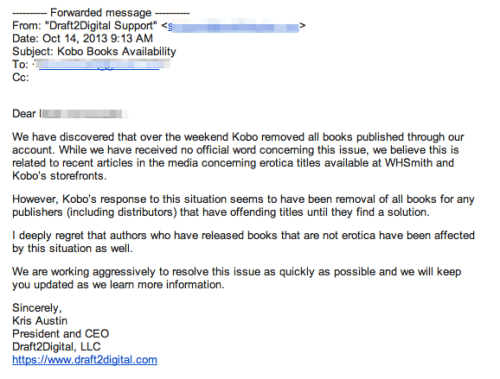
Yesterday, Kobo pulled all the content from the distributor Draft 2 Digital in response to the complaints retailers were receiving about the incest and beastiality books being self published. Authors refer to this content as Psuedo Incest because it is really about step brothers and step fathers, not blood relatives, but because Daddy PI was showing up in the children’s literature section, WH Smith went to the drastic step of shutting down its website (which is likely costing them thousands, if not hundreds of thousands of dollars a day) and Kobo pulled all the D2D content. Much of the D2D content is not “porn” but YA, sweet romance, and the like.

Part of the problem is that authors who are writing PI stuff will relabel their content in order to get around the filters. I think the extreme reaction is due to a few authors trying to mess with the system and reducing the efficacy of filters. For instance, authors would change the title of their book to get through the filter but the cover would have a different title – one that is disallowed. Authors would use the names of famous authors in their tags or descriptions so that the books would show up when someone was searching for other things. I can’t tell you how irksome it was that one author’s porn books kept showing up when I was trying to compile a new release list for “Forever Romance.”

Other authors were putting up excerpts in the description area that were full on sex scenes.

At Kobo, their search function is even worse.  Search a middle grade author name and a bunch of porn titles show up because Kobo can’t get its search feature to work correctly.

What is clear is that Direct 2 Digital uses no filters unlike Smashwords. None of the Smashwords titles were taken down but the ones from D2D were, likely because D2D had no way of filtering out the questionable content.

There’s been a great deal of panic and accusations flying but the actions appear to be taken primarily by Kobo and WH Smith. For now, it appears the following is true:

  • Kobo is removing self published content in addition to the Draft 2 Digital stuff. If a book was part of an indie consortium that Kobo doesn’t like, then the whole consortium’s books were removed. No update as to when this will be resolved.
  • No content has been removed from any reader’s Kindle. Lots of readers seem to be in a tizzy about this but I have seen zero evidence of this. – Indie authors have been whispering this into indie bloggers’ ears and it was all over facebook last night. Removing content from the store (or in Amazon’s case, putting the content into draft status) is not the same thing as taking stuff away from your Kindle account. Amazon won’t even remove plagiarized crap from your Kindle account. Seriously I had to restrain myself from using allcaps all over the Internet yesterday and it wasn’t easy.
  • Amazon is not going to war against self published erotica. Given that the dino porn is still up as is tons of other porn, the evidence is strongly against any war against indies and/or erotica. What they don’t want is a bunch of in your face incest, rape and child porn stuff showing up in regular searches but when authors keep trying to futz with the filter, the banhammer comes down hard and broad. They appear to be putting any erotica author’s work into draft if it contains “sister, brother, child, babysitter, daddy, mother” and the like.  The author will then have to go back to Amazon and republish the work. Some authors reported that working within hours while others were still being vetted.
  • Amazon is going through and putting authors’ titles to “draft” status which means that the content isn’t deleted, but rather it can’t be purchased until Amazon determines that the content doesn’t violate its anti porn clause (which it selectively enforces).
  • Authors having their content removed is a bigger deal than readers having their content removed. Or do Kobo and other retailers not have the right to enforce their content policies just like Goodreads? Or is somehow constraining commercial speech and the sale of porn more concerning than critical speech?

Anyway, I digress. Enough people complained and media sat up and now the retailers are doing something. Does this mean that the content is never coming back? Doubtful. Right now it means that Amazon and Kobo are vetting content that they pulled which is likely going to take a really long time.

via Tuesday News: Kobo and WH Smith overreact to the porn titles in their catalogs | Dear Author


The 15 Countries Where The Most Young People Are Online | Co.Exist


Full Article

What did children do before computers? If the future goes the way of babies with iPads, it’s a question we might be asking ourselves soon. But if you’re between 15 and 24 years old and live in the United States, there’s already a good chance you grew up playing around with MS Paint. According to a new report out from the UN’s International Telecommunication Union (ITU), growing up with the Internet qualifies you as a “digital native,” and some countries have a far higher proportion of them than others.

The results, however, might surprise you.
The 15 Countries Where The Most Young People Are Online | Co.Exist | ideas + impactSource: ITU

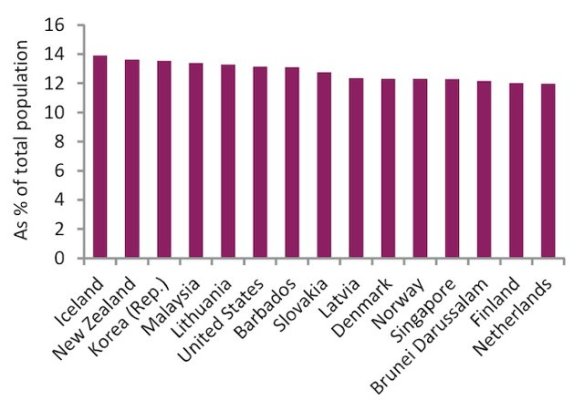
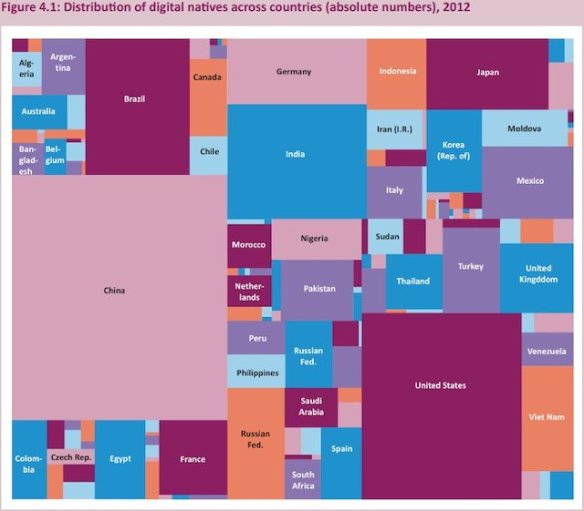
Out of a global population of 7 billion, 363 million of us have grown up “surrounded by and using tools and toys of the digital age.” China and India boast the largest number of these people, but digital natives only make up a relative minority of their respective populations. When it comes to countries with the highest percentages of digital natives, the United States actually comes in sixth place, below Lithuania and Malaysia.

Iceland, however, ranks number one in digital native penetration, with 14% of the Icelandic population having grown up on computers. That makes sense, given that Iceland has the highest percentage of young people in Europe (and a small population). New Zealand makes number two on the list for the same reason. South Korea, meanwhile, ranks third largely because of high Internet use among all youth and its government’s aggressive investment in educational technology: By 2015, all Korean schools will provide cloud-based learning services to students.

Malaysia comes in fourth place on the list, and for striking reasons. Unlike Iceland or New Zealand, Malaysia doesn’t have a particularly high concentration of 15-to-24 year-olds. But like South Korea, the young people who do live in Malaysia have spent more time with the Internet: By 2012, 74.4% of youths had at least five years of Internet experience under their belts. Much of that, explains the report, can be attributed to the fact that the Malaysia has brought so many of its schools online, and by 2000 had already stocked 31% of its primary schools and 54% of its secondary schools with computer facilities.
The 15 Countries Where The Most Young People Are Online | Co.Exist | ideas + impactAbsolute numbers of digital natives by country. Source: ITU

Starting in January of this year, Malaysian 21-to-30-year-olds have been able to score $65 rebates on certain smartphones, courtesy of government subsidies. The country’s National Broadband Initiative has set about dramatically lowering costs of accessing the Internet, including launching the 1 Million Netbooks program, which distributes netbooks to low-income families.

The report notes that proportions of digital natives largely stick to levels of economic development. In high-income, developed countries, digital natives with five years of Internet experience or more make up 86% of young Internet users, while in the developing world, digital natives only count as 47% of young Internet users. The global average comes to slightly more: Digital natives make up 56% of all young Internet users–more than 362 million people worldwide.

via The 15 Countries Where The Most Young People Are Online | Co.Exist | ideas + impact.

Gates, Zuck, Dorsey chip in to teach 10M students coding | CNET News


While computer programming and coding are becoming more common K-12 class options, these subject matters are still a mystery to many students. A nonprofit called Code.org is trying to change that by enlisting a star-studded entourage of techies to help with its new “Hour of Code” campaign.

The goal of Hour of Code is to introduce computer programming to 10 million K-12 students in the US during Computer Science Education Week. The event happens December 9 to 15[, 2013].

Joining the cause are several individuals, such as long-time philanthropist Microsoft Chairman Bill Gates, Facebook CEO Mark Zuckerberg, Twitter co-founder Jack Dorsey, and LinkedIn co-founder Reid Hoffman. Companies are also supporting the initiative, including Google, Microsoft, Amazon, Apple, Yahoo, and others.

via Gates, Zuck, Dorsey chip in to teach 10M students coding | Internet & Media | CNET News

Also See: Gates, Zuckerberg Back Code.org’s Mission To Bring Computer Science To Every School | FastCompany

Why Are Infographics So Popular? [Infographic] | Marketing Technology Blog


According to Graphs.net, research shows that the search volume for Infographics has increased by a whopping 800% between 2010 and 2012. Wow! At the same time, there’s been an explosion of popularity with visual content – from technologies like Postano to platforms like Pinterest. Visual mediums aren’t going anywhere… I believe their popularity will continue to grow over the next few years.

via Why Are Infographics So Popular? [Infographic] | Marketing Technology Blog

Why are infographics so popular?

Which Governments Prioritize Privacy and Which Lay On the Spying? [Infographic] | Gizmodo


Privacy is on everyones’ minds in the U.S. since revelations about the NSA exploded. You can’t talk on the phone about some casual pot smoking anymore without your friend making the, “Hi NSA!” joke. And apparently for good reason.

So Backgroundchecks.org pulled together a bunch of sources to make a global privacy scoreboard and rank the top five best and top five worst countries in terms of government surveillance. It

Where in the world can you get some privacy?

‘s interesting to see how governments go about monitoring different media and why. Better luck next time Bahrain and Nigeria, but nicely done Spain.

via Which Governments Prioritize Privacy and Which Lay On the Spying?.

Technology Adoption by Lower Income Populations | Pew Research Center


Aaron Smith, Senior Researcher at the Pew Research Center’s Internet Project, discusses the Project’s latest research about internet usage, broadband adoption, and the impact of mobile connectivity among lower-income populations.

E-patients and their hunt for health information | Pew Research Center


Lee Rainie, Director of the Pew Internet Project, described the Project’s research on how patients and caregivers seek health information in the digital age and how people fit librarians into their general information needs as well as their specific health needs.


Recent Pew Research Links


25 percent of men watch online porn, and other ‘facts’ about Americans’ online video habits | The Washington Post
Do you spend a lot of time watching videos on YouTube? You’re not alone. The Pew Internet & American Life project released new survey data on how Americans engage with video online Thursday. And the percentage of online adults who watch or download videos has grown from 69 percent of adult Internet users in 2009 to 78 percent today.

Online Video 2013 | Pew Internet
Over the past four years, the percent of American adult internet users who upload or post videos online has doubled from 14% in 2009 to 31% today. That includes 18% of adult internet users who post videos they have created or recorded themselves—many of whom hope their creations go viral. The share of online adults who watch or download videos has also grown from 69% of internet users in 2009 to 78% today, and mobile phones have become a key part of the video viewing and creating experience.

Who’s Not Online and Why | Pew Internet
As of May 2013, 15% of American adults ages 18 and older do not use the internet or email. Asked why they do not use the internet:

  • 34% of non-internet users think the internet is just not relevant to them, saying they are not interested, do not want to use it, or have no need for it.
  • 32% of non-internet users cite reasons tied to their sense that the internet is not very easy to use. These non-users say it is difficult or frustrating to go online, they are physically unable, or they are worried about other issues such as spam, spyware, and hackers. This figure is considerably higher than in earlier surveys.
  • 19% of non-internet users cite the expense of owning a computer or paying for an internet connection.
  • 7% of non-users cited a physical lack of availability or access to the internet.

Cell Phone Activities 2013 | Pew Internet
Fully 91% of American adults own a cell phone and many use the devices for much more than phone calls. In our most recent nationally representative survey, we checked in on some of the most popular activities people perform on their cell phones and found:

  • 81% of cell phone owners send or receive text messages
  • 60% of cell phone owners access the internet
  • 52% send or receive email
  • 50% download apps
  • 49% get directions, recommendations, or other location-based information
  • 48% listen to music
  • 21% participate in a video call or video chat
  • 8% “check in” or share their location