74 Essential Books for Your Personal Library: A List Curated by Female Creatives | Open Culture


When Open Culture recently published Jorge Luis Borges’ self-compiled list of 74 ‘great works of literature’, commissioned by Argentine publisher Hyspamerica, I, along with many others, saw one glaring issue in the otherwise fantastically diverse list: it included no works by female writers.

Whether intentional or not, the fact that women are excluded from Borges’ noteworthies (and in 1985, no less) means that a vast number of historically and culturally significant books and writings have been overlooked. While this ought not to discredit the works listed in any way, after witnessing the immense popularity of Borges’ list I certainly felt that for his selection to be relevant today it needed to be accompanied by a list of works which had been overlooked due to the gender of their respective authors.

I decided to put a suggestion to a group of international women writers, artists and curators, and we compiled our own list of 74 ‘great works of literature’ — one just as varied, loose and substantial as that of Borges, but made up solely of writers identifying as women or non-gender-binary. Over two days we amassed many suggestions, which I’ve now curated to form the list below. It’s not intended to invalidate the original, but rather to serve as an accompaniment to highlight and encourage a dialogue on gender imbalances in creative and intellectual realms, as well as to provide a balance by actively ‘equalising’ that of Jorge Luis Borges.

SEE THE LIST: 74 Essential Books for Your Personal Library: A List Curated by Female Creatives | Open Culture.
NPR’s Top 100 Science-Fiction & Fantasy Books – How many have you read? | NPR


More than 5,000 of you nominated. More than 60,000 of you voted. And now the results are in. The winners of NPR’s Top 100 Science-Fiction and Fantasy survey are an intriguing mix of classic and contemporary titles.

READ MORE NPR’s Top 100 Science-Fiction & Fantasy Books – How many have you read? | NPR

Projection Mapping Brings an Ancient Greek Statue to Life | WIRED


PURISTS WILL SCOFF, but we could be nearing a future where new technologies make art museums come to life. Not hyperbolically, in the sense that virtual reality displays and touchscreen tablets let you interact with art in new ways (we’re already seeing that in spades, thanks to smart renovations at places like the Cleveland Museum of Art and the new Cooper Hewitt.)

This is more literal. In this near-future, works of art might actually register facial expressions. They might blink, or look right at you. READ MORE: Projection Mapping Brings an Ancient Greek Statue to Life | WIRED.

Artist Takes Old Books and Gives Them New Life as Intricate Sculptures | Open Culture


New York-based artist Brian Dettmer cuts into old books with X-ACTO knives and turns them into remixed works of art. Speaking at TED Youth last November, he told the audience, “I think of my work as sort of a remix …. because I’m working with somebody else’s material in the same way that a D.J. might be working with somebody else’s music.” “I carve into the surface of the book, and I’m not moving or adding anything. I’m just carving around whatever I find interesting. So everything you see within the finished piece is exactly where it was in the book before I began.”

READ MORE: Artist Takes Old Books and Gives Them New Life as Intricate Sculptures | Open Culture.

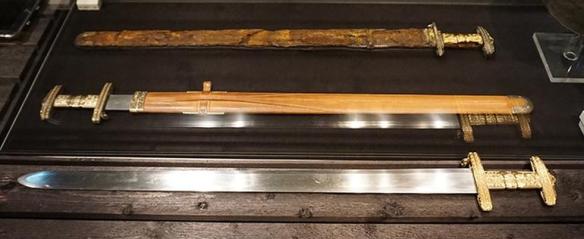
3D printing produces a perfect replica of a sixth-century sword | CNET


A damaged sixth-century sword in a museum in Norway has been perfectly reproduced as new through 3D printing.

READ MORE: 3D printing produces a perfect replica of a sixth-century sword | CNET.

Cosplay, Comics, and Geek Culture in Libraries [Blog] by Ellyssa Kroski


Ellyssa Kroski of iLibrarian fame said farewell to the iLibrarian blog in late 2014. iLibrarian was one of my top resources for emerging technologies in libraries and information services. I will miss the iLibrarian posts but am excited about the new website she has launched called Cosplay, Comics, and Geek Culture in Libraries. I’ve participated in coding and medieval times events over the past few years and am surprised at how quickly these events are transitioning into the mainstream. With the increasing popularity and growth of these activities, CCGC in Libraries is sure to be a great resource for librarians and fans of cosplay, comics and geek culture.

Speaking of geek culture, I’ve been watching TNT’s The Librarians series and I guess I’m hooked. It’s silly and over the top but I enjoy the mix of science fiction, mystery and adventure. IMO each episode’s concept/theme is more interesting than the overarching storyline. Cassandra’s outfits are way too distracting though! The remaining 2 episodes of Season 1 air tonight, January 18, 2015, on the Space channel in Canada. 

Via the CCGC in Libraries website.

Welcome everyone to Cosplay, Comics, and Geek Culture in Libraries! This is an exciting time for geeks of all kinds to be involved with libraries as today’s savvy libraries have begun to embrace new ways to engage library patrons such as fandom events, comic book and graphic novel collections, comic cons, cosplay events.

The intersection of these interests with libraries is a perfect match as libraries are striving to develop entertaining and educational new programs and services that will appeal to not only children but young adults as well as “kids at heart” of all ages. And these new programs and resources fit well with the interests of cosplayers who can utilize the equipment in library makerspaces such as 3D printers and sewing machines to create many of their props and costume pieces, as well as comics fans who can come to the library to read comics and graphic novel collections, video and board game enthusiasts who attend library gaming events, and geeks of all types who are drawn to “nerd nights”, Dr. Who marathons, and Harry Potter socials, etc.

I decided to start this blog, not only because I am a self-proclaimed geek, cosplayer, and comics reader and collector myself, but because this is a cutting-edge area of growth in libraries with significant appeal to today’s patrons. I think that there is much that we can do to expand and develop this type of programming and collection development. And I’m not alone. I’ve been joined by a talented group of international writers, librarians, information professionals, and library patrons to provide articles and inspiration to libraries seeking to incorporate cosplay, comics, and geek culture in their libraries!

A Better Way to Think About the Genre Debate | The New Yorker


A very thoughtful essay questioning the distinction between genre versus literature, using Station Eleven by Emily St. John Mandel as an example. Well worth the read.

Snip

It’s hard to talk in a clear-headed way about genre. Almost everyone can agree that, over the past few years, the rise of the young-adult genre has highlighted a big change in book culture. For reasons that aren’t fully explicable (Netflix? Tumblr? Kindles? Postmodernism?), it’s no longer taken for granted that important novels must be, in some sense, above, beyond, or “meta” about their genre. A process of genrefication is occurring.

That’s where the agreement ends, however. If anything, a divide has opened up. The old guard looks down on genre fiction with indifference; the new arrivals—the genrefiers—are eager to change the neighborhood, seeing in genre a revitalizing force. Partisans argue about the relative merits of “literary fiction” and “genre fiction.” (In 2012, Arthur Krystal, writing in this magazine, argued for literary fiction’s superiority; he fielded a pro-genre-fiction riposte from Lev Grossman, in Time.) And yet confusion reigns in this debate, which feels strangely vague and misformulated. It remains unclear exactly what the terms “literary fiction” and “genre fiction” mean. A book like “Station Eleven” is both a literary novel and a genre novel; the same goes for “Jane Eyre” and “Crime and Punishment.” How can two contrasting categories overlap so much? Genres themselves fall into genres: there are period genres (Victorian literature), subject genres (detective fiction), form genres (the short story), style genres (minimalism), market genres (“chick-lit”), mode genres (satire), and so on. How are different kinds of genres supposed to be compared? (“Literary fiction” and “genre fiction,” one senses, aren’t really comparable categories.) What is it, exactly, about genre that is unliterary—and what is it in “the literary” that resists genre? The debate goes round and round, magnetic and circular—a lovers’ quarrel among literati.

READ MORE: A Better Way to Think About the Genre Debate | The New Yorker

DPLA Community Reps Produce Hackathon Planning Guide, Now Available | DPLA


We’re excited to announce the release of a new Community Reps-produced resource, GLAM Hack-in-a-box, a short guide to organizing and convening a hackathon using cultural heritage data from GLAM organizations Galleries, Libraries, Archives, Museums including DPLA. We hope this guide will serve as a useful resource for those either unfamiliar with or inexperienced in pulling together a hackathon.

via Digital Public Library of America » Blog Archive » DPLA Community Reps Produce Hackathon Planning Guide, Now Available.

How An Octogenarian Preserved An Endangered Native American Language | Gizmodo


Marie Wilcox is the last fluent speaker of Wukchumni, one of 130 different endangered Native American languages in the United States that dont have any kind of digital—or analog—legacy.

Over the course of seven years in Californias San Joaquin Valley, she worked with her daughter and grandson to catalog everything she knows about the language. First, she hand-scrawled memories on scraps of paper; then, she hunt-and-pecked on an old keyboard to complete a dictionary and type out legends like “How We Got Our Hands.” Next, she recorded the whole thing on audio for pronunciation—its very specific!—and posterity.

via How An Octogenarian Preserved An Endangered Native American Language | Gizmodo

Definitely recommend watching the video. I am in awe of Marie’s dedication to preserving the Wukchumni language. Amazing, inspiring story!

The 12 Weirdest Reasons For Banning Science Fiction and Fantasy Books | io9


The 12 Weirdest Reasons For Banning Science Fiction and Fantasy Books | io9