More Vendors Help Libraries Stream Video | The Digital Shift


Since the beginning of 2013, four major library vendors have announced the launch of new or expanded streaming services that will enable patrons to view movies and television shows at their library or at home using computers, tablets, smart TVs, or any device equipped with a web browser.

See the full article: More Vendors Help Libraries Stream Video | The Digital Shift.

Google Copyright Infringement Reports to Quadruple This Year | Mashable


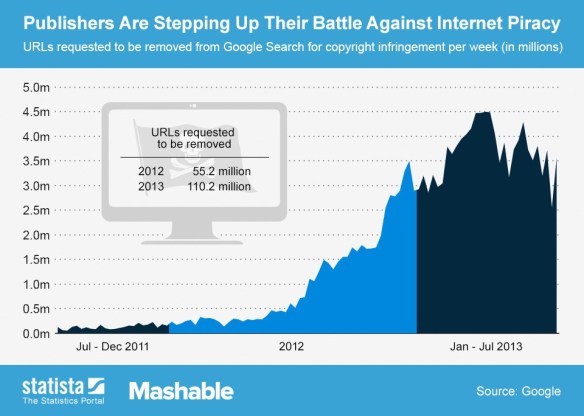
The rate of copyright infringement reports Google received in 2013 is on track to quadruple the number of reports received in 2012.

In the first seven months of 2013, publishers have submitted 110.2 million requests to remove copyright-infringing content, compared with 55.2 million requests in all of 2012.

via Google Copyright Infringement Reports to Quadruple This Year | Mashable.

Image: Tony Karumba/AFP/Getty Images

Image: Tony Karumba/AFP/Getty Images

You may also like:

Governments’ Attempts To Censor Google Have Doubled Since 2011 | TechCrunch

SAPL To Debut Digital Commons, Test “Public Proof” OverDrive Kiosk | The Digital Shift


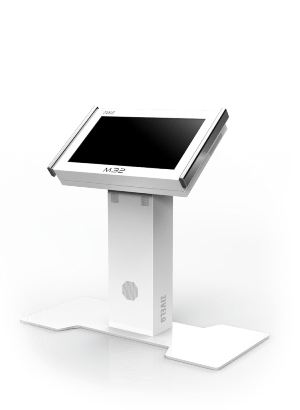
As a beta tester for OverDrive, SAPL will be experimenting with an installation of the company’s new OverDrive Media Station (OMS) interface on a ruggedized kiosk that could be deployed in public areas outside of a library.

SAPL will be featuring the OMS interface on a Zivelo M32 Floor Display, a pedestal-mounted kiosk made with an aircraft-grade aluminum enclosure. With swipes and taps that will be intuitive for anyone who has used a tablet or smartphone, patrons can navigate the OMS interface to explore a library’s collection of ebooks, audiobooks, music, and videos, and easily read or listen to samples, place holds, or have an available ebook sent to their tablet, e-reader, or smartphone.

See the full article: SAPL To Debut Digital Commons, Test “Public Proof” OverDrive Kiosk | The Digital Shift.

OverDrive OMS

For The First Time, Americans Are Consuming More Digital Media Than TV | Fast Company


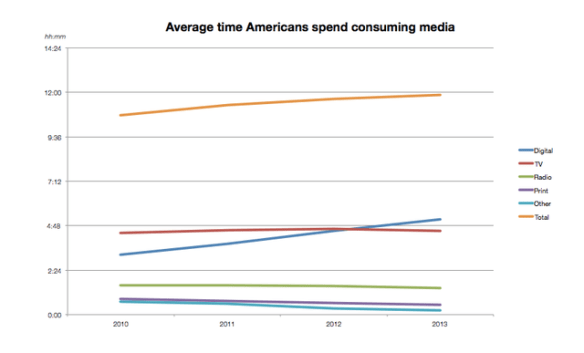
Further proof that traditional broadcasters should learn to embrace streaming video to capture more eyeballs, Americans will consume more digital media than TV for the first time ever in 2013. The news comes from new numbers released by eMarketer.

For The First Time, Americans Are Consuming More Digital Media Than TV | Fast Company | Business + Innovation

via For The First Time, Americans Are Consuming More Digital Media Than TV | Fast Company | Business + Innovation.

4 Dazzling Stargazing Maps | Mashable


4 Dazzling Stargazing Maps | Mashable.

The 4 stargazing maps discussed:

  1. Planetarium
  2. Interactive Skychart
  3. 100,000 Stars
  4. Starmap

Google To Launch Play Textbooks In August, Partners With 5 Major Publishing Houses | TechCrunch


Google To Launch Play Textbooks In August, Partners With 5 Major Publishing Houses | TechCrunch

The company has partnered with five major textbook publishers to launch this service. These partners are Pearson, Wiley, Macmillian Higher Education, McGraw-Hill and Cengage Learning. Google says it will have a “comprehensive selection” of textbooks from these publishers in the store that will cover subjects like law, math and accounting, but it did not announce exact numbers.

Amazon vs. your public library | Fortune Tech


I’m posting this but its not really new ‘news’ for libraries.

See the full article: Amazon vs. your public library | Fortune Tech.

Could Amazon (AMZN), tech’s behemoth retailer, really be threatened by the neighborhood library — a centuries-old institution known for musty shelves, high school cram sessions, and “Shhhhhh. Quiet please?” The answer is complex. Much hinges on whether libraries and publishers can iron out differences that have limited the selection of e-books available for lending.

The State of Digital Rights: A Discussion | Mashable


For the past few weeks, Mashable has been crowdsourcing a Digital Bill of Rights to highlight the digital freedoms and protections our readers feel each user should be guaranteed as a citizen of the Internet.

After hundreds of comments and contributions on the Google Doc and through social media, a Digital Bill of Rights by the Internet, for the Internet, has been created. The document, though, is a work in progress as more users from across the world continue to include their thoughts and additions to it.

via The State of Digital Rights: A Discussion | Mashable.

The Digital Museum Where Outdated Apps Can Live Forever | Gizmodo


There’s a crew of hero historians [and librarians!!] out there slurping up the Internet for posterity in case we want to see it later, but what about all the apps? Well now there’s a place for them too. Parts of them, at least.

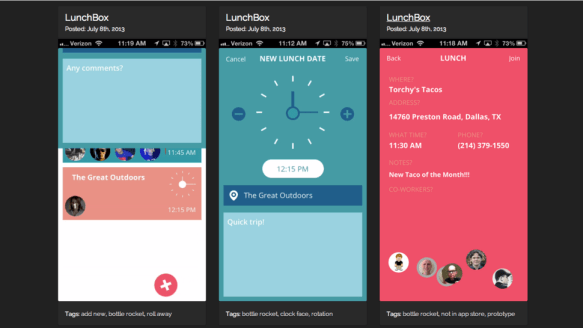
Capptivate.co was put together by Alli Dryer of Bottle Rocket Apps, and serves as the realitely new resting place for apps of old. The site doesn’t index full copies of the apps, or provide any of their functionality, but instead it hosts a distinct kind of snapshot: a little five-second video that showcases each’s signature look and feel.

via The Digital Museum Where Outdated Apps Can Live Forever | Gizmodo.

Caaptivate.co

Last.fm Founders Throw The Lights On Lumi, A Site That Uses Your Browsing History To Recommend New Content | TechCrunch


The closure of Google Reader has put a spotlight on RSS and apps that people use to help make their way around the long tail of internet content. Lumi is tapping into a similar concept, but taking a very different approach.

RSS requires users to proactively select sites and information they wanted to track online — and some might argue that this proactive, sometimes technical element is what has prevented RSS readers from really going mainstream. Lumi, meanwhile, has been created with inactivity in mind. People can do nothing and still get relevant, current content delivered regardless, using algorithms that track where you travel online to provide links to what else you might like to see.

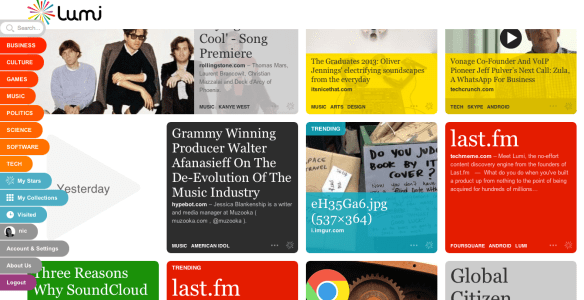
lumi

As long as you have downloaded the extension, which monitors whatever else do you on your computer, “you don’t have to do anything extra,” Stiksel told me in an interview. “You don’t click buttons or subscribe to new feeds. You can go away for two weeks and it’s even more fresh when you return. Because the system knows more about you.”

via Last.fm Founders Throw The Lights On Lumi, A Site That Uses Your Browsing History To Recommend New Content | TechCrunch.

This is what lumi looks like. The sidebar menu will disappear once you scroll off of it. Lumi reminds me of Stumble Upon, except at the content-specific level, rather than the website-specific level. Unfortunately, lumi is not recognizing my version of Safari at this time though it supposedly does recognize Chrome, Firefox and Safari, so the extension could not be installed. A cool and colourful new content discovery web service!

lumi