‘Big Disconnect’ Offers Guidance for Parents in a Tech-Crazed World | PBS


Did you hear the one about the 7-year-old boy who opened a Wii on Christmas morning and when his parents finally checked on him, he’d played for 18 hours? Or the one about the 13-year-old girl who accidentally “butt-dialed” an old acquaintance whose number now belonged to a transsexual prostitute, who then launched a vendetta against the girl? Catherine Steiner-Adair, a psychologist whom parents seem to call whenever there’s a digital/psychological crisis at home, has heard all these stories and more, and shares them in “The Big Disconnect: Protecting Childhood and Family Relationships in the Digital Age.”

A new policy statement issued by the American Academy of Pediatrics on October 28 recommends parents control the quantity and content of the media their children consume, keep tech gadgets out of kids’ bedrooms, and model good behavior for kids by limiting their own tech use. Steiner-Adair advises the same limits, and backs these up with examples from the children and families she works with as a counselor. Here are the key lessons “The Big Disconnect” taught me, and the grades I’d give myself for how well I’m handling tech at each age.

Read: ‘Big Disconnect’ Offers Guidance for Parents in a Tech-Crazed World | Mediashift | PBS.

Upstagram Is A Flying Raspberry Pi That Publishes Live Pictures On Instagram | TechCrunch


What do Instagram, the Raspberry Pi and the movie “Up” have in common? When you mash all these things together, you get Upstagram, a neat hack that the Hackerloop team just unveiled.

First, the team made a replica of the house in “Up” using paper and foam. It was just big enough to fit a Raspberry Pi and its camera, a battery and a 3G hotspot. The Raspberry Pi, an open source and very cheap mini-computer to tweak, experiment and try new things with, is a hacker’s dream.

Then, the team used about 90 helium balloons to make the house fly above Paris’ landscape. While Instagram is only available on iOS and Android, they reverse-engineered the posting process to transform the Raspberry Pi into an Instagram-taking machine.

Read more: Upstagram Is A Flying Raspberry Pi That Publishes Live Pictures On Instagram | TechCrunch.

Pew Research


Twitter a news source? Not so much | CNET
A new Pew survey shows only 16 percent of US adults use Twitter and only 8 percent use the social network for news. But these users tend to be young, educated, and wealthy.

The State of Digital Divides
Lee Rainie, Director of the Pew Research Center’s Internet Project, presented the project’s latest findings about who has and doesn’t have access to the internet, broadband, and cell phones. He noted that some of the factors associated with non-use of technology are age, household income, educational attainment, community type, and disability. He also cited findings about why people say they do not use the internet.

How to Erase Yourself From the Internet | Gizmodo


If your growing weariness of being constantly tethered to the Internet has become overwhelming, it might be time to scrub yourself from the social media sphere altogether. Here’s how you can become a ghost on the Internet, by tracking down and eliminating your digital past.

Read: How to Erase Yourself From the Internet | Gizmodo.

Provides instructions for how to remove/deactivate accounts for Facebook, Twitter, LinkedIn, and Google+. Recommends other tools including Account Killer, Just Delete Me and Knowem.

Abha Dawesar: Life in the “digital now” | TED.com


One year ago, Abha Dawesar was living in blacked-out Manhattan post-Sandy, scrounging for power to connect. As a novelist, she was struck by this metaphor: Have our lives now become fixated on the drive to digitally connect, while we miss out on what’s real?

via Abha Dawesar: Life in the “digital now” | Video on TED.com.

The Internet Archive Opens Its Historical Software Collection To All | Gizmodo, Internet Archive


Full Post

Gamers of a certain age will no doubt scream Oh wow, I remember that! as they click through the Internet Archive’s latest project.

The non-profit organization recently launched the Historical Software Collection, with the mission of making old programs accessible (including plenty of games!) that were originally released for platforms like Atari 2600, Apple II, and Commodore 64.

Software itself isn’t new to the Archive, but it’s spent the past couple of years making these programs playable in-browser. So whether it’s E.T. on Atari 2600 from 1982 or VisiCalc on the Apple II from 1979, there’s no need to download a heap of emulators to try them out.

Archiving video games can present special challenges, as David Gibson at the Library of Congress has explained so well. But the independent Internet Archive claims to have the largest software archive in the world, and it should be interesting to see how the next few years work out for them.

Perhaps one of the greatest challenges they’ll face is copyright. Technically, all of these programs are still covered under copyright law. And I have no doubt that the myriad companies responsible for managing the rights to something like E.T. are figuring out if they should intervene. Hopefully, no one will try to pull these programs. But if they do, it will be just one more example of how desperately broken our current copyright system is. [Internet Archive]

The Internet Archive Opens Its Historical Software Collection To All | Gizmodo

Evgeny Morozov on Why Our Privacy Problem is a Democracy Problem in Disguise | MIT Technology Review


As Web companies and government agencies analyze ever more information about our lives, it’s tempting to respond by passing new privacy laws or creating mechanisms that pay us for our data. Instead, we need a civic solution, because democracy is at risk.

Snip: “When all citizens demand their rights but are unaware of their responsibilities, the political questions that have defined democratic life over centuries—How should we live together? What is in the public interest, and how do I balance my own interest with it?—are subsumed into legal, economic, or administrative domains. “The political” and “the public” no longer register as domains at all; laws, markets, and technologies displace debate and contestation as preferred, less messy solutions.

But a democracy without engaged citizens doesn’t sound much like a democracy—and might not survive as one.”

A lengthy but thought provoking read on the right to privacy and democracy. Read: Evgeny Morozov on Why Our Privacy Problem is a Democracy Problem in Disguise | MIT Technology Review.


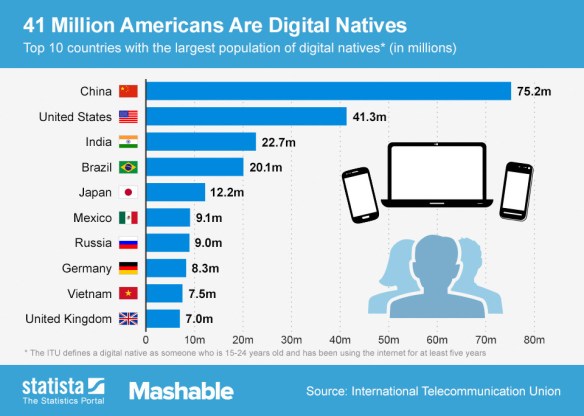
Top 10 Countries With the Most Digital Natives | Mashable


Statista created the following chart, which lists the 10 countries that boast the most digital natives. Check it out, below, for the full results.

Digital Natives

via Top 10 Countries With the Most Digital Natives | Mashable.

Related:

Librarians in the Digital Age [Infographic] | USC Online Library Science Degree

Image


The 15 Countries Where The Most Young People Are Online | Co.Exist


Full Article

What did children do before computers? If the future goes the way of babies with iPads, it’s a question we might be asking ourselves soon. But if you’re between 15 and 24 years old and live in the United States, there’s already a good chance you grew up playing around with MS Paint. According to a new report out from the UN’s International Telecommunication Union (ITU), growing up with the Internet qualifies you as a “digital native,” and some countries have a far higher proportion of them than others.

The results, however, might surprise you.
The 15 Countries Where The Most Young People Are Online | Co.Exist | ideas + impactSource: ITU

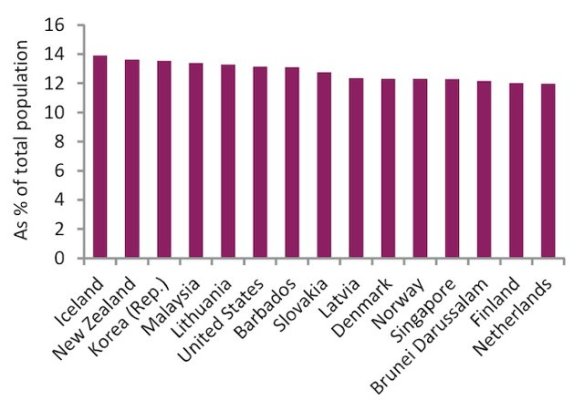
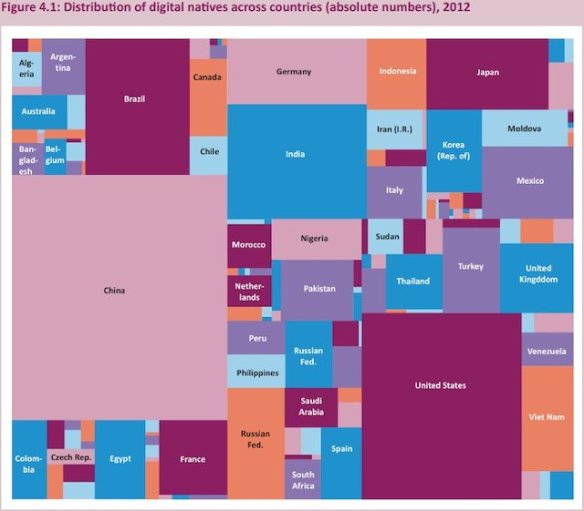
Out of a global population of 7 billion, 363 million of us have grown up “surrounded by and using tools and toys of the digital age.” China and India boast the largest number of these people, but digital natives only make up a relative minority of their respective populations. When it comes to countries with the highest percentages of digital natives, the United States actually comes in sixth place, below Lithuania and Malaysia.

Iceland, however, ranks number one in digital native penetration, with 14% of the Icelandic population having grown up on computers. That makes sense, given that Iceland has the highest percentage of young people in Europe (and a small population). New Zealand makes number two on the list for the same reason. South Korea, meanwhile, ranks third largely because of high Internet use among all youth and its government’s aggressive investment in educational technology: By 2015, all Korean schools will provide cloud-based learning services to students.

Malaysia comes in fourth place on the list, and for striking reasons. Unlike Iceland or New Zealand, Malaysia doesn’t have a particularly high concentration of 15-to-24 year-olds. But like South Korea, the young people who do live in Malaysia have spent more time with the Internet: By 2012, 74.4% of youths had at least five years of Internet experience under their belts. Much of that, explains the report, can be attributed to the fact that the Malaysia has brought so many of its schools online, and by 2000 had already stocked 31% of its primary schools and 54% of its secondary schools with computer facilities.
The 15 Countries Where The Most Young People Are Online | Co.Exist | ideas + impactAbsolute numbers of digital natives by country. Source: ITU

Starting in January of this year, Malaysian 21-to-30-year-olds have been able to score $65 rebates on certain smartphones, courtesy of government subsidies. The country’s National Broadband Initiative has set about dramatically lowering costs of accessing the Internet, including launching the 1 Million Netbooks program, which distributes netbooks to low-income families.

The report notes that proportions of digital natives largely stick to levels of economic development. In high-income, developed countries, digital natives with five years of Internet experience or more make up 86% of young Internet users, while in the developing world, digital natives only count as 47% of young Internet users. The global average comes to slightly more: Digital natives make up 56% of all young Internet users–more than 362 million people worldwide.

via The 15 Countries Where The Most Young People Are Online | Co.Exist | ideas + impact.