Books for Boys and Books for Girls: Problems with Gendered Reading | Book Riot


Interesting opinion piece from Kelly Jensen, a librarian and a blogger.

Snip: “When we buy into these ideas about boys and reading, we also make a statement about girls and reading. We believe they’re automatically readers. They don’t need our support or encouragement to be life-long readers because reading is part and parcel of being a girl.”

Read: Books for Boys and Books for Girls: Problems with Gendered Reading | Book Riot

This Is Why There Aren’t Enough Women In Tech | ValleyWAG


This Is Why There Aren’t Enough Women In Tech | ValleyWAG
The discussion in the above post includes anecdotal stories of female computer science students and women in technology.

Taking computer science classes as a female post-secondary student, I recall the overwhelming ratio of males to females in classes. There were 5 girls to 45 guys on the first day of Intro to Java, with 2 of the girls dropping the class within a few weeks. When I decided to do a directed study in my final term of my undergrad I had two professors who signed on to guide me. Once of them was a computer science professor and he was never available to help me or provide guidance. That experience was demoralizing and there was a real fear I would not attain a pass for the course and graduate on time. From my experiences since then, I do think it is much harder for women to be hired and advance in technology related careers than men. The issue of culture fit being discussed here begins in university classes. There needs to be more inclusivity and acceptance of women in STEM fields.

You may also like:

What It’s Like To Be A Woman Making Video Games | Jezebel


Guest Editorial by Whitney Hills.

Quotables:

“At some of these studios, there are literally no other women in sight. There’s a women’s bathroom, but the light is always off, because you’re the only one who uses it, and you have to fumble for it in the dark. If it’s nighttime and you’re walking down the vacated hallway of a shared office building in an unfamiliar city to a bathroom only you use, you feel afraid you’ll be cornered.”

**************

“When there’s a decision to be made about who from the company will go visit a developer to discuss a new project, you are told that they really need to send “a guy’s guy… Someone who can hold his liquor, drink a lot with the developers, and earn their trust.” Definitely not you.”

The full story: What It’s Like To Be A Woman Making Video Games | Jezebel.

GLBTI Fiction: Opening the Fiction Closet | Library Journal


Prior to World War II, GLBTI literature was hidden, with knowledge of its existence largely known only to members of the community, who shared texts among themselves. Occasionally a work of fiction would find its way into general circulation, but the books typically resorted to coded inferences of desire or served as warnings against the danger and immorality of homosexuality. This pattern continued until the 1969 Stonewall riot, which is largely accepted as the beginning of the GLBTI rights movement. The last three decades of the 20th century saw the establishment of GLBTI presses, bookstores, awards, and reading and book clubs, as well as literary festivals, writers’ conferences, and professional organizations. The closet was open, and the GLBTI community had found its voice.

Collection development and readers’ advisory (RA) staff can take advantage of a unique opportunity for professional growth by acquainting themselves with the widely dispersed sources of information about GLBTI literature. The task of identifying worthy contemporary purchases is best accomplished by consulting awards and recommended reading lists.

See the full article (which includes a longish list of recommended GLBTI fiction): via GLBTI Fiction: Opening the Fiction Closet | Library Journal.

Recent HBR Articles Supporting Women as Leaders


Here’s a tip. You have to register at HBR to see the full articles without the registration wall. BUT if you subscribe to the HBR RSS feed  (feeds.harvardbusiness.org/harvardbusiness/) via Feedly or another RSS reader, you will be able to see the full article without the registration requirement, as the full article text will show up in your feed page.

Good Leaders Get Emotional | Doug Sundheim – Harvard Business Review


Good Leaders Get Emotional | Doug Sundheim – Harvard Business Review

[http://blogs.hbr.org/cs/2013/08/good_leaders_get_emotional.html]

Much of what comes out of people’s mouths in business these days is sugar-coated, couched, and polished. The messages are manufactured, trying to strike just the right tone. Genuine emotion stands in stark contrast. It’s a real person sharing a real feeling. When we hear it, we’re riveted — for one because it’s rare, but also because it’s real. Sometimes it’s uncomfortable and a little messy. But that’s what makes it powerful. No one is trying to hide anything.

We hide emotions in an attempt to stay in control, look strong, and keep things at arm’s length. But in reality, doing so diminishes our control and weakens our capacity to lead — because it hamstrings us. We end up not saying what we mean or meaning what we say. We beat around the bush. And that never connects, compels, or communicates powerfully.

Yes, being too emotional in business can create problems. It clouds objective analysis, screws up negotiations, and leads to rash decisions. But in nearly two decades of working with leaders, I’ve found that showing too much emotion is far less of a problem than the opposite — showing too little.

Emotions are critical to everything a leader must do: build trust, strengthen relationships, set a vision, focus energy, get people moving, make tradeoffs, make tough decisions, and learn from failure. Without genuine emotion these things always fall flat and stall. You need emotion on the front end to inform prioritization. You need it on the back end to motivate and inspire.

Over the last 17 years working with senior teams I’ve collected a lot of examples of leaders getting emotional — to good end. Here are a few:

“I’m angry that I had to spend 3 hours dealing with a problem that you created — a problem that you should have handled. Don’t put me in that position again.” Joan, a partner in a consulting firm hated conflict and rarely said things like this. She normally just rolled up her sleeves and took care of problems herself, even if she hadn’t created them. Then she got promoted to the head of the Southeast Region. There were too many problems to take care of by herself. Her outburst above and the ensuing conversation was a survival tactic, but it sent a clear message to the partner in charge of the Atlanta office. Don’t let this employee staffing issue happen again, and if it does, fix it yourself — before it lands on my plate. It was uncharacteristically aggressive for Joan, but exactly what the situation needed. That was two years ago and the problem hasn’t happened since.

“I think most of the ideas on this list are sh**ty…but that one’s great. Let’s do it.” Jamie, the CEO at a biotech company had a reputation for walking the fine line between galvanizing a team and offending them. He shot straight and went with his gut. While he had to clean up messes from time to time, it was never anything egregious. And his approach had a profoundly positive impact on the organization. Everyone knew where they stood with him. And everyone knew that he meant what he said. When he got excited about something, no matter what, he was going to make it happen. His energy and emotion accelerated innovation and execution across the company.

“I’m upset. I’m responsible. I apologize.” It was the type of mea culpa no one expected from Jeremy. The COO of a software firm, he had had a horrible relationship for years with Ron, a key product development VP. Finally, frustrated and tired, Ron quit. Within months it became clear that Jeremy had underestimated Ron’s impact on his team. It started to fall apart. With Ron gone, Jeremy was able to step back and see that he’d let a small issue create a huge problem. And that his stubbornness was at the root of it. He apologized to the executive team with a tear in his eye. I was there. It was shocking. That’s not the kind of guy Jeremy was. In an instant I understood how much he cared about the company and how ashamed he felt. Everyone saw it. Amazingly, he ended up apologizing to Ron and hiring him back.

Often, one of the reasons we don’t show emotion is because we’re not even aware we’re feeling it. We’re angry, frustrated, or upset and we suppress it. We’re excited, motivated, or inspired and we temper it. We do it without even realizing it. Emotional data seems less relevant in the business world where logical data reigns supreme. But it’s not only relevant, It’s usually the lynchpin to change and growth.

One further point. It’s important to note there’s a gender bias around showing emotion at work. I’ve seen that in the same places where men get labeled tough, passionate, or open, women get labeled bitchy, hysterical, or weak. I find this double standard particularly destructive and insidious because it leads to women’s emotions getting dismissed more readily than men’s, often at exactly the times where that emotion is most needed — times when no one else in the room is raising the most important points. We all need to stay aware of this double standard and not enable it.

My advice to all leaders is to pay attention to your emotions. At least a couple times a week, stop for 10 minutes and ask yourself, “What am I feeling right now?” Write it down if you can. Keeping a regular journal is a helpful way to understand how you’re feeling.

Then pick your spots to let loose a little. Let your emotions out. Let people in. Both are critical to effective leadership.

 

3 Projects That Aim To Unleash Girls’ Inner Geeks | ReadWrite


Women are disproportionately underrepresented in science-related majors and careers. How some projects are bridging the gap, and encouraging the future females of the technical field.

via 3 Projects That Aim To Unleash Girls’ Inner Geeks | ReadWrite.

The 3 projects discussed are She++, WISH and Tech Choices.

Sexism and abuse isn’t only on Twitter: one woman’s gaming experience | theguardian.com


A commenter describes the reactions of male players she beat in an MMORPG – and the change when she played as a ‘man’.

Quotable: “…[E]ven though these personal threats were against the game rules, the game’s staff assumed no responsibility for enforcing the rules, or else blamed me for ‘provoking’ the male players. (One game operator did tell me that I ‘provoked’ the threats by ‘playing too well’ and suggested I deliberately lose more often so as not to bruise male egos. This game operator was, by the way, female.)”

via Sexism and abuse isn’t only on Twitter: one woman’s gaming experience | Technology | theguardian.com.


There Are Plenty of Women in Tech, You Just Haven’t Noticed | PCMag.com


Quotable: “The reason most people don’t know there are many women who sleep, eat, and breathe tech is because these aren’t the women most acknowledged in and by the tech industry, especially the men.”

See the full article: There Are Plenty of Women in Tech, You Just Haven’t Noticed | PCMag.com.

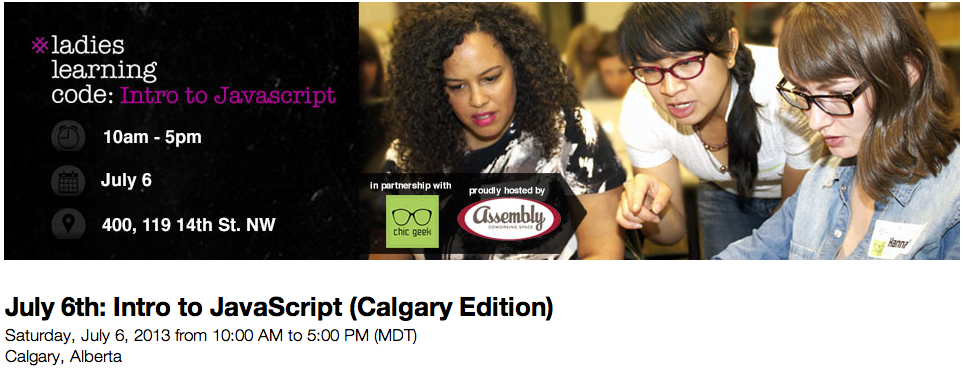
Ladies Learning to Code (Calgary Edition) – Intro to JavaScript


There is another Ladies Learning to Code event in Calgary. This one is an Introduction to JavaScript. The event costs $54.49, which I think is very reasonable. Register here. The event space is in Hillhurst, an area affected by the #yycflood. As invites were sent yesterday, I’m assuming the location is not damaged.

Ladies Learning to Code (Calgary Edition)