I can well imagine that the insertion of modern technology into many of Edgar Allan Poe’s stories would have a tremendous benefit for those stories’ victims, and a deleterious effect on their monomaniacal plots. In one of the ironies of cultural transmission, the timeless quality of Poe’s work seems to depend upon its use of deliberately ancient methods of surveillance and torture. In a further paradox of sorts, Poe’s work never suffers, but only seems to shine, when technology is applied to it.
The fantasy genre can be daunting — magic, creatures, and unpronounceable names can seem, well, a bit weird to people who haven’t read those kinds of books before. However, as millions upon millions of fans know, there’s something to be said for the escapism and sense of wonder that a fantastical novel can provide.
There’s also the question of size to consider. One glance at hefty high-fantasy series like Lord of the Rings (approximately 1,200 pages altogether) and Game of Thrones (4,228 pages and counting) can intimidate even the most avid of readers. But rest assured, not all fantasy novels are as massive and terrifying.
Whether you’re new to fantasy, or even new to reading for pleasure, there is always a point A from which to start. In this hypothetical scenario, consider “Game of Thrones” point D.
In March of 2012, the Guardian announced a major literary and cultural discovery: more than 500 new fairy tales had been unearthed in Germany. The haul of stories was vast, impressively so. It contained in its pages a new world of enchanted animals, magic and romance, legend, otherworldly creatures, parables about nature, and wild exaggeration. But there was something else. These tales had been collecting dust in a bunch of old boxes for more than 150 years. This dating is significant: it confirms that the tales are roughly contemporaneous with those of the Brothers Grimm. To be sure, this was an historic and unprecedented discovery. The woman who made it, a cultural curator and folklorist named Erika Eichenseer, compared the collection to “buried treasure.”
But before Eichenseer found this treasure, before she undertook the truly invaluable work of reading, sorting, and transcribing these tales, she had to discover them in a municipal archive in Regensburg, Germany. And before they were placed in this archive, they were the property of one Franz Xaver von Schönwerth, a high-ranking government official and amateur folklorist of the mid-nineteenth century, who, inspired by the Brothers Grimm, took it upon himself to travel around the Upper Palatinate region of Bavaria, to collect and interview and record the stories he heard from the people there. Schönwerth’s hard work did not go unnoticed. Jacob Grimm, in 1885, declared that “Nowhere in the whole of Germany is anyone collecting [folklore] so accurately, thoroughly and with such a sensitive ear.”
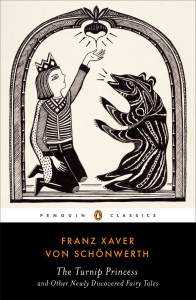
The fruits of this labor of love, of Schönwerth’s (and later Eichenseer’s) hard work, have now been expertly translated, introduced, and commented upon by Maria Tatar in a volume titled The Turnip Princess and Other Newly Discovered Fairy Tales.
When Open Culture recently published Jorge Luis Borges’ self-compiled list of 74 ‘great works of literature’, commissioned by Argentine publisher Hyspamerica, I, along with many others, saw one glaring issue in the otherwise fantastically diverse list: it included no works by female writers.
Whether intentional or not, the fact that women are excluded from Borges’ noteworthies (and in 1985, no less) means that a vast number of historically and culturally significant books and writings have been overlooked. While this ought not to discredit the works listed in any way, after witnessing the immense popularity of Borges’ list I certainly felt that for his selection to be relevant today it needed to be accompanied by a list of works which had been overlooked due to the gender of their respective authors.
I decided to put a suggestion to a group of international women writers, artists and curators, and we compiled our own list of 74 ‘great works of literature’ — one just as varied, loose and substantial as that of Borges, but made up solely of writers identifying as women or non-gender-binary. Over two days we amassed many suggestions, which I’ve now curated to form the list below. It’s not intended to invalidate the original, but rather to serve as an accompaniment to highlight and encourage a dialogue on gender imbalances in creative and intellectual realms, as well as to provide a balance by actively ‘equalising’ that of Jorge Luis Borges.
More than 5,000 of you nominated. More than 60,000 of you voted. And now the results are in. The winners of NPR’s Top 100 Science-Fiction and Fantasy survey are an intriguing mix of classic and contemporary titles.
Mia Wasikowska is beyond amazing! If I could only ever watch her and Keira Knightley’s movies, I would still die happy. The upcoming gothic horror film she is cast in, Crimson Peak by Guillermo del Toro, sounds creepy and intriguing…to be released October 2015 and also stars Chastain, Hiddleston and Hunnan.
I tried accessing ShoutFactory! content this morning (Thursday, February 5) but content is not yet playable/accessable on my desktop or iPad. I’m interesting in checking out Twilight Zone, Bushido Man and Dreamscape. An error comes up “Sorry, the requested video is not yet available on this device.” Content may be accessible later this afternoon or there may be an issue with accessing content from Canada. The About Us page states “SHOUT! FACTORY TV is a free-to-the viewer, ad-supported video offering containing full-length television shows, movies, specials, and original content viewable through desktop computers, mobile, tablet, and “over-the’top” devices such as Roku…In addition, Shout! Factory maintains a vast digital distribution network which delivers video and audio content to all the leading digital service providers in North America.”
The big four broadcast networks — ABC, CBS, Fox, and NBC — don’t really have specific brands. They’re nebulous, offering drama, comedy, reality, and whatever else they put on the air. They’re the giant department stores of TV. Cable channels are more like specialty stores. ESPN is for sports fans. Nickelodeon is for kids. TNT knows drama.
The same is now happening with streaming services. We have a “big three” — Netflix, Hulu, and Amazon Prime. We have offshoots of TV networks, like HBO Go and Showtime Anytime.
And now we’re starting to see the rise of specialty streaming services, like one launching from Shout! Factory. Previously known for releasing DVDs of films and TV shows other studios didn’t want to, Shout’s new streaming service carries the same philosophy to the world of online TV. It’s filled with classic shows and movies that are hard to find elsewhere. It’s got more of an eye toward curation than building a platform. It’s built off of others’ software.
What’s hitting the big screen this year? Basically, everything. Luke Skywalker, James Bond, the Terminator, Velociraptors, all the superheroes. But there are also some great surprises, like a movie based on a beloved Nebula-winning novel. Here are the 67 Science Fiction And Fantasy Movies To Watch Out For In 2015! | io9.
Of all the books published over the last 12 months, which were the very best? We wanted to get a sense of the consensus, so we aggregated 23 different Best of 2014 lists — from The Washington Post to Library Journal to Buzzfeed and more. Then we compiled rankings based on the number of times each books was listed.
Below you’ll find an infographic that highlights the top-ranked books. (We created separate infographics for books in the romance, mystery & thriller, business, young adult, and nonfiction categories.) We hope you find some great new books on these lists — we certainly did! via The Best Books of 2014 | The Ultimate List | BookBub Blog
A very thoughtful essay questioning the distinction between genre versus literature, using Station Eleven by Emily St. John Mandel as an example. Well worth the read.
Snip
It’s hard to talk in a clear-headed way about genre. Almost everyone can agree that, over the past few years, the rise of the young-adult genre has highlighted a big change in book culture. For reasons that aren’t fully explicable (Netflix? Tumblr? Kindles? Postmodernism?), it’s no longer taken for granted that important novels must be, in some sense, above, beyond, or “meta” about their genre. A process of genrefication is occurring.
That’s where the agreement ends, however. If anything, a divide has opened up. The old guard looks down on genre fiction with indifference; the new arrivals—the genrefiers—are eager to change the neighborhood, seeing in genre a revitalizing force. Partisans argue about the relative merits of “literary fiction” and “genre fiction.” (In 2012, Arthur Krystal, writing in this magazine, argued for literary fiction’s superiority; he fielded a pro-genre-fiction riposte from Lev Grossman, in Time.) And yet confusion reigns in this debate, which feels strangely vague and misformulated. It remains unclear exactly what the terms “literary fiction” and “genre fiction” mean. A book like “Station Eleven” is both a literary novel and a genre novel; the same goes for “Jane Eyre” and “Crime and Punishment.” How can two contrasting categories overlap so much? Genres themselves fall into genres: there are period genres (Victorian literature), subject genres (detective fiction), form genres (the short story), style genres (minimalism), market genres (“chick-lit”), mode genres (satire), and so on. How are different kinds of genres supposed to be compared? (“Literary fiction” and “genre fiction,” one senses, aren’t really comparable categories.) What is it, exactly, about genre that is unliterary—and what is it in “the literary” that resists genre? The debate goes round and round, magnetic and circular—a lovers’ quarrel among literati.

 infophile