What is reddit? | YouTube


▶ What is reddit? | YouTube.

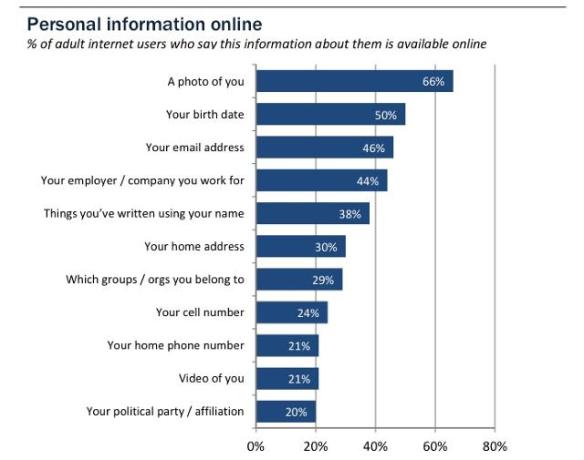
Ever Been Twitter/Email/Facebook-Hacked? You’re Not Alone | Co.Exist


As of July, more people are disabling cookies, editing profiles, using encryption services, and Googling how to install those encryption services than before. But a new survey out from the Pew Research Center’s Internet Program and Carnegie Mellon University sheds light on other reasons why we might feel like our information is vulnerable: It could be because many of us have been screwed over by our bad privacy habits on the Internet already.

Ever Been Twitter/Email/Facebook-Hacked? You're Not Alone | Co.Exist | ideas + impact

The full story including more charts: Ever Been Twitter/Email/Facebook-Hacked? You’re Not Alone | Co.Exist | ideas + impact.

Google Outlines Anti-Piracy Tactics in Comprehensive Report | Mashable


The Internet giant took a proactive step in the battle against online piracy Tuesday by releasing a 26-page report titled “How Google Fights Piracy.” Google announced this release through a post on its public policy blog, which summarized “highlights” of the report.

via Google Outlines Anti-Piracy Tactics in Comprehensive Report | Mashable.

Google, Facebook and Yahoo petition court to disclose government data requests | Engadget


It’s not every day you see Google, Facebook and Yahoo aligned on a issue, but a push toward increased governmental transparency is just the sort of cause that’ll put competing web companies on the same outraged page. All three noted [September 9, 2013] through their respective channels that they’ve filed petitions with the Foreign Intelligence Surveillance Court (FISC) to disclose the number of requests the government has issued for user data under national security statutes.

The full story: Google, Facebook and Yahoo petition court to disclose government data requests | Engadget.

BiblioTech Digital Library Opens this Week | GoodEReader


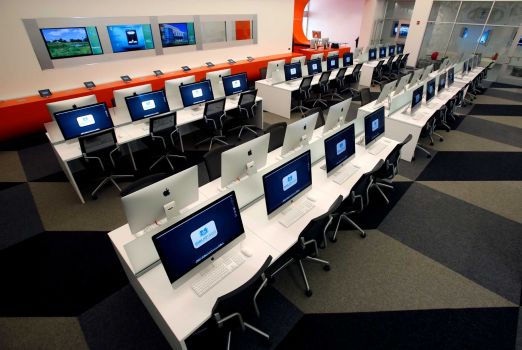
The BiblioTech library in Bexar County is doing something that no library in the US has ever done. Since last year, the organizers had a grand vision of an all digital library. Six hundred e-readers and over ten thousand eBooks will be available to loan out when the new library opens this week.

BiblioTech Library

via BiblioTech Digital Library Opens this Week | GoodEReader.

The 10 Governments That Requested (And Got) The Most Facebook User Data | Co.Exist


74 countries sought data from Facebook for 38,000 of the network’s total 1.15 billion users.

Requests for Facebook data made from Jan to June 2013 (some requests include multiple users):

  1. United States (11,000-12,000 requests, 79% success)
  2. India (3,245 requests, 50% success)
  3. United Kingdom (1,975 requests, 68%success)
  4. Germany (1,886 requests, 37% success)
  5. Italy (1,705 requests, 53% success)
  6. France (1,574 requests, 39% success)
  7. Brazil (715 requests, 33% success)
  8. Australia (546 requests, 64% success)
  9. Spain (479 requests, 51% success)
  10. Poland (233 requests, 9% success)

The full discussion: The 10 Governments That Requested (And Got) The Most Facebook User Data | Co.Exist | ideas + impact.

Links for Recent Pew Research News


Pew: 30% Of U.S. Adults Don’t Have Broadband; 10% Use Smartphones As Sole Internet Access; 20% Have Zilch | TechCrunch – August 26, 2013
Pew Research…releas[ed] the results of a survey that shows how one of the more advanced countries in the world, the U.S., is still not quite there in leading by example: 20% of U.S. adults are still without broadband or smartphones for internet access. And 3% of people in the country still using dial-up connections.

The below link is related the same Pew research results as the article above but provides discussion on a different perspective – the digital divide in America.  See the original Home Broadband 2013 Pew report – August 26, 2013.

Latest Pew Study Shows 70 Percent of U.S. Has Broadband. But Access Is Still Unequal | Wired.com – August 26, 2013
Pew’s results demonstrate that the digital divide is persistent, with close correlations between socioeconomic status and home Internet access. The report is also a reminder that policymakers use the words “high-speed broadband” to include everything other than dialup access, which is far too broad a definition.

Adult Trend Data | Pew Internet 
Latest data about device ownership by American adults up to end-May 2013.

Pew Study: More millennials are living with their parents than ever before | Stephen’s Lighthouse | August 22, 2013
According to a Pew poll, 36 percent of young adults are afflicted with Failure to Launch syndrome.

Teens say they generally rely on themselves to figure out how to manage their privacy online | Stephen’s Lighthouse – August 22, 2013
Teens say they generally rely on themselves to figure out how to manage their privacy online; Still, 70% of teens have at one time sought advice about how to manage their privacy online. See the Pew Internet report from August 15, 2013.

Teens and Mobile Apps Privacy | Pew Internet – August 22, 2013
As teens gain access to mobile devices, they have embraced app downloading. But many teen apps users have taken steps to uninstall or avoid apps over concern about their privacy. Location information is considered especially sensitive to teen girls, as a majority of them have disabled location tracking features on cell phones and in apps because they are worried about others’ access to that information.

Teens Haven’t Abandoned Facebook (Yet) | Pew Internet – August 15, 2013
When we released our “Teens, Social Media and Privacy” report in May, one thread of news coverage focused on teens’ “waning enthusiasm” for Facebook. This theme surfaced during our focus group discussions with teens and stood in contrast to the excitement that was associated with newer platforms like Instagram and Twitter.

Student Leadership: Time to get on Board! | Hack Library School


Here’s an MLIS student’s take on getting involved in leadership activities while completing a graduate program.

Student Leadership: Time to get on Board! | Hack Library School.

Facebook Leads an Effort to Lower Barriers to Internet Access | NYTimes.com


About one of every seven people in the world uses Facebook. Now, Mark Zuckerberg, its co-founder and chief executive, wants to make a play for the rest — including the four billion or so who lack Internet access.

On Wednesday, Facebook plans to announce an effort aimed at drastically cutting the cost of delivering basic Internet services on mobile phones, particularly in developing countries, where Facebook and other tech companies need to find new users. Half a dozen of the world’s tech giants, including Samsung, Nokia, Qualcomm and Ericsson, have agreed to work with the company as partners on the initiative, which they call Internet.org.

The companies intend to accomplish their goal in part by simplifying phone applications so they run more efficiently and by improving the components of phones and networks so that they transmit more data while using less battery power.

There is considerably more content to this article. See the full story:  Facebook Leads an Effort to Lower Barriers to Internet Access | NYTimes.com.

Explore Mashable’s Crowdsourced Digital Bill of Rights


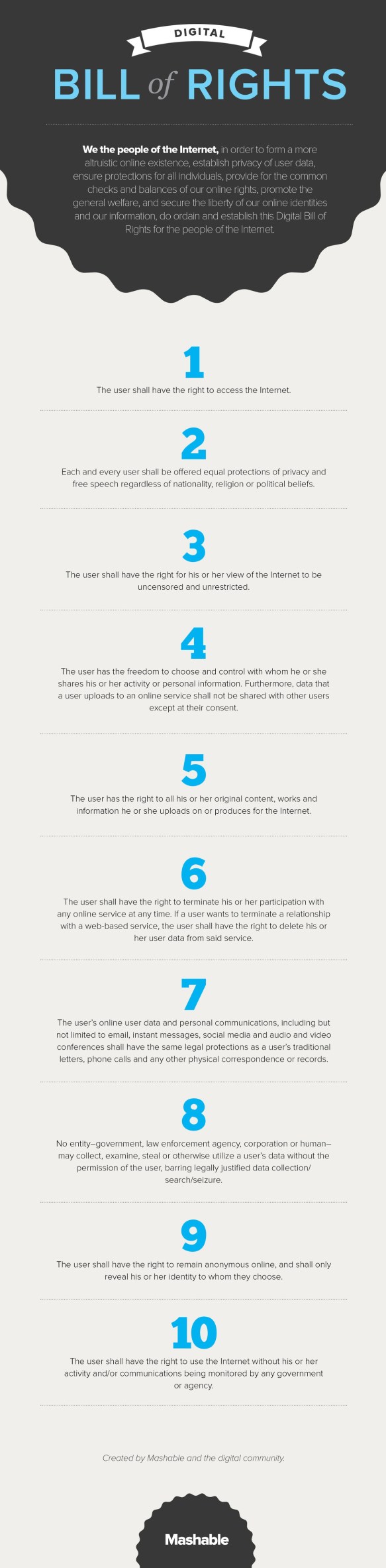
After six weeks of public discussions, document updates and changes, as well as incorporating input from digital rights experts, Mashable is pleased to unveil its first-ever Digital Bill of Rights, made for the Internet, by the Internet.

via Explore Mashable’s Crowdsourced Digital Bill of Rights.

Digital Bill of Rights