The Anatomy of a Successful Responsive Website [INFOGRAPHIC] Mashable


The rate of copyright infringement reports Google received in 2013 is on track to quadruple the number of reports received in 2012.
In the first seven months of 2013, publishers have submitted 110.2 million requests to remove copyright-infringing content, compared with 55.2 million requests in all of 2012.
via Google Copyright Infringement Reports to Quadruple This Year | Mashable.
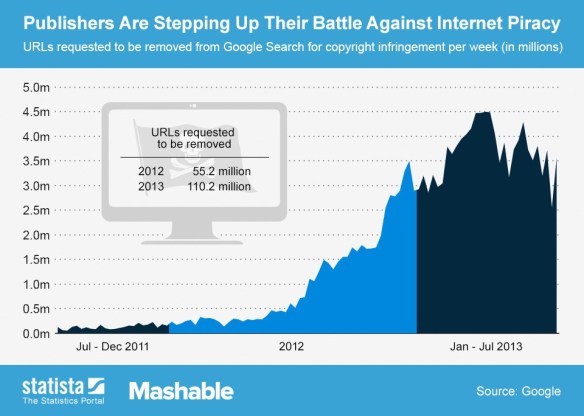
Image: Tony Karumba/AFP/Getty Images
You may also like:
Governments’ Attempts To Censor Google Have Doubled Since 2011 | TechCrunch
Info ladies crisscross the countryside offering the chance to see a loved one, get a blood sugar check or even legal advice.

Read this amazing story of entrepreneurial spirit: ‘Info ladies’ go biking to bring remote Bangladeshi villages online | Global development | Guardian Weekly.
The Pew Research Center’s Internet & American Life Project has been studying online adults’ social networking site use since 2005, and has seen substantial growth since then. Today, 72% of online adults use social networking sites. Although younger adults continue to be the most likely social media users, one of the more striking stories about the social networking population has been the growth among older internet users in recent years. Those ages 65 and older have roughly tripled their presence on social networking sites in the last four years—from 13% in the spring of 2009 to 43% now.
In this report we also studied online adults’ use of Twitter. The percentage of internet users who are on Twitter has more than doubled since November 2010, currently standing at 18%. Internet users ages 18-29 are the most likely to use Twitter—30% of them now do so…via 72% of Online Adults are Social Networking Site Users | Pew Research Center’s Internet & American Life Project
The full report here.

For the past few weeks, Mashable has been crowdsourcing a Digital Bill of Rights to highlight the digital freedoms and protections our readers feel each user should be guaranteed as a citizen of the Internet.
After hundreds of comments and contributions on the Google Doc and through social media, a Digital Bill of Rights by the Internet, for the Internet, has been created. The document, though, is a work in progress as more users from across the world continue to include their thoughts and additions to it.
An analysis of the most highly contested articles on Wikipedia reveals the controversies that appear invariant across languages and cultures.
See the full article: Edit Wars Reveal The 10 Most Controversial Topics on Wikipedia | MIT Technology Review. The 10 most controversial topics are:
Pew Study: Technology Aids Students’ Writing Skills Though Challenges Remain | The Digital Shift
Digital technologies are impacting American middle and high school students’ writing in many ways, both good and bad, a new national report from the Pew Research Center shows.
Internet adoption becomes nearly universal among some groups, but others lag behind | Pew Research Center
New data from the latest survey by the Pew Research Center’s Internet Project in the spring shows that 85% of Americans adults use the internet at least occasionally. Five years ago, in an April 2008 survey, 73% of adults used the internet. Ten years ago, in May 2003, 63% of adults used the internet.
Personal. Portable. Participatory. Pervasive. from Pew Research Center’s Internet & American Life Project
Today, the American Library Association (ALA) joined an unprecedented coalition of Internet companies and advocates to deliver a letter to the U.S. government demanding greater transparency around national security-related surveillance of Internet and telephone communications.
A perennial topic of conversation among people who debate literature on the Internet is the relative importance of books as physical objects. Foremost among defenders of the printed book are those who extol the sensual pleasures of reading—the feel of the pages, the heft of the object, the smell of the paper—and maintain that it is impossible to experience those pleasures digitally.
In a related, but separate, camp are those attracted not to the tactile pleasures of books but to their beauty as objects.
via Internet Book Fetishists Versus Anti-Fetishists | The New Yorker.

 infophile