Broadband providers aren’t “common carriers,” court says, and that makes all the difference in a decision certain to shake up the fixed broadband and wireless industries.
Amazon ‘drones’ stir up privacy concerns among lawmakers | CNET
Sen. Edward Markey says the Federal Aviation Administration needs to adopt privacy regulations before allowing services like Amazon Prime Air, which will use drones to deliver packages, to get off the ground.
Amazon Prime Air drones revealed on 60 Minutes, aim to deliver in half an hour (video) | Engadget
Amazon CEO Jeff Bezos took to 60 Minutes to reveal the company’s latest delivery method: drones. In what is likely a cunning reminder of the e-tailer’s upcoming Cyber Monday sales, these bots will apparently be capable of delivering packages up to five pounds (86 percent of orders are apparently less than that), with the aim of getting them to your house in under half an hour. The system is called Prime Air and the octo-copter drones, which wait, ready to deliver, at the end of conveyor belts, have a range of 10 miles. As Amazon puts it, “Putting Prime Air into commercial use will take some number of years as we advance the technology and wait for the necessary FAA rulesand regulations” and Bezos himself added in the TV segment that it won’t be before 2015 at the very earliest. While it sounds like they”ll take their time to get here (if they ever do), we’ve at least got a video of the drones in action — it’s right after the break.
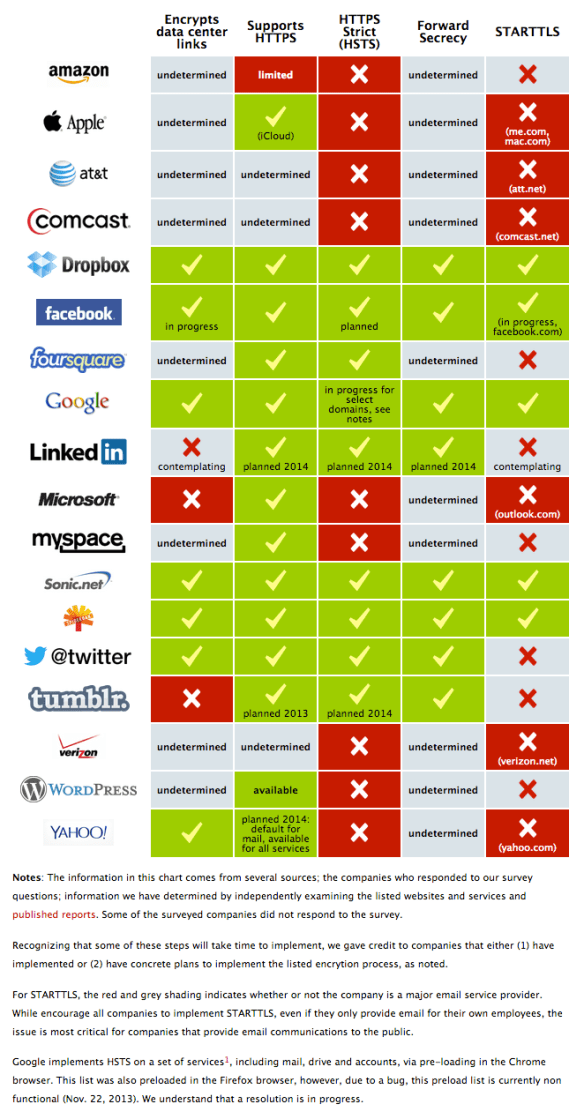
We’ve asked the companies in our Who Has Your Back Program what they are doing to bolster encryption in light of the NSA’s unlawful surveillance of your communications. We’re pleased to see that four companies—Dropbox, Google, SpiderOak and Sonic.net—are implementing five out of five of our best practices for encryption. In addition, we appreciate that Yahoo! just announced several measures it plans to take to increase encryption, including the very critical encryption of data center links, and that Twitter has confirmed that it has encryption of data center links in progress.
Google’s latest updates to its terms of service have left many privacy advocates crying foul. One new feature called “shared endorsements” allows your name and photograph to be used in targeted advertisements on Google property sites.
Google’s support page for shared endorsements claims the feature will allow for more friend-based recommendation of music and restaurants, working much like Facebook’s Sponsored Stories.
Shared endorsements are not unique. Many sites, apps and browsers are using your information in ways you might not entirely comply with if you’d take the time to read their privacy policies. Often, opting out is only a click away, though it may be difficult to find out where exactly to click.
We’ve compiled this list of ways various Internet companies are tracking and using your data — plus, given you the tools to opt out, if you wish.
Decision in French court comes after former head of Formula One said that showing images breaches his privacy.
The important consideration in this story is the following snip:
The decision is a setback to Google as it tries to defend a global stance that the search engine is merely a platform that delivers links to content and it should not be responsible for policing them.
Although Google can delete images on its website, it cannot prevent others reposting them, resulting in a constant game of catch-up.
In a statement, Google said the court’s request would require it to build a new software filter to continuously catch new versions of the posted images and remove them.
“This is a troubling ruling with serious consequences for free expression and we will appeal it,” said Google’s associate general counsel Daphne Keller in a statement.
Web inventor Berners-Lee sounds alarm on mass spying | CNET
Sir Tim Berners-Lee says the activities of the NSA and its UK counterpart, the GCHQ, could warp his baby, making the Internet vulnerable to attack and depriving humanity of a “safe space” for problem solving.
If your growing weariness of being constantly tethered to the Internet has become overwhelming, it might be time to scrub yourself from the social media sphere altogether. Here’s how you can become a ghost on the Internet, by tracking down and eliminating your digital past.
Provides instructions for how to remove/deactivate accounts for Facebook, Twitter, LinkedIn, and Google+. Recommends other tools including Account Killer, Just Delete Me and Knowem.
Jamie Oliver has banned his children from social media – and in many families there is a constant battle between demands for privacy and safety. Here, parents share the lessons they have learned and the techniques they use.
Facebook’s analytics chief Ken Rudin recently opened up to The Journal about how the social network plans to track user behavior. Long story short, Facebook plans to track it very closely. At the moment, the company is testing software that would record everything from when a user’s Newsfeed is visible on the screen to how long a user hovers over a certain part of the page.
That’s right. Facebook wants to know exactly where you’re moving your mouse. At all times.

 infophile