Google Submits New Patent for Triggered Sounds in eBooks | GoodEReader


Google…filed for a new patent that would make eBooks come alive with sounds. The sounds would be triggered by events within the book, such as lapping waves, an ominous crescendo, or maybe an outdoor market. The new application would have the sounds stored on a server and would be pushed out to the eBook users are reading at the time.

The full story: Google Submits New Patent for Triggered Sounds in eBooks | GoodEReader.

Ron McCallum: How technology allowed me to read | TED.com


Months after he was born, in 1948, Ron McCallum became blind. In this charming, moving talk, he shows how he is able to read — and celebrates the progression of clever tools and adaptive computer technologies that make it possible. With their help, and that of generous volunteers, he’s become a lawyer, an academic, and, most of all, a voracious reader. Welcome to the blind reading revolution.

via Ron McCallum: How technology allowed me to read | Video on TED.com.

Oyster: The Netflix Of Books | HuffPost Books


Oyster, an app launched [September 5, 2013] by a trio of self-proclaimed bookworms, is already being called the “Netflix for books.” That’s a lofty moniker, but the app may just live up to the hype – it offers access to over 100,000 books for $9.95 a month!

Right now, the only Big 5 publisher it’s partnered with is HarperCollins, but they’ve still got some really big books: “Life of Pi,” “Water for Elephants,” and “The God Delusion” all came up when we were browsing.

According to its website, they are constantly adding new titles, so who knows? Other bigger publishers may be signing on as well.

Right now, Oyster is invitation-only, and it’s only available as an iPhone app (although they’ll be adding on a iPad app later this fall). The app is free to download. You can request an invite here.

via Oyster: The Netflix Of Books  | HuffPost Books.

Tumblr Opens Reblog Book Club | GalleyCat


Tumblr has launched the Reblog Book Club, its first official book club. The series opens with Fangirl by Rainbow Rowell, “a coming-of-age story about fanfiction, family, and first love.”

If you want to join the book club conversation, you can post to your Tumblr with the #reblogbookclub tag or you can follow this link to post on the official Tumblr page. 

via Tumblr Opens Reblog Book Club | GalleyCat.

Do books have the power to heal? | Macleans.ca


Most of Ella Berthoud’s patients are young professionals: cosmopolitan careerists in their 30s or 40s. Some are burdened with anxiety. Some feel adrift in their mid-lives. Many are approaching rites of passage: a first child, retirement, a gap year in India, the death of a spouse. But others have more singular afflictions. One patient was hooked on chick lit, and “terrified of reading anything more demanding.” A young couple was eager to rekindle a fizzling romance. Berthoud—a London-based “bibliotherapist”—has heard it all. In each case, the prescription is the same: Read a book.

via Do books have the power to heal? | Macleans.ca.

The post also includes a transcript of today’s (September 10, 2013) live chat with Ella Berthoud.

Run-n-Read keeps e-book text steady while you’re on the treadmill | Engadget


Weartrons may help those athletic readers maintain their focus with its upcoming Run-n-Read peripheral. The clip-on device detects its wearer’s movements and compensates for them on a host Android or iOS device, keeping e-book text steady in the midst of a treadmill run. Owners can also tap the Run-n-Read to turn pages, and the gadget doubles as a pedometer in between reading sessions.

via Run-n-Read keeps e-book text steady while you’re on the treadmill | Engadget

See the Weartrons Run-n-Read crowdfunding campaign.

Start-Ups Take Library Jobs | Reinventing Libraries | Library Journal


Three years ago, I wrote here that “libraries are so valuable that they attract voracious new competition with every technological advance” (see “Libraries, Ebooks, and Competition,” LJ 8/10, p. 22–23). At the time, I was thinking about Google, Apple, Amazon, and Wikipedia as the gluttonous innovators aiming to be hired for the jobs that libraries had been doing. I imagined Facebook and Twitter to be the sort of competitors most likely to be attracted by the flame of library value. But it’s the new guys that surprise you. To review the last three years of change in the library world, I’d like to focus on some of the start-ups that have newly occupied digital niches in the reading ecosystem. It’s these competitors that libraries will need to understand and integrate with to remain relevant.

The full story: Start-Ups Take Library Jobs | Reinventing Libraries | Library Journal.

The article reviews competitors GoodReads, Wattpad, Readmill, SIPX and Zola Books.

New Kindle Paperwhite Has Goodreads Built into Device | GalleyCat


Amazon has unveiled a new Kindle Paperwhite, building Goodreads interaction straight into the $119 eReader. Goodreads members can now rate books and share passages from inside the Kindle.

via New Kindle Paperwhite Has Goodreads Built into Device | GalleyCat.

E-Books Could Be The Future Of Social Media | Co.Labs


In the future, e-books will act just like social networks. We’ll use them on our phones, share and comment right inside e-reader apps, and publishers will use our data to help them make better marketing decisions. If you think digital reading is exploding now, just wait.

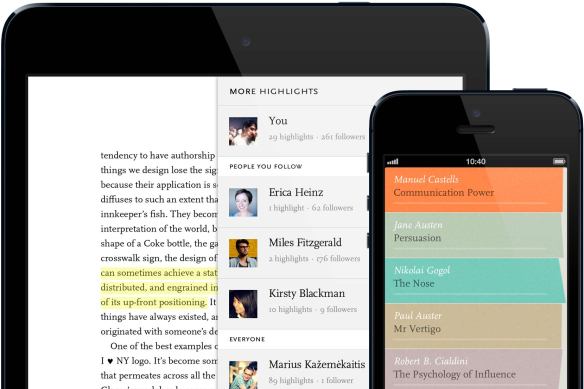
The article examines a new reading app called Readmill, which makes “each and every book its own self-contained social network.” See the full story: E-Books Could Be The Future Of Social Media ⚙ Co.Labs ⚙ code + community.

E-Books Could Be The Future Of Social Media ⚙ Co.Labs ⚙ code + community

Image Attribution: Readmill

GLBTI Fiction: Opening the Fiction Closet | Library Journal


Prior to World War II, GLBTI literature was hidden, with knowledge of its existence largely known only to members of the community, who shared texts among themselves. Occasionally a work of fiction would find its way into general circulation, but the books typically resorted to coded inferences of desire or served as warnings against the danger and immorality of homosexuality. This pattern continued until the 1969 Stonewall riot, which is largely accepted as the beginning of the GLBTI rights movement. The last three decades of the 20th century saw the establishment of GLBTI presses, bookstores, awards, and reading and book clubs, as well as literary festivals, writers’ conferences, and professional organizations. The closet was open, and the GLBTI community had found its voice.

Collection development and readers’ advisory (RA) staff can take advantage of a unique opportunity for professional growth by acquainting themselves with the widely dispersed sources of information about GLBTI literature. The task of identifying worthy contemporary purchases is best accomplished by consulting awards and recommended reading lists.

See the full article (which includes a longish list of recommended GLBTI fiction): via GLBTI Fiction: Opening the Fiction Closet | Library Journal.