Do books have the power to heal? | Macleans.ca


Most of Ella Berthoud’s patients are young professionals: cosmopolitan careerists in their 30s or 40s. Some are burdened with anxiety. Some feel adrift in their mid-lives. Many are approaching rites of passage: a first child, retirement, a gap year in India, the death of a spouse. But others have more singular afflictions. One patient was hooked on chick lit, and “terrified of reading anything more demanding.” A young couple was eager to rekindle a fizzling romance. Berthoud—a London-based “bibliotherapist”—has heard it all. In each case, the prescription is the same: Read a book.

via Do books have the power to heal? | Macleans.ca.

The post also includes a transcript of today’s (September 10, 2013) live chat with Ella Berthoud.

People Like Giving More When The Giving Is Social | Co.Exist


There are many, many selfless motivations for giving to a charity or doing a good deed. But being honest, most of us would also admit that these activities also make us feel good about ourselves–perhaps, dare I say it, even increase our overall happiness.

Do-gooders, charities, and even governments, then, might want to listen up to the results of a set of three recent psychology studies that are the first to measure in experiments what forms of “giving” are most likely to give us a warm, fuzzy feeling inside.

The full story: People Like Giving More When The Giving Is Social | Co.Exist | ideas + impact.

Pew: 86% Of U.S. Adults Make Efforts To Hide Their “Digital Footprints” Online; Fear Of Creeping Ads And Malicious Hackers Outweighs State Spy Worries | TechCrunch


As surveyed by the Pew Research Center, the average U.S. citizen appears to be more concerned about the data collecting abilities of advertising networks like those of Google and Facebook, faceless malicious hackers, and even friends and family, than they are the government.

See the full discussion of the research findings: Pew: 86% Of U.S. Adults Make Efforts To Hide Their “Digital Footprints” Online; Fear Of Creeping Ads And Malicious Hackers Outweighs State Spy Worries | TechCrunch.

Kelly McGonigal: How to make stress your friend | TED.com


Stress. It makes your heart pound, your breathing quicken and your forehead sweat. But while stress has been made into a public health enemy, new research suggests that stress may only be bad for you if you believe that to be the case. Psychologist Kelly McGonigal urges us to see stress as a positive, and introduces us to an unsung mechanism for stress reduction: reaching out to others.

via Kelly McGonigal: How to make stress your friend | TED.com.

Scientists Use Videogames to Improve Older Brains | WSJ


In the future, your doctor may prescribe you a videogame.

In a groundbreaking new study at the University of California, San Francisco, scientists found that older adults improved cognitive controls such as multitasking and the ability to sustain attention by playing a specially designed videogame — and that the effects can be long lasting.

The study, to be published in the scientific journal Nature on Thursday, is part of a broader effort to understand whether specially designed videogames can help treat neurological disorders, such as attention-deficit hyperactivity disorder and even depression. There is growing evidence, researchers say, that videogames could eventually become therapies on par, or used in tandem, with ingestible medications.

See the full story: Scientists Use Videogames to Improve Older Brains | Digits | WSJ.

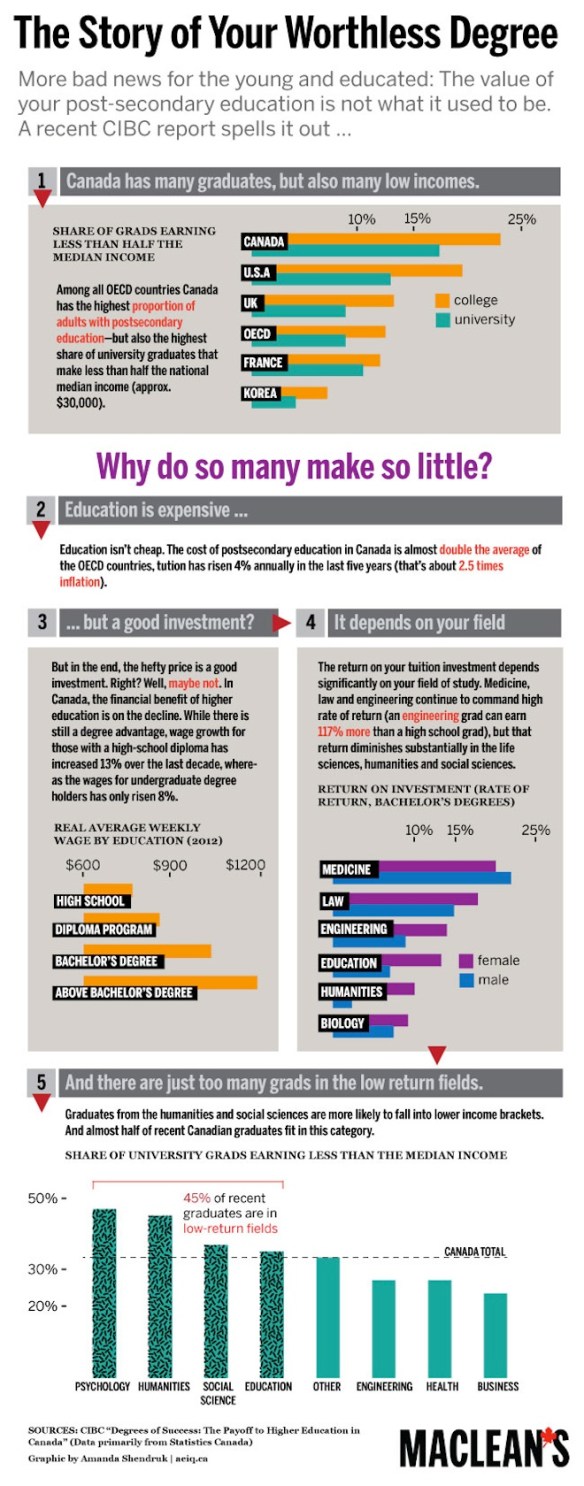
Degree or disagree: Your field of study matters [Infographic] | Macleans.ca


Degree or disagree: Your field of study matters – Blog Central, Show and Tell | Macleans.ca

Story of Your Worthless Degree

Value of Libraries Megapost | Stephen’s Lighthouse


I have been pulling together all of my posts on studies and reports on the value of public libraries for my work with the Federation of Ontario Public Libraries.  I thought I might as well post it here too. I’m sure I’ve got some dupes in here but c’est la vie!  Hope you find it useful!  There are many useful talking points and proofs in this research.

See the very mega megapost: Value of Libraries Megapost | Stephen’s Lighthouse.

The 10 Hottest Fields of Science Research | Wired Science


Scientific research is a large and sprawling endeavor, with thousands of laboratories around the world studying their own ultra-specialized piece of a much more significant whole. It’s the logical intersection of reductionist scientific heritage and centuries of technological advances: in order to advance our understanding of the world around us, we must pursue increasingly specific sub-disciplines.

Which is why Thomson Reuters’ scene-scoping study on “100 Key Scientific Research Fronts” is a welcome report for science enthusiasts eager to stay updated on cutting-edge research but lacking the time to read every issue of Science or Nature cover-to-cover.

The list:

  1. Impact of Climate Change on Food Crops
  2. Tectonic Evolution of the Southern Central Asian Orogenic Belt
  3. Transcatheter Aortic Valve Implantation
  4. DNA Methylation Analysis and Missing Heritability
  5. Ocean Acidification and Marine Ecosystems
  6. Enhanced Visible Light Photocatalytic Hydrogen Production
  7. Alkali Doped Iron Selenide Superconductors
  8. Galileon Cosmology
  9. High Energy Rechargeable Lithium Air Batteries
  10. Urban Policy Mobilities and Global Governance Issues

via The 10 Hottest Fields of Science Research – Wired Science.

Links for Recent Pew Research News


Pew: 30% Of U.S. Adults Don’t Have Broadband; 10% Use Smartphones As Sole Internet Access; 20% Have Zilch | TechCrunch – August 26, 2013
Pew Research…releas[ed] the results of a survey that shows how one of the more advanced countries in the world, the U.S., is still not quite there in leading by example: 20% of U.S. adults are still without broadband or smartphones for internet access. And 3% of people in the country still using dial-up connections.

The below link is related the same Pew research results as the article above but provides discussion on a different perspective – the digital divide in America.  See the original Home Broadband 2013 Pew report – August 26, 2013.

Latest Pew Study Shows 70 Percent of U.S. Has Broadband. But Access Is Still Unequal | Wired.com – August 26, 2013
Pew’s results demonstrate that the digital divide is persistent, with close correlations between socioeconomic status and home Internet access. The report is also a reminder that policymakers use the words “high-speed broadband” to include everything other than dialup access, which is far too broad a definition.

Adult Trend Data | Pew Internet 
Latest data about device ownership by American adults up to end-May 2013.

Pew Study: More millennials are living with their parents than ever before | Stephen’s Lighthouse | August 22, 2013
According to a Pew poll, 36 percent of young adults are afflicted with Failure to Launch syndrome.

Teens say they generally rely on themselves to figure out how to manage their privacy online | Stephen’s Lighthouse – August 22, 2013
Teens say they generally rely on themselves to figure out how to manage their privacy online; Still, 70% of teens have at one time sought advice about how to manage their privacy online. See the Pew Internet report from August 15, 2013.

Teens and Mobile Apps Privacy | Pew Internet – August 22, 2013
As teens gain access to mobile devices, they have embraced app downloading. But many teen apps users have taken steps to uninstall or avoid apps over concern about their privacy. Location information is considered especially sensitive to teen girls, as a majority of them have disabled location tracking features on cell phones and in apps because they are worried about others’ access to that information.

Teens Haven’t Abandoned Facebook (Yet) | Pew Internet – August 15, 2013
When we released our “Teens, Social Media and Privacy” report in May, one thread of news coverage focused on teens’ “waning enthusiasm” for Facebook. This theme surfaced during our focus group discussions with teens and stood in contrast to the excitement that was associated with newer platforms like Instagram and Twitter.

New IFLA Global Trends Report | American Libraries Magazine


It’s designed to assess “the impact of new technology on our global information environment,” said IFLA President Ingrid Parent, introducing the new IFLA Trend Report August 19[, 2013] during the World Library and Information Congress in Singapore.

Commissioned in 2012 and involving social scientists, economists, business leaders, educators, legal experts, and technologists, Riding the Waves or Caught in the Tide? examines “high-level societal trends,” challenging library professionals to be aware that:

  • (1) new technology will both expand and limit who has access to information,
  • (2) online education will transform and disrupt traditional learning,
  • (3) boundaries of data protection and privacy will be redefined,
  • (4) hyper-connected societies will listen to and empower new groups, and
  • (5) the global information economy will be transformed by new technologies.

via New Report Portends Global Societal Trends, as IFLA Continues in Singapore | American Libraries Magazine.

New Report Portends Global Societal Trends, as IFLA Continues in Singapore | American Libraries Magazine