Absolutely fabulist: The computer program that writes fables | CNET


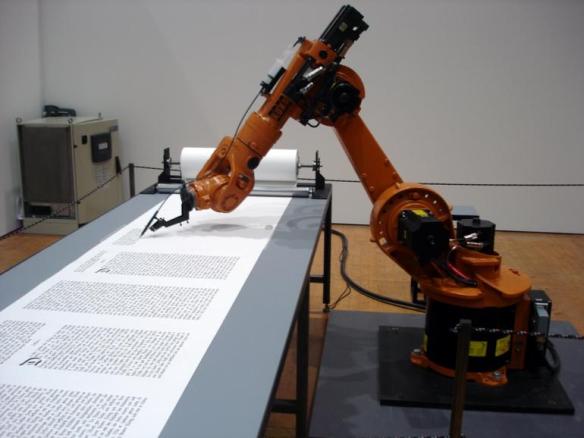
Forget a thousand monkeys at a thousand typewriters, researchers have created a computer program that writes fables by itself.

It might be a long way from “A Tale of Two Cities”, but researchers at Australia’s University of New South Wales have developed a computer program that is capable of writing its own fables.

The Moral Storytelling System, known as MOSS, has been developed by Margaret Sarlej, a PhD candidate at the School of Computer Science and Engineering at UNSW, led by Australian Research Fellow and artificial intelligence expert Dr Malcolm Ryan.

While humans are capable of creating simple or complex stories without a second thought, Sarlej said this is a skill that computers can’t easily emulate.

READ MORE: Absolutely fabulist: The computer program that writes fables | CNET.
Nearly 100 percent of libraries offer tech training and STEM programs, study finds | DistrictDispatch


According to a new study from the American Library Association ALA, nearly 100 percent of America’s public libraries offer workforce development training programs, online job resources, and technology skills training. Combined with maker spaces, coding classes, and programs dedicated to entrepreneurship and small business development, libraries are equipping U.S. communities with the resources and skills needed to succeed in today’s – and tomorrow’s – global marketplace.

READ: Nearly 100 percent of libraries offer tech training and STEM programs, study finds | DistrictDispatch

Display Technology Makes Reading Glasses Unnecessary | MIT Technology Review


Researchers are developing technology that can adjust an image on a display so you can see it clearly without corrective lenses. READ: Display Technology Makes Reading Glasses Unnecessary | MIT Technology Review.

Read the books that inspired Darwins theory of evolution | Engadget


Charles Darwins Galapagos expedition is one of the most famous scientific voyages in history and now you can see how he fed his mind aboard the Beagle. Darwin Online, which houses the world’s largest Darwin collection, has now published in PDF format what it believes to be all 404 books that Darwin had access to on the ships library. They comprise some 195,000 pages with 5,000 corresponding illustrations in French, English and Spanish from encyclopedias, history books, literature and even a racy Spanish novel. Darwin called his years aboard the Beagle a crucial a period that helped him create his seminal theory of evolution, On the Origin of Species. Though you may not have as much time as Darwin did on the infamously long trip, its worth a look just for the spectacular hand-drawn illustrations.

Access links here: Read the books that inspired Darwins theory of evolution | Engadget

Bee-Inspired Bots Skitter and Swarm at NYCs Museum of Mathematics | Gizmodo


Dr. James McLurkin has a swarm of robots. Individually, theyre not that smart, but a crateful of them behaves in some very complex ways, like the bees that inspired them. Gizmodo got to see the wee machines in action, and while theyre adorable, they represent some serious future bot capabilities.

Dr. McLurkin, a professor of computer science, runs the Multi-Robot Systems Lab at Rice University. He and his team research distributed algorithms for multi-robot systems. In other words, using the combined abilities of several rather simple robots to perform complex tasks. Dr. McLurkin has spent the past three years developing Robot Swarm, an exhibit of his hive-mind bots set to debut at Manhattans Museum of Mathematics in early 2015. This week, Dr. McLurkin gave a sneak preview of the exhibit, and Gizmodo was there.

READ MORE Bee-Inspired Bots Skitter and Swarm at NYCs Museum of Mathematics | Gizmodo

The real Jane Austen immortalised as waxwork | CNET


Working from a single confirmed portrait of the Regency author, a forensic artist has created what she believes to be the most accurate representation of Jane Austen possible. READ: The real Jane Austen immortalised as waxwork | CNET

Japan’s New Robot Museum Guides Are All Too Human | Mashable


Japans New Robots Are All Too Human

If you’re searching for the uncanny valley, look no further than the work of Osaka University professor Hiroshi Ishiguro. He has been creating humanoid robots for years, and his latest incarnation — which is so realistic its scary — will act as robot guides at the National Museum of Emerging Science and Innovation in Japan Miraikan.

The museum will welcome three robots, introduced in Japan on Tuesday. There’s the youthful-looking Kodomoroid, the adult female Ontonaroid and the baby-like Telenoid. With the exception of Telenoid, these robots look remarkably lifelike, have eerily expressive faces and are designed, in a limited sense, to move and communicate like real people.

Read More: Japans New Robots Are All Too Human | Mashable

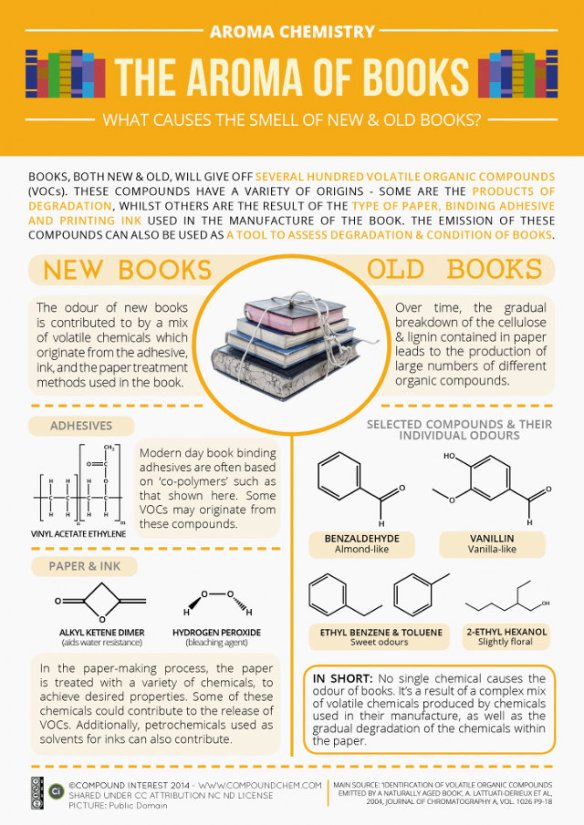
What Makes Old Books Smell Like Old Books? [Infographic]| Co.Exist


One of the most unique and little-noted features of the dead-tree reading platform is its smell. A crisp new edition of Pride and Prejudice is scented a whole lot differently than the musty, middle-aged printing still being read in many a high school English class today.

But what causes these smells? A UK chemist and teacher who runs the blog Compound Interest, an exploration of everyday chemical compounds, went to investigate and came up with an infographic to explain the matter.

Read More: What Makes Old Books Smell Like Old Books? | Co.Exist | ideas + impact

What Makes Old Books Smell Like Old Books? | Co.Exist | ideas + impact

Glasses-free 3-D projector | MIT News Office


Over the past three years, researchers in the Camera Culture group at the MIT Media Lab have steadily refined a design for a glasses-free, multiperspective, 3-D video screen, which they hope could provide a cheaper, more practical alternative to holographic video in the short term.

Read More: Glasses-free 3-D projector | MIT News Office.

Kinematics | Nervous System Blog


Kinematics is a system for 4D printing that creates complex, foldable forms composed of articulated modules. The system provides a way to turn any three-dimensional shape into a flexible structure using 3D printing. Kinematics combines computational geometry techniques with rigid body physics and customization. Practically, Kinematics allows us to take large objects and compress them down for 3D printing through simulation. It also enables the production of intricately patterned wearables that conform flexibly to the body.

Read More: Kinematics | Nervous System Blog.