How to Create Your Own Infographics « librarianlifestyle


How to Create Your Own Infographics « librarianlifestyle.

Mashable: The Ultimate Digital Customer Service Guide


The Ultimate Digital Customer Service Guide

Some of the tips in these articles can be applied to library and information services professions, such as number eight “14 Community-Driven Tips for Better Customer Relationships.”

GTA Technology Topics, Tips and Tricks: Online Privacy


I’ve seen the commentary on online privacy intensify the past few months. Facebook routinely changes its privacy policy it seems and Google has moved to one privacy policy for all of its applications. I think its good we hear about the privacy infractions by companies in the news, such as when the Sony database was hacked into and personal data was stolen from users. It really concerns me though about all the intrusions and privacy breaches that are not disclosed. Organizations need to start being more accountable for the client data they are charged with protecting and we need to start expecting more from the organizations we provide our personal information to. Users need to arm themselves to protect their information and identity, so its important to create awareness and give users tools to protect themselves. In that spirit here are some useful and informative links on online privacy.
 
The Sad State of Social Media Privacy Article & Infographic from Marketing Tech Blog/MDG Advertising.com
 
 
The Electronic Frontier Foundation proposed in 2010 a Bill of Privacy Rights for Social Network Users. They again built on this theme by creating A Mobile User Privacy Bill of Rights earlier this month.
 
 
The iLibrarian has a great post on this very topic which I am including below:
 
Social media and online privacy are always a concern, but more so in recent times with variable and ever-changing privacy policies. Here are five stories from the last couple of weeks covering online privacy:

Are You In Control of Your Social Media Privacy? [INFOGRAPHIC]
Stephanie Buck at Mashable blogs about a recent infographic titled Social Media Management: Protect Your Privacy created by ZoneAlarm, based on a 2012 study by Pew

Do You Value Your Internet Privacy?
Alicia Eler at ReadWriteWeb takes a look at a recent study released by the European Network and Information Security Agency (ENISA) in which researchers investigated whether or not customers of online services would pay a mark-up to an online service provider who protected their information better.

Social Media Privacy: 3 Questions to Ask Before Authorizing Third-Party Apps
Jamie Beckland at Mashable talks about how best to insure your privacy on social sites and whether it’s a good idea to authorize outside apps to access your information.

Internet privacy a growing concern, Pew finds
Benny Evangelista, SFGate dicusses privacy with regard to search engines and whether or not people’s search histories are being tracked.

How Do We Explain Patron Privacy in a World of Target Markets?
Laura Crossett writes an insightful article about privacy and library patrons.

GTA Technology Topics, Tips and Tricks: Pinterest


As an update to my prior post on Social Bookmarking, this post is dedicated to the new hot social media trend Pinterest (though it has been around since 2008).
 
Pinterest is a website of virtual inboards. From an LIS perspective, users “catalog” items and create visual collections by topic/interest/category.
 
Some may argue its an advertising tool to sell things and promote brands…I think Pinterest is a great tool to see what’s trending and popular.
 
Pinterest may have useful applications for libraries as discussed in these posts by the iLibrarian “5 Ways to Use Pinterest in Your Library” and “5 More Ways to Use Pinterest in You Library“.
 
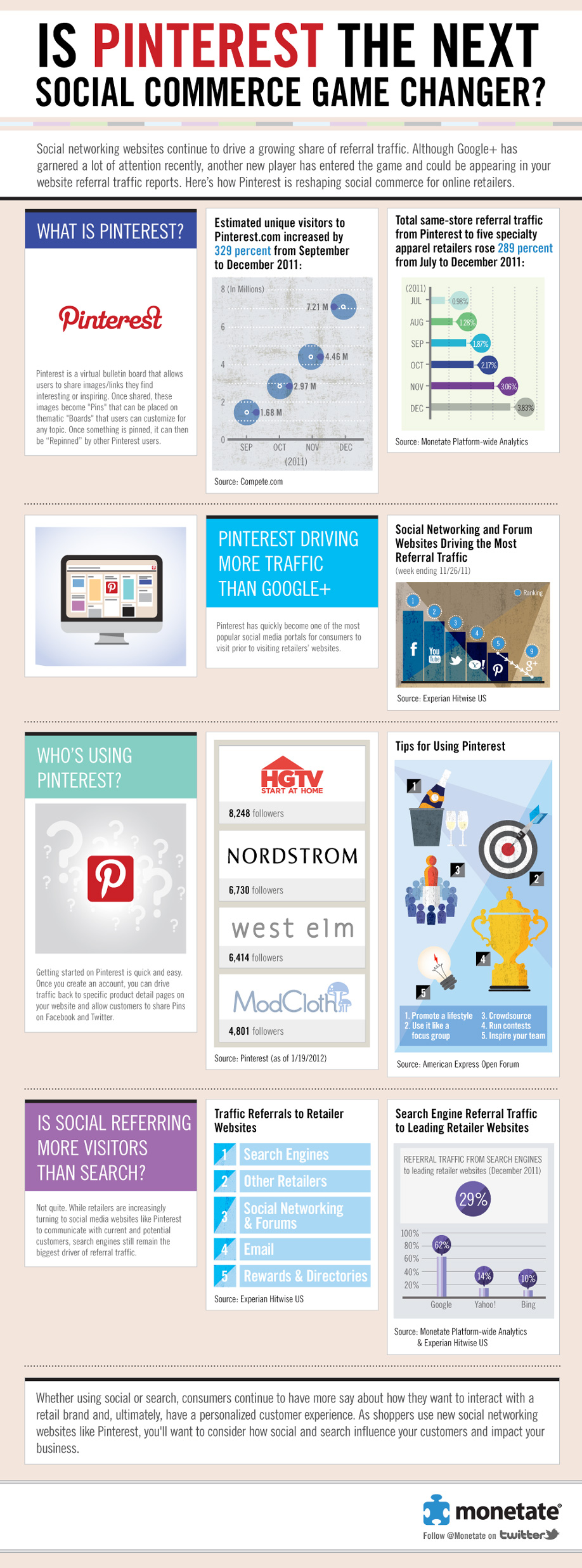
Here’s an infographic for some Pinterest stats…one of which is that 97% of Pinterest’s Facebook fans are women! Apparently Pinterest has no revenue business model right now and is focused on growing the service.
 

Another Infographic: Is Pinterest The Next Social Commerce Game Changer?


GTA Technology Topics, Tips & Tricks: Social Bookmarking & Recommender Sites


Here are some great websites to take a look at for social bookmarking (excluding Twitter and related web applications). Social bookmarking tools can be used to find recommendations, what is popular, share what you love, and find further information on a topic. This recent article by eBizMBA lists the top 15 of February 2012. The hottest social bookmarking website right now is Pinterest. It does look pretty cool.  I wish I had the time to use all these social bookmarking tools!
 
Pinterest – “Pinterest lets you organize and share all the beautiful things you find on the web. People use pinboards to plan their weddings, decorate their homes, and organize their favorite recipes.”  I love how visually-based this website is! With such cool pin boards as “Plan a Wedding” or “Save your inspirations.”
 
Reddit – “The front page of the Internet.” Lists links and ranks the most popular websites on the Internet and websites that are trending. 
 
Delicious – “Delicious helps you find cool stuff and collect it for easy sharing. Dig into stacks created by the community, and then build your own!” 
 
Digg – “Digg is a place for people to discover and share content from anywhere on the web. From the biggest online destinations to the most obscure blog, Digg surfaces the best stuff as voted on by our community.”
 
StumbleUpon – “We help you explore new and interesting things from every corner of the Web.”  You tell StumbleUpon what you like and it will recommend web pages, videos, photos and more that “you wouldn’t have found on your own.”
 
GetGlue – “GetGlue is a social network for entertainment. Users check-in and share what they are watching, listening to and reading with friends; get fresh recommendations, exclusive stickers, discounts and other rewards from their favorite shows and movies.”
 

Mentoring 2.0


HLWIKI Canada provides a Mentoring 2.0 summary (mentoring in web 2.0 context) and references for Library and Information Studies students.

An Interesting Concept: Reverse Mentoring


Helpful in teaching more senior employees about social media, internal and external communication, motivating young workers and learning about other cultures.

Role reversal: Mentoring from the bottom up – The Globe and Mail.