Bosses May Use Social Media to Discriminate | WSJ.com


Many companies regularly look up job applicants online as part of the hiring process. A new study suggests they may also use what they find to discriminate.

The study, a Carnegie Mellon University experiment involving dummy résumés and social-media profiles, found that between 10% and a third of U.S. firms searched social networks for job applicants’ information early in the hiring process. In those cases, candidates whose public Facebook profiles indicated they were Muslim were less likely to be called for interviews than Christian applicants. The difference was particularly pronounced in parts of the country where more people identify themselves as conservative. In those places, Christian applicants got callbacks 17% of the time, compared with about 2% for Muslims.

The same experiment, conducted from February to July of this year, found that online disclosures about job candidates’ sexuality had no detectable impact on employers’ early interest.

The research is the latest example of how people’s digital trails can have far-reaching and unintended effects, particularly in the job market.

Read the rest of the story: Bosses May Use Social Media to Discriminate | WSJ.com.
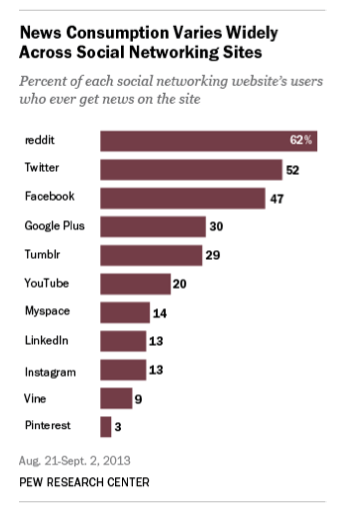
Pew Social Media Study: 30% Of The U.S. Gets News Via Facebook; Reddit Has The Most News-Hungry Regular Users | TechCrunch


The Pew Research Center is today releasing comparative numbers looking at how U.S. adults use social networking sites to read news (a follow-on from earlier research focusing on two specific sites, Facebook and Twitter).

This is significant for a couple of reasons. Social media sites have become a key component of how many news organizations today are looking to reach consumers as old-media forms like printed editions continue to decline. In turn, social media sites are turning news a way of attracting more eyeballs to improve their own ad-based businesses. That is to say, news and social media are dancing partners that are still working out how to move in the same direction without stepping on each other’s feet, and this survey is one indicator of how well the public is receiving that.

Read more and see all the charts: Pew Social Media Study: 30% Of The U.S. Gets News Via Facebook; Reddit Has The Most News-Hungry Regular Users | TechCrunch.

Pew: News Consumption

Why Facebook Would Pay $3 Billion for Snapchat (And Why It Shouldn’t) | Wired.com


Facebook just tried to spend $3 billion on a 20-person company that lets you send disappearing photos. At least, that’s the word from The Wall Street Journal, a rather trustworthy source.

According to the paper, SnapChat rejected the offer. But the amazing thing is that Facebook would offer that much money in the first place. SnapChat has no revenues, and its collection of users — however many there are — is puny when you consider that Facebook reaches over 1.2 billion people around the world. Across the internet, so many people are asking themselves: Why on earth would Facebook offer so much for this tiny company?

Read more: Why Facebook Would Pay $3 Billion for Snapchat (And Why It Shouldn’t) | Wired Business | Wired.com.

Networked Worlds & Networked Enterprises | Pew Research Center


Networked Worlds & Networked Enterprises
Lee Rainie, Director of the Pew Research Center’s Internet Project, shows how the large, loosely knit social circles of networked individuals expand opportunities for learning, problem solving, decision making, and personal interaction.

The new social operating system of “networked individualism” requires us to develop networking skills and strategies, work on maintaining ties, and balance multiple overlapping networks. The “triple revolution” that has brought on this transformation: the rise of social networking, the capacity of the Internet to empower individuals, and the always-on connectivity of mobile devices.

Drawing on extensive evidence, Rainie examines how the move to networked individualism has driven changes in organizational structure, job performance criteria, and the way people interact in workplaces. He presents a glimpse of the new networked enterprise and way of working.


5 sites teens flock to instead of Facebook | MarketWatch


Reviews Snapchat, Pheed, PicsArt, Tumblr, and Vine. Read: 5 sites teens flock to instead of Facebook | MarketWatch

You may also like: Snapchat Ceo Evan Spiegel Talks Sexts And Growth | AP

The Beginner’s Guide to TweetDeck | Mashable


TweetDeck‘s development path might look more like a roller coaster than the typical incline, but it’s for good reason. After Twitter bought the app in 2011, TweetDeck pulled support for various social networks — most recently Facebook — and dropped its mobile apps in order to focus on its core purpose in desktop form: Twitter.

Social media managers and casual tweeters alike can benefit from TweetDeck’s organizational tools, such as customizable columns, multiple account toggling and scheduling. With a modern, clean design and automatically refreshing feeds, TweetDeck’s utility comes in its simplicity and ease in setting up.

Here’s how to get started on TweetDeck. Soon your personal and professional Twitter troubles will be long gone.

Read the guide: The Beginner’s Guide to TweetDeck | Mashable

Related:

Upstagram Is A Flying Raspberry Pi That Publishes Live Pictures On Instagram | TechCrunch


What do Instagram, the Raspberry Pi and the movie “Up” have in common? When you mash all these things together, you get Upstagram, a neat hack that the Hackerloop team just unveiled.

First, the team made a replica of the house in “Up” using paper and foam. It was just big enough to fit a Raspberry Pi and its camera, a battery and a 3G hotspot. The Raspberry Pi, an open source and very cheap mini-computer to tweak, experiment and try new things with, is a hacker’s dream.

Then, the team used about 90 helium balloons to make the house fly above Paris’ landscape. While Instagram is only available on iOS and Android, they reverse-engineered the posting process to transform the Raspberry Pi into an Instagram-taking machine.

Read more: Upstagram Is A Flying Raspberry Pi That Publishes Live Pictures On Instagram | TechCrunch.

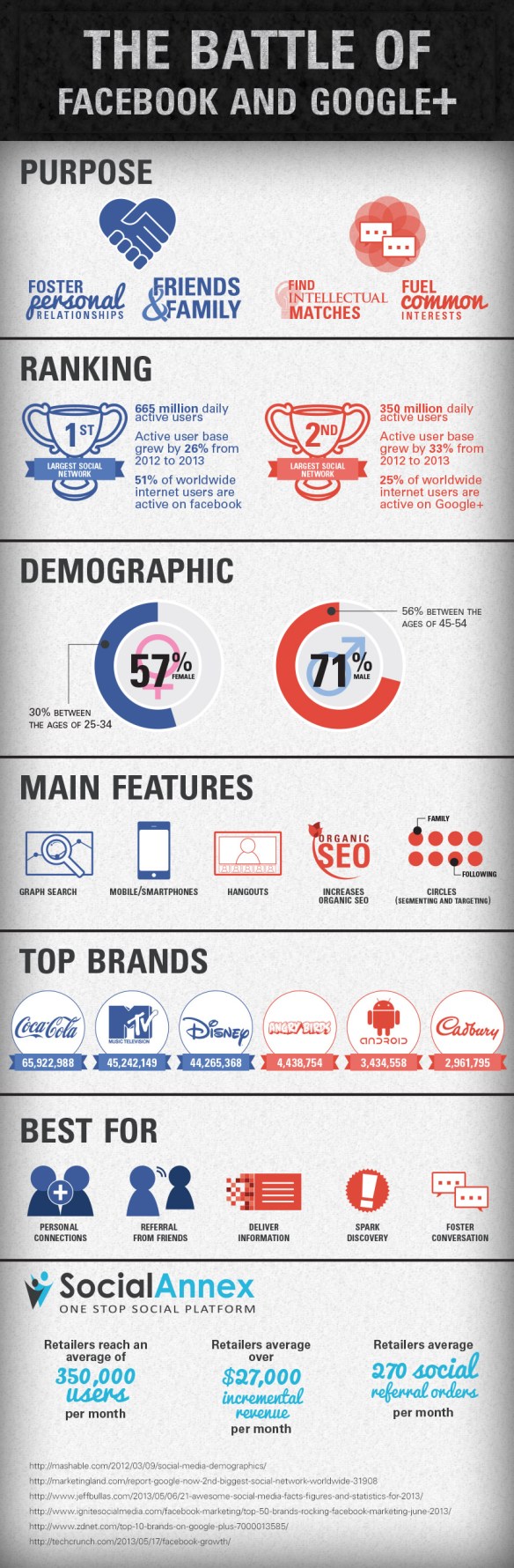
The Battle of Facebook and Google+ [Infographic] | Social Annex

Image


The Battle of Facebook and Google+

How Amazon and Goodreads could lose their best readers | Salon.com

Aside


The original post is lengthy but worth the read, as it includes some discussion about censorship and creative user protest on the GoodReads platform.

With 20 million members (a number some have noted is close to the population of Australia) and a reputation as a place where readers meet to trade information and share their excitement about books, the social networking site Goodreads has always appeared to be one of the more idyllic corners of the Internet. The site sold to Amazon for an estimated $190 million this spring, and Goodreads recommendations and data have been integrated into the new Kindle Paperwhite devices, introducing a whole new group of readers to the bookish community.

But if, at a casual glance, the two companies — Goodreads and Amazon — seem to be made for each other, look again. A small but growing faction of longtime, deeply involved Goodreads members are up in arms about recent changes to the site’s enforcement of its policies on what members are permitted to say when reviewing books, and many of them blame the crackdown on the Amazon deal. They’ve staged a protest of sorts, albeit one that’s happening mostly out of the public eye. Their charge is censorship and their accusation is, in the words of one rebel, that Goodreads and Amazon want “to kill the vibrant, creative community that was once here, and replace it with a canned community of automaton book cheerleaders.”

Read the rest of the story: How Amazon and Goodreads could lose their best readers | Salon.com

The Beginner’s Guide to HootSuite | Mashable


Juggling multiple social media accounts across several networks can get hectic, especially when there’s a fine line between a manageable number of browser tabs and a terrible guessing game.

Self-respecting social media addicts should test the many management tools available, and they will find HootSuite to be among the best to streamline sharing for work and play. Users can conserve precious tab space by connecting their Twitter, Facebook, Google+ (pages only), LinkedIn, Foursquare, WordPress and Mixi accounts under the HootSuite umbrella, and take advantage of the convenient scheduling feature.

How to get started: The Beginner’s Guide to HootSuite | Mashable.