E-Books Could Be The Future Of Social Media | Co.Labs


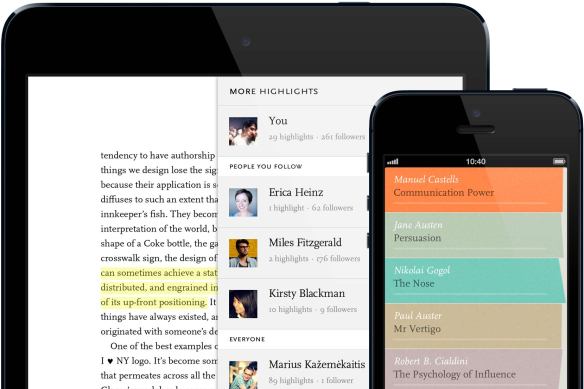
In the future, e-books will act just like social networks. We’ll use them on our phones, share and comment right inside e-reader apps, and publishers will use our data to help them make better marketing decisions. If you think digital reading is exploding now, just wait.

The article examines a new reading app called Readmill, which makes “each and every book its own self-contained social network.” See the full story: E-Books Could Be The Future Of Social Media ⚙ Co.Labs ⚙ code + community.

E-Books Could Be The Future Of Social Media ⚙ Co.Labs ⚙ code + community

Image Attribution: Readmill

Links for Recent Pew Research News


Pew: 30% Of U.S. Adults Don’t Have Broadband; 10% Use Smartphones As Sole Internet Access; 20% Have Zilch | TechCrunch – August 26, 2013
Pew Research…releas[ed] the results of a survey that shows how one of the more advanced countries in the world, the U.S., is still not quite there in leading by example: 20% of U.S. adults are still without broadband or smartphones for internet access. And 3% of people in the country still using dial-up connections.

The below link is related the same Pew research results as the article above but provides discussion on a different perspective – the digital divide in America.  See the original Home Broadband 2013 Pew report – August 26, 2013.

Latest Pew Study Shows 70 Percent of U.S. Has Broadband. But Access Is Still Unequal | Wired.com – August 26, 2013
Pew’s results demonstrate that the digital divide is persistent, with close correlations between socioeconomic status and home Internet access. The report is also a reminder that policymakers use the words “high-speed broadband” to include everything other than dialup access, which is far too broad a definition.

Adult Trend Data | Pew Internet 
Latest data about device ownership by American adults up to end-May 2013.

Pew Study: More millennials are living with their parents than ever before | Stephen’s Lighthouse | August 22, 2013
According to a Pew poll, 36 percent of young adults are afflicted with Failure to Launch syndrome.

Teens say they generally rely on themselves to figure out how to manage their privacy online | Stephen’s Lighthouse – August 22, 2013
Teens say they generally rely on themselves to figure out how to manage their privacy online; Still, 70% of teens have at one time sought advice about how to manage their privacy online. See the Pew Internet report from August 15, 2013.

Teens and Mobile Apps Privacy | Pew Internet – August 22, 2013
As teens gain access to mobile devices, they have embraced app downloading. But many teen apps users have taken steps to uninstall or avoid apps over concern about their privacy. Location information is considered especially sensitive to teen girls, as a majority of them have disabled location tracking features on cell phones and in apps because they are worried about others’ access to that information.

Teens Haven’t Abandoned Facebook (Yet) | Pew Internet – August 15, 2013
When we released our “Teens, Social Media and Privacy” report in May, one thread of news coverage focused on teens’ “waning enthusiasm” for Facebook. This theme surfaced during our focus group discussions with teens and stood in contrast to the excitement that was associated with newer platforms like Instagram and Twitter.

Vanish from the Internet With This One-Stop Website | Wired.com


Even if you’re not Edward Snowden, there are times when excising your social media presence is necessary. Companies usually don’t make it easy, though, often hiding the delete button inside myriad confusing menus and settings. Save some time and bookmark justdelete.me, a new page that collects direct links for killing various accounts dead and puts them all on one, easy-to-use page.

Justdelete.me is an excellent resource and evidently quite a bit of work went into it. For instance, for Facebook, the link goes directly to the delete button (no “deactivation” shenanigans here.) But not all accounts are as simple: Sometimes you’ve got to contact customer service, or, like Netflix, they’ll cancel your account but won’t delete your data. Even here justdelete.me excels, linking to the relevant help pages and contact forms.

Give Robb Lewis the good Netizen of the month award. Although most competent computer users could eventually find all these various methods to delete online accounts, it’s quite a bit faster (and less frustrating) when they’re all on one page. He even put the source for justdelete.me on Github too — so if he loses interest or the various social media companies change their policies, this killer idea can live on.

justdelete.me

Article copied in whole from: Vanish from the Internet With This One-Stop Website | Gadget Lab | Wired.com.

The Millions : Shelf-Love


Do you want to show off your bookshelf online without typing up a list of your books on Goodreads? Well, you strange exhibitionist, you can do that now with Bookshelfies, a Tumblr featuring pictures of people standing in front of — well, you know.

via The Millions : Shelf-Love.

LinkedIn Growing Up: Opens Up To High School Students Over 13, Launches Dedicated Pages For Universities Worldwide | TechCrunch


[T]oday LinkedIn made a bold move to start reaching out itself to this very lucrative, if fickle, audience: is beginning to promote itself to high school students (“13+ for most countries around the world” a spokesperson explains to me) and it has launched University Pages, dedicated pages for universities for people to add to their profiles and to reach out to people. LinkedIn hopes that both moves will not only expand the reach of how people use its site as their default anchor for resume-style information online. And also how it, too, could potentially tap into this user base to begin long-term relationships.

Both of these are getting rolled out globally, with the younger users starting to get accepted beginning September 12.

See the full story: LinkedIn Growing Up: Opens Up To High School Students Over 13, Launches Dedicated Pages For Universities Worldwide | TechCrunch.

How Technology Has Innovated Loneliness | Gizmodo


It’s simple, as the world has gotten easier because technology has gotten better since touch screens have gotten touchier and social networks have filled every social void in our empty soul, we’re still searching for substance. Too often social networks can result in the technological equivalent of empty calories—sure it feels good to get liked and sounds good to chat but it’s not as genuine and fulfilling as real life.

Shimi Cohen was inspired by Sherry Turkle’s book Alone Together and created this wonderful animation that discusses the ‘innovation of loneliness’.

via How Technology Has Innovated Loneliness | Gizmodo.

Free e-book: Hanging Out, Messing Around, Geeking Out| Tame The Web


Free e-book: Hanging Out, Messing Around, Geeking Out | Tame The Web

Full title: Hanging Out, Messing Around, Geeking Out: Kids Living and Learning New Media.

From the series forward: This book series is founded upon the working hypothesis that those immersed in new digital tools and networks are engaged in an unprecedented exploration of language, games, social interaction, problem solving, and self-directed activity that leads to diverse forms of learning. These diverse forms of learning are reflected in expressions of identity, how individuals express independence and creativity, and in their ability to learn, exercise judgment, and think systematically.

Direct link to the pdf here.

Hanging Out, Messing Around, Geeking Out

72% of Online Adults are Social Networking Site Users | Pew Research Center


The Pew Research Center’s Internet & American Life Project has been studying online adults’ social networking site use since 2005, and has seen substantial growth since then. Today, 72% of online adults use social networking sites. Although younger adults continue to be the most likely social media users, one of the more striking stories about the social networking population has been the growth among older internet users in recent years. Those ages 65 and older have roughly tripled their presence on social networking sites in the last four years—from 13% in the spring of 2009 to 43% now.

In this report we also studied online adults’ use of Twitter. The percentage of internet users who are on Twitter has more than doubled since November 2010, currently standing at 18%. Internet users ages 18-29 are the most likely to use Twitter—30% of them now do so…via 72% of Online Adults are Social Networking Site Users | Pew Research Center’s Internet & American Life Project

The full report here.

72% of Online Adults are Social Networking Site Users | Pew Research Center's Internet & American Life Project


Twitter Updates Rules to Crack Down on Abuse – Mike Isaac | Social | AllThingsD


After a week of public outcry over a series of threats against high-profile media figures, Twitter on Saturday announced an update to its site rules, aiming to more directly combat abuse and harassment that occurs across the network.

See the full article: Twitter Updates Rules to Crack Down on Abuse – Mike Isaac | Social | AllThingsD.

BookVibe spies on social media to recommend reads | Crave – CNET


A new service scrapes your social network for books worth your time.

via BookVibe spies on social media to recommend reads | Crave – CNET.

BookVibe