Make Your Own Computer For $99 | Co.Design


For most of us, the inner-workings of a MacBook Air remain a pleasant, whirring mystery. That is until, something goes horribly south and we realize we need a Genius to fix it. But what if there was a way to demystify the mechanics of computing and simply build your own?

That’s the promise behind the new Kano computer kit, which is touting itself as “the first computer that anyone can make.”

Read: Make Your Own Computer For $99 | Co.Design | business + design.

A Girl Who Codes | Fast Company


A Girl Who Codes | Fast Company | Business + Innovation

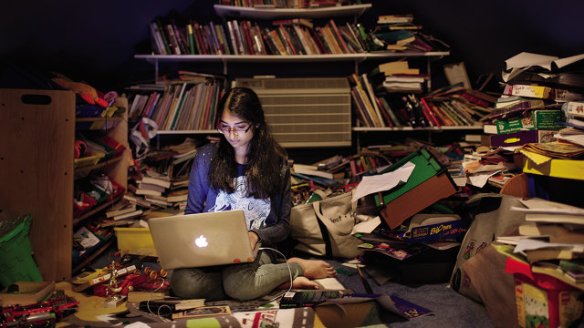
Computing has always been a boys’ club. How 18-year-old nikita rau–and other young women like her–are finally changing that.

Read: A Girl Who Codes | Fast Company | Business + Innovation.

What Teens, Screens and Digitally Divided Attention Spans Mean for Learning [Infographic] | The LAMP


What Teens, Screens and Digitally Divided Attention Spans Mean for Learning

What Teens, Screens and Digitally Divided Attention Spans Mean for Learning [Infographic] | The LAMP

9 Things You Need To Know About Teens, Technology & Online Privacy | Pew Research


Amanda Lenhart presented nine major themes from the Project’s five-report series on Teens and Online Privacy. In a talk delivered to the Family Online Safety Institute’s annual conference on November 7th, Amanda examined youth’s social media diversification and sharing practices, privacy choices, and the ways that youth concepts of privacy differ from adults.

Tradecraft Launches A School For Teaching Non-Technical Skills To Tech Workers | TechCrunch


For many companies in Silicon Valley, it’s fairly easy to find, train, and evaluate technical talent — for the most part, it’s easy to determine and quantify how well a person codes. But evaluating and training non-technical personnel is something many struggle with. To help change this, a new school called Tradecraft has emerged to help teach those seeking UX, growth, and sales positions the skills they need to succeed in the tech world.

Tradecraft was founded by Russ Klusas and Misha Chellam, who believe it (or something like it) is necessary to teach necessary skills to non-technical tech workers.

Read: Tradecraft Launches A School For Teaching Non-Technical Skills To Tech Workers | TechCrunch.

Infographic: When Will Wearable Tech Really Take Off? | PCMag.com


A few years ago, “wearable technology” meant little more than a clunky 1980s calculator watch or a Bluetooth headset. Now, people are accessorizing with color-coordinated fitness trackers and super-spy-like smartwatches.

According to ShotTracker, wearable tech is “the next megatrend” — changing the way we live, work, and play.

Read more:  Infographic: When Will Wearable Tech Really Take Off? | News & Opinion | PCMag.com.

Wearable Tech Megatrend

Smithsonian now lets you view artifacts in 3D | CNET News


Smithsonian X 3D

You can now take a 3D peek at several famous historical artifacts thanks to a project from the Smithsonian Institution.

Launched on Wednesday, the Smithsonian X 3D Web site serves up a collection of 3D images of artifacts digitally scanned by the museum through a partnership with Autodesk. You canexplore the artifacts in detail by manipulating their images via mouse on your computer or via finger on a supported touch-screen device.

Read: Smithsonian now lets you view artifacts in 3D | Internet & Media – CNET News.

Related: The Smithsonian Is Uploading Its Lost Treasures to the Internet | Gizmodo

Classrooms Go High-Tech With Google Play for Education | PCMag.com


Google is making it more convenient for schools around the country to integrate tablets and educational apps into the classroom.

The search giant on Wednesday officially launched tablets running Google Play for Education, a version of the Google Play app store specifically designed for K-12 schools in the U.S.

Read: Classrooms Go High-Tech With Google Play for Education | News & Opinion | PCMag.com.

Gender in Tech Librarianship | Roy Tennant | The Digital Shift


One of the avenues by which this issue could be improved would be to hire more women into library tech positions in the first place. In my experience there is definitely a barrier to getting hired into these positions, or even interviewed. I was the only graduate in my cohort with a focus in information technology and it was lonely. Whenever I introduce myself to others in my field and I say I specialize in tech, I usually see the same expression, a little confused, a little flabbergasted. Its disheartening. On the flip side, patrons are hugely appreciative of someone they can connect with who can help them with computer literacy and device support.

I’m glad women in librarianship who specialize in tech have professionals in our field like Sarah Houghton and Ellyssa Kroski to, if not wave the banner for our gender, then at least illustrate definitively how intelligent, skilled and multifaceted women can be in library tech. Raising awareness is of utmost importance and this is why I’m lending my own comment to this story. 

Gender in Tech Librarianship | Roy Tennant | The Digital Shift.

Certainly I’ve written about this issue before, and I will keep writing about it until there are no more reasons to do so. But the reason why I’m writing about the issue of gender imbalance in library tech is because I was recently at the Internet Librarian Conference in Monterey, CA, where my esteemed professional colleague and completely famous Sarah Houghton, “Librarian in Black” had organized a panel on this very topic.

The panelists all gave a brief statement from their own experience and perspective (a mix of both women and men), then a microphone was carried around the room for the attendees to provide their own perspectives and stories. And the stories of harassment, put-downs, insults, marginalization, and worse, just rolled right in.

Unfortunately, I was surprised. Surprised because these were not the kind of subtle kinds of discrimination that I knew went on and that I try to prevent or alleviate. For example, packing a speaking panel with men, which happens all to often and a reason for which I have refused to participate at times. No, these stories were much more obvious, egregious, and, in some cases, breathtaking — and not in a good way.

At the end of the program I left depressed. Depressed that such things were happening on a regular basis — not yesterday, not a long time ago, but today. Depressed because since I’d never witnessed anything near what many of the stories related, I was mystified about how I could help prevent them.

But at least getting this out in the open is a start. The unfortunate thing is that those who really needed to be there most likely weren’t, nor will they ever be. So it’s up to us who were in the room, or would have been had they had the chance, to work harder to make all of our workplaces welcoming to all. Until that day arrives, we will soldier on.

At this conference we had the opportunity to have the necessary information sharing. Perhaps at the next one (and ongoing throughout the year in virtual form) we could share some strategies for making things better. That’s a program I could get behind.

Snail Mail vs. Email | ivancash | Vimeo


I went around San Francisco asking random people on the street how they felt about email versus handwritten letters. This video was created to help promote the Snail Mail My Email project and its third annual event, going on November 11 – 17, 2013.

Snail Mail My Email (snailmailmyemail.org) is a collaborative art project I founded where volunteers handwrite strangers’ emails and send physical letters to the intended recipients, free of charge. The project has since transitioned to a week-long annual event.

via Snail Mail vs. Email from ivancash on Vimeo.