Upstagram Is A Flying Raspberry Pi That Publishes Live Pictures On Instagram | TechCrunch


What do Instagram, the Raspberry Pi and the movie “Up” have in common? When you mash all these things together, you get Upstagram, a neat hack that the Hackerloop team just unveiled.

First, the team made a replica of the house in “Up” using paper and foam. It was just big enough to fit a Raspberry Pi and its camera, a battery and a 3G hotspot. The Raspberry Pi, an open source and very cheap mini-computer to tweak, experiment and try new things with, is a hacker’s dream.

Then, the team used about 90 helium balloons to make the house fly above Paris’ landscape. While Instagram is only available on iOS and Android, they reverse-engineered the posting process to transform the Raspberry Pi into an Instagram-taking machine.

Read more: Upstagram Is A Flying Raspberry Pi That Publishes Live Pictures On Instagram | TechCrunch.

The Hummingbird Drone | PBS Video


The Hummingbird Drone | Watch NOVA Online | PBS Video.

Four Great Reports for Tracking Technology Trends | Ellyssa Kroski | OEDB.org


It’s not enough anymore for libraries to adopt new technologies and practices once they’ve been out for several years. It’s vital nowadays to know what’s on the horizon so that you can plan for it in your library including training staff, building related applications, and offering new services. One of the best ways to keep up with developments in the library, information, and technology fields is to follow and read trend reports.  

Read: Four Great Reports for Tracking Technology Trends | Ellyssa Kroski | OEDB.org.

News: Education & Technology, Librarianship


Education & Technology

Web inventor Berners-Lee sounds alarm on mass spying | CNET
Sir Tim Berners-Lee says the activities of the NSA and its UK counterpart, the GCHQ, could warp his baby, making the Internet vulnerable to attack and depriving humanity of a “safe space” for problem solving.

The Amazingly Unlikely Story of How Minecraft Was Born | WIRED
Excerpt from new book.

Librarianship

Mom Complains About Library’s Porn Policy | NBC Chicago
A suburban mother is demanding the Orland Park Public Library ban pornography on its computers. More scandal: Library book overdue in Texas? Go directly to jail | Teleread

Can Technology Ever Make Us Truly Happy? | Gizmodo


Humans are clever: what sets us apart from the rest of the creatures on the planet is our ability to think about the world around us—and shape it. But in making all the technological advances that seems so smart, are we making the world better, or just different?

This video takes a pretty lofty view of that poser. Considering ideas like super intelligence, super longevity and super well being, it asks some pretty fundamental questions about whether those kinds of technological accomplishments are actually a good thing or not. What do you think? via Can Technology Ever Make Us Truly Happy? | Gizmodo

You Don’t Have Enough Tech | Roy Tennant | The Digital Shift


Full Article

You Don’t Have Enough Tech | Roy Tennant | The Digital Shift | November 5, 2013

I recently spoke at the Information Today “Library Leaders Digital Strategy Summit”, a mini-conference held in conjunction with the Internet Librarian Conference in Monterey, California. I was signed up to be on a library technology panel, and to focus on what library managers needed to know about technology. In the execution it was less formal, since the panelists were parceled out among the tables where the participants were sitting while Rebecca Jones and Mike Ridley plied us with questions.

In typical style, I didn’t like the first question, so I answered the question I wish I had been asked. I did this because whenever I address an audience I try to think about the most important thing they should hear and I focus on that. That’s what I told them, and then I said:

“I decided that the single most important thing I can tell you about technology in libraries is this: You don’t have enough techYou don’t have enough technical staff and the staff you have don’t have enough technical knowledge.”

Heads nodded all over the room. Apparently, as I often do, I had stated the obvious. But it opened up a rich vein of discussion that stretched into the buffet lunch that we brought back to our tables. While chatting with one library leader, we agreed that the best way to hire new staff wasn’t by specific experience, but personality characteristics. I even wrote a Library Journal column about it way back in 1998 (see the archived version).

The other part of this is that the day is long past when we should be hiring staff without any sort of technical capabilities. I mean, done. Fully baked. To help illustrate this, I related the fact that I had decided to go to library school to get my masters in the early 1980s. Even then, I knew that computers were going to be important to librarianship. I mean, srsly. However, since I couldn’t stomach the idea of spending years in a basement somewhere (where most computer science students were relegated back in the day), I majored in Geography and minored in Computer Science. I then went to library school to get my Masters, where I had already far surpassed the computer science requirements at the time.

This means that even 30 years ago the handwriting was on the wall. Tech was our future. It still is, only more so. If you are a children’s librarian your charges shouldn’t know more about how to use an iPad than you do. If you fancy yourself a public service librarian you had better know how to troubleshoot public computers and printers.  If you are an archivist you are (or should be) at Ground Zero of your institution’s digitization plans. There are, in other words, no professional positions in a modern library that lack a technical component.

Also, the more technical abilities you bring to your position — any position — the more valuable you will be to your organization. So you decide: how valuable do you want to be?

Meanwhile, as the sun rose higher in the Monterey sky and we looked out from our perch at the top of the Monterey Marriott overlooking the bay, we perhaps could be forgiven for thinking we could see farther than we really could. Today’s world was at least 30 years in the making. We had a warning. We knew this was coming. We have no one to blame but ourselves. You don’t have enough tech.

News: Education & Technology, Librarianship


Education & Technology

Startup Gives Free Stuff to Student Influencers | Mashable
Sumpto, a startup that identifies top social-media influencers at colleges across the country, sends students free gifts from brands in hopes that they will tweet, post and share photos of the free swag on their social-media accounts.

Twitter strives to explain itself to the public | CNET
A new “About Twitter” page attempts to describe the social network and explain how and why people tweet.

Bill Gates Believes Human Health Is More Important Than Tech | Mashable
In a wide-ranging interview with the Financial Times, which focused primarily on his work to bring health aid to the world’s impoverished regions, Gates offers a glimpse into how much his views have changed regarding the importance of technology in our lives.

E Ink Looks Beyond E-Readers | MIT Technology Review
Facing a declining market for e-readers, E Ink’s new R&D facility is trying out some different ideas.

Lenovo pursued BlackBerry bid, but Ottawa rejected idea | Globe & Mail
[T]he Canadian government told the smartphone company it would not accept a Chinese takeover because of national security concerns.

Apple: “Our Business Does Not Depend on Collecting Personal Data” | AllThingsD
Apple published a formal report on federal government data requests and in so doing became the first tech company to disclose such inquiries by both account and device.

Librarianship

Museum of Science Fiction might be coming to DC | CNET
Trekkies and wanna-be Mars colonists might soon have a permanent brick-and-mortar site for sharing their love of all things science fiction

Illinois Library Comes Under Fire | American Libraries Magazine
“Sometimes libraries that are doing ‘all the right things’ pay a price for their excellence through uncivil attacks and attempts to dismantle their work,” Barbara Jones, director of ALA’s Office for Intellectual Freedom (OIF), told American Libraries. She is referring to Orland Park (Ill.) Public Library (OPPL) in south suburban Chicago, which has endured several intellectual-freedom challenges over the past few months.

MELSA, 3M Develop New Ebook Sharing Feature for Consortia | The Digital Shift

The Library Vending Machine | BookRiot
Changing demographics and difficulty securing new funds for new libraries, The Pioneer Library System in Norman, Oklahoma decided to to use technology to meet its patrons needs. So last week, it opened the first 24-hour library vending machine in the United States. Built by EnvisionWare, this fully automated machine will be able to to dispense more than 400 pieces of media (books/DVDs/audiobooks) and store more than 1000 returned items.

What is Tor? A beginner’s guide to the privacy tool | theguardian.com


The anonymity software has sparked controversy but who built it, what is it used for, what browser does it use – and why is the NSA so worried by it?

Read: What is Tor? A beginner’s guide to the privacy tool | Technology | theguardian.com.

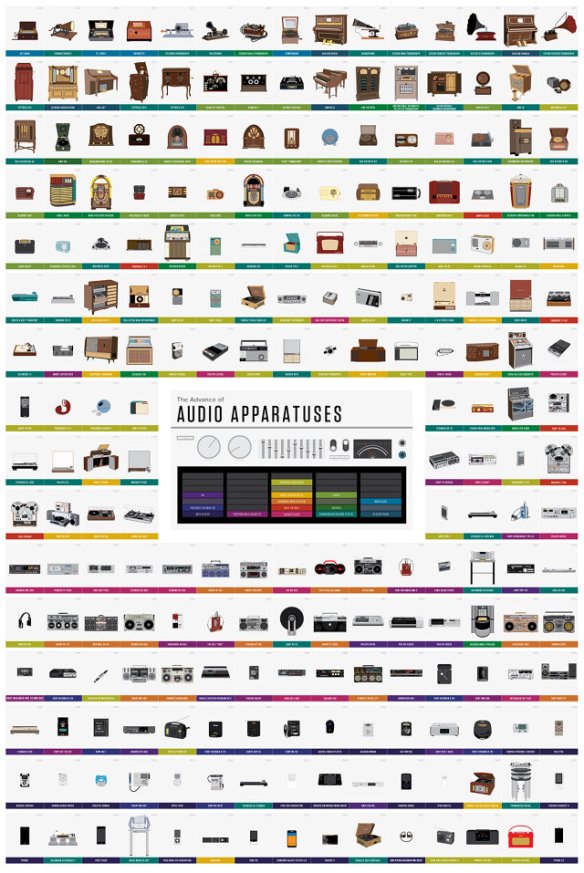
Infographic: The History Of Audio Equipment | Co.Design


A prominent sci-fi writer once told me that, as prescient as they’d been, he and his peers had missed one big tech trend: Miniaturization. And they really did miss it. Because as you examine Pop Chart Lab’s latest mega print of 219 sonic devices across history, The Advance of Audio Apparatuses, it’s obvious that technology has been getting smaller for a long time.

Read more: Infographic: The History Of Audio Equipment | Co.Design | business + design.

Infographic: The History Of Audio Equipment | Co.Design | business + design

Life with Raspberry Pi: Sparking a School Coding Revolution | The Digital Shift


Our classroom glows with activity. One kid drafts a how-to article in which he explains the steps involved in wiring a cardboard Minecraft controller. Another writes a branching-path, choose-your-own-adventure story in Twine, a free, downloadable interactive fiction app. A student who’s claimed throughout his middle-school career that he isn’t a writer leans close to his laptop screen, finding and fixing coding errors. He composes, compiles, and debugs more than 100 lines of code to light up a three-by-three-light LED display plugged into his laptop.

A pair of especially curious students sits huddled around our newest computer, an exposed-faced circuit board smaller than a paperback book. It’s called a Raspberry Pi. They’re watching how the code they write in one window changes the course of a game in another. They may not know it yet, but these kids are playing with an open-source computing platform that just might change the way we teach young people how to interact with computers.

Read: Life with Raspberry Pi: Sparking a School Coding Revolution | The Digital Shift.