The Internet Archive Opens Its Historical Software Collection To All | Gizmodo, Internet Archive


Full Post

Gamers of a certain age will no doubt scream Oh wow, I remember that! as they click through the Internet Archive’s latest project.

The non-profit organization recently launched the Historical Software Collection, with the mission of making old programs accessible (including plenty of games!) that were originally released for platforms like Atari 2600, Apple II, and Commodore 64.

Software itself isn’t new to the Archive, but it’s spent the past couple of years making these programs playable in-browser. So whether it’s E.T. on Atari 2600 from 1982 or VisiCalc on the Apple II from 1979, there’s no need to download a heap of emulators to try them out.

Archiving video games can present special challenges, as David Gibson at the Library of Congress has explained so well. But the independent Internet Archive claims to have the largest software archive in the world, and it should be interesting to see how the next few years work out for them.

Perhaps one of the greatest challenges they’ll face is copyright. Technically, all of these programs are still covered under copyright law. And I have no doubt that the myriad companies responsible for managing the rights to something like E.T. are figuring out if they should intervene. Hopefully, no one will try to pull these programs. But if they do, it will be just one more example of how desperately broken our current copyright system is. [Internet Archive]

The Internet Archive Opens Its Historical Software Collection To All | Gizmodo
Leap Motion: Making Gesture Computing A Reality | Information Space


Read: Leap Motion: Making Gesture Computing A Reality | Information Space


8 myths about wearable tech | CNET News


Wearable devices are predominantly technical fascinations at the moment, but they have widespread market potential — if misconceptions can be set straight.

The 8 myths discussed:

  1. Wearable devices are just another form factor for smartphones.
  2. Consumers will quickly embrace wearable tech.
  3. Wearable devices are standalone products.
  4. The wearable market is new.
  5. The wearable market will remain a niche.
  6. First to market is a can’t-miss winning formula.
  7. Power consumption and batteries will not be big issues.
  8. Wearable devices are secure.

Read: 8 myths about wearable tech | Business Tech – CNET News.

An All-in-One Guide to the Maker Culture and 3D Printing | Ellyssa Kroski | OEDB.org


The maker culture is a thriving movement amongst all types of people who want to create and design their own objects, crafts, or computer code.  This DIY community is using state-of-the-art technology such as 3D printers to design and craft their own 3D objects.  This introductory guide will give you an overview of today’s maker movement, resources for getting started, 3D printer reviews, links to actual project designs and instructions, maker publications, events, and directories, videos about 3D printing and maker culture, and an article list of resources about libraries and makerspaces.

Resources categorized into the following sections:

  • What is the Maker Movement?
  • Getting Started Guides
  • 3D Printers
  • 3D Projects
  • Maker Events
  • Makerspaces Directories
  • Maker Videos
  • Libraries and Makerspaces Resource List

Read: An All-in-One Guide to the Maker Culture and 3D Printing | Ellyssa Kroski | OEDB.org.

50 Powerful Statistics About Tech Mega Trends Affecting Every Business | Vala Afshar


There are five mega trends impacting the IT departments of every company: Mobile, Social, Cloud, Apps and Big Data. In this presentation, Vala Afshar reveals ten startling stats for each mega trend.

Everyone in Tech Should Read Fiction. Here’s Why | Mashable


For many in today’s tech world, novel reading is a luxury — something you might do once or twice a year, if you’re lucky. It’s often the first thing that goes out the window when times are busy.

Perhaps, if you’re in the industry, you’ve convinced yourself that fiction doesn’t matter. Isn’t your reading time better spent with Flipboard or Zite or Instapaper, catching up on all those important articles and assorted long reads? 

But if you’re purely in the nonfiction realm, you’re starving yourself and your work of an important resource.

Read the full story: Everyone in Tech Should Read Fiction. Here’s Why | Mashable

You may also like: Neil Gaiman: Why our future depends on libraries, reading and daydreaming | theguardian

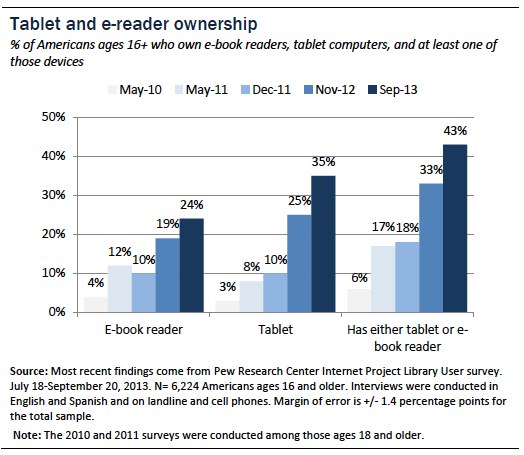
Tablet and E-reader Ownership Update | Pew Research Center


The number of Americans ages 16 and older who own tablet computers has grown to 35%, and the share who have e-reading devices like Kindles and Nooks has grown to 24%. Overall, the number of people who have a tablet or an e-book reader among those 16 and older now stands at 43%.

Up from 25% last year, more than half of those in households earning $75,000 or more now have tablets. Up from 19% last year, 38% of those in upper-income households now have e-readers.

Tablet and E-reader Ownership Update | Pew Research Center's Internet & American Life Project

Read the full report or download the pdf.

via Tablet and E-reader Ownership Update | Pew Research Center’s Internet & American Life Project.

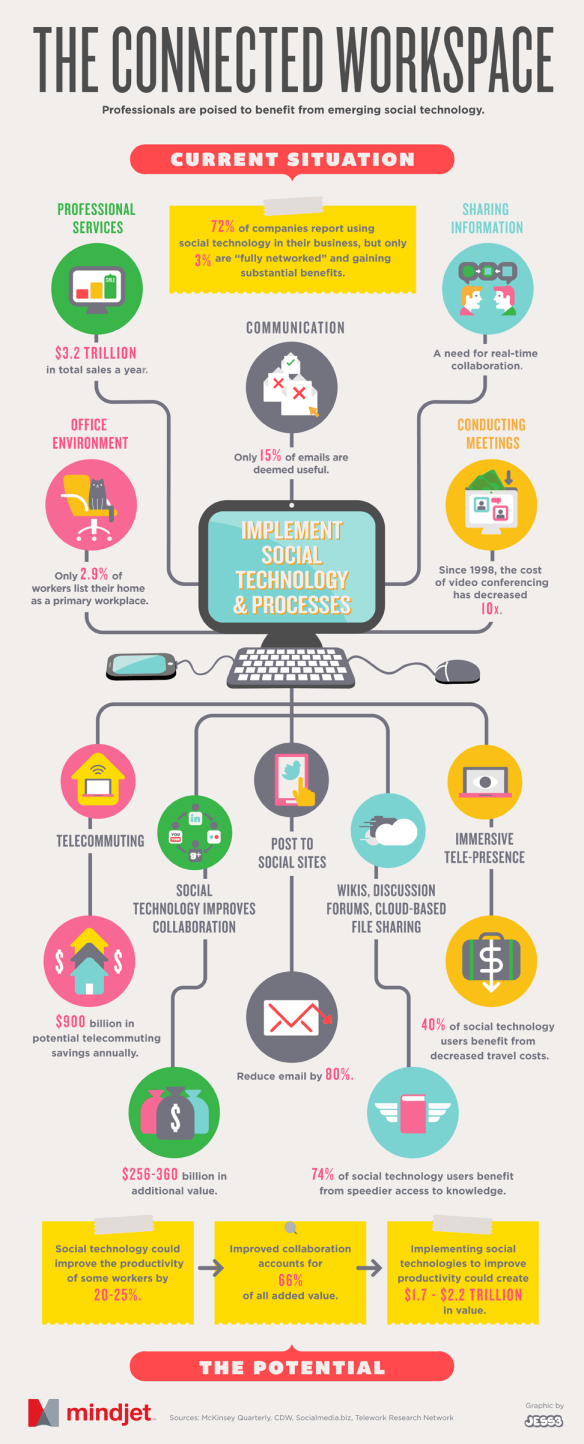
The State of the Connected Workspace [INFOGRAPHIC] | mindjet

Image


The Connected Workspace

To Predict The Future Of Technology, Figure Out How People Will Use It Illegally | Co.Exist


I find that it’s often useful to imagine the unintended, seedy, improper, or illicit uses of new tools and systems…Thinking along those lines can help to uncover the more subtle connections between a new technology and incumbent systems, spot hidden security flaws, or even reveal markets for a product that the developer had ignored.

Read: To Predict The Future Of Technology, Figure Out How People Will Use It Illegally | Co.Exist | ideas + impact.

Eight Technology Trends Disrupting Business in 2014 | Kyle Lacy | ExactTarget