1st website ever restored to its 1992 glory – Technology & Science – CBC News


You can now re-visit the first web page ever — built 21 years ago — by directing your browser to the first ever web address. On Monday, the files for the website were put back online at the first ever URL: http://info.cern.ch/hypertext/WWW/TheProject.html.

via 1st website ever restored to its 1992 glory – Technology & Science – CBC News.

Very cool to view the first website – all text and hyperlinks. Not all the links are valid. As an information professional, I especially appreciate How Can I Help ? and What’s out there? by Subject (classified by subject of interest). Project Gutenberg has been around a long time!
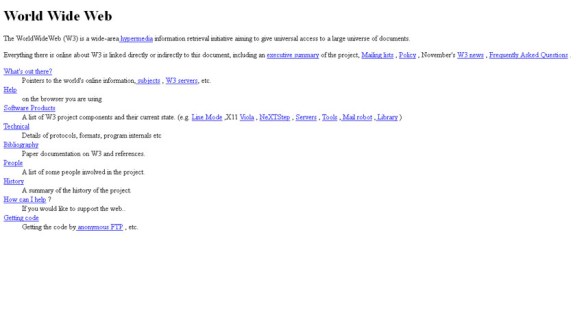

First WWW Website

10 Developer Tips To Build A Responsive Website [Infographic] – ReadWrite


From the article:

Many website owners say to themselves, “I want my site to look great on mobile, but I don’t know where to start.”

If you are in the business of building and designing websites, you cannot ignore the fact that many people are going to be visiting your sites on their smartphones and tablets. The Web and the mobile browsers remain one of the top ways that users interact with websites and if they have trouble on their smartphone, there is a good chance they are not coming back.

That’s where responsive design can help.

Responsive design is a concept where you build your website once and then format it so it can adapt to any screen size that accesses it. Designers use HTML5 and CSS to build the sites and set parameters so the content will resize itself whether the user is in vertical or horizontal viewing mode, on a tablet, desktop or smartphone or even a screen as large as a television.

via 10 Developer Tips To Build A Responsive Website [Infographic] – ReadWrite.

Tips Responsive Web Design

Responsive web design vs. mobile app development | TechRepublic


Most businesses and organizations have websites, and with the popularity and proliferation of all sizes of mobile devices, a mobile strategy for those websites is more important than ever.

via Responsive web design vs. mobile app development | TechRepublic

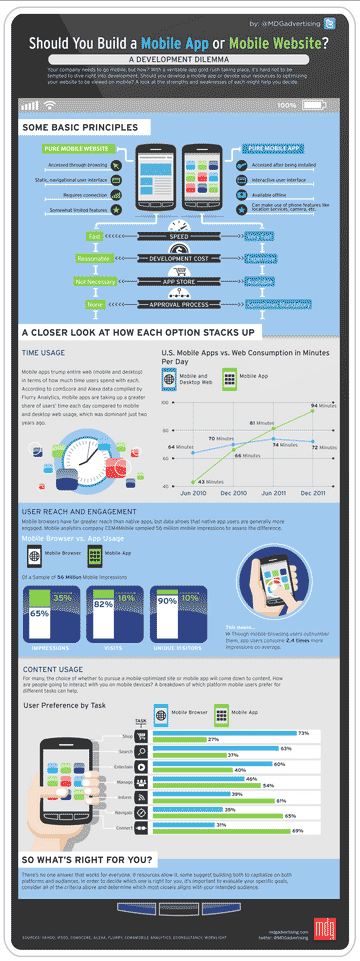
Mobile App or Mobile Website?

Collection of Links: Resources for Learning to Code


Update (August 30, 2015): Coding resources available on the Internet are listed here.

I began learning to code more than a decade ago during my undergraduate days at university sitting in a darkened room in front of a SunSystem computer running Unix. I programmed in C++ and Java for endless hours. I never complained about my biology and math labs and tutorials again after taking a computer science class! I did not realize at the time how useful I would find this skill in future years. During my Masters, which I completed in 2012, I learned to program in HTML/XHTML and CSS from the ground up, although I had prior knowledge from building my own websites. Now my next goals are to learn to code PHP and APIs. I not only want to learn these languages to bolster my resume but to learn more about the fundamentals of Internet and mobile architecture. How they are connected. I think learning to code is a great way to learn how to solve problems.

I find it surprising how popular coding is becoming, especially in libraries. Although now with the morphing of hackerspaces and makerspaces in libraries maybe its not so surprising. Librarians are known for being pioneers in education, learning and collaborative efforts after all. We can now even learn a programming language by attending a conference session – the 2013 ALA Conference in June will be presenting a LITA Pre-conference Introductory Python Workshop2012 was known as Code Year. With this push for awareness and education of coding there are now numerous resources one can use to learn abut coding and how to code. Here are a few of them:

Literacy

Learning to Code

APIs/Apps

The Five Worst UX Mistakes Websites Make | UX Magazine


The Five Worst UX Mistakes Websites Make | UX Magazine

  • Mistake #1: Paying too much Attention to the Macro and Short-Shrifting the Micro
  • Mistake #2: Putting too much Time into Designing your Home Page
  • Mistake #3: Relying too much on Text
  • Mistake #4: Designing for the Wrong Generation
  • Mistake #5: Ignoring Multi-Screen Behavior

Book publishers blast Amazon’s plan to control domain names | Internet & Media – CNET News


“Two industry groups argue that the retailer’s plan to control several generic top-level domains, including .book, .author, and .read, would be anti-competitive.”

via Book publishers blast Amazon’s plan to control domain names | Internet & Media – CNET News.

Collection of Links: Resources for Libraries


Apps
Free Software for Libraries Ideas Exchange – iLibrarian
50 Great Mobile Apps for Librarians – Proverbial Lone Wolf Librarian’s Weblog

Technology
Internet Librarian: Speed Technology Dating – Librarian in Black (30 technology recommendations – from Raspberry Pi to Liquid Space)
How to Create Your Own Knowledge Base – iLibrarian
Library Now! Google now technology applied to libraries? – Musings about Librarianship
What To Do with a Raspberry Pi (The New $35 Computer That Could Replace Your Opac Terminals) – The Digital Shift
Digitally Embedding the Law Library – Ellyssa Kroski

Web Design and Websites
Responsive Web Design and Libraries – iLibrarian
Transforming the Library Website: You and the IT Crowd – iLibrarian
Blogging Mega-post: 21 Resources for Tips, Strategies, and Content Ideas – iLibrarian
10 Essential Tools for the Lean Web Developer – Mashable

Egypt Crowdsources Censorship | Fast Company


“The Egyptian government is now crowdsourcing censorship efforts. A new web page created by the country’s National Telecommunications Registry Agency, allows citizens to report blasphemous websites (Arabic-language links). According to Alix Dunn of tech activism blog The Engine Room, the site is designed to help find pages showing a controversial anti-Islam film.”

via Egypt Crowdsources Censorship | Fast Company.

Stephen’s Lighthouse | Major NEW and Must-Read Pew Report on Libraries


Major NEW and Must-Read Pew Report on Libraries – Stephen’s Lighthouse.

13 [Web] Design Trends For 2013 | Gizmodo


Discussed:

  1. Flat Design
  2. Fewer Button (More Gestures)
  3. Animation as Affordance
  4. “Hamburger” Menu Drawer
  5. Native Over Web
  6. Responsive if not Native
  7. Wider Websites
  8. Larger Fonts
  9. Larger Search Inputs
  10. GIFs as Design Elements
  11. Designing for Humans
  12. New Colors
  13. Vector

13 Design Trends For 2013 | Gizmodo.