Gender in Tech Librarianship | Roy Tennant | The Digital Shift


One of the avenues by which this issue could be improved would be to hire more women into library tech positions in the first place. In my experience there is definitely a barrier to getting hired into these positions, or even interviewed. I was the only graduate in my cohort with a focus in information technology and it was lonely. Whenever I introduce myself to others in my field and I say I specialize in tech, I usually see the same expression, a little confused, a little flabbergasted. Its disheartening. On the flip side, patrons are hugely appreciative of someone they can connect with who can help them with computer literacy and device support.

I’m glad women in librarianship who specialize in tech have professionals in our field like Sarah Houghton and Ellyssa Kroski to, if not wave the banner for our gender, then at least illustrate definitively how intelligent, skilled and multifaceted women can be in library tech. Raising awareness is of utmost importance and this is why I’m lending my own comment to this story. 

Gender in Tech Librarianship | Roy Tennant | The Digital Shift.

Certainly I’ve written about this issue before, and I will keep writing about it until there are no more reasons to do so. But the reason why I’m writing about the issue of gender imbalance in library tech is because I was recently at the Internet Librarian Conference in Monterey, CA, where my esteemed professional colleague and completely famous Sarah Houghton, “Librarian in Black” had organized a panel on this very topic.

The panelists all gave a brief statement from their own experience and perspective (a mix of both women and men), then a microphone was carried around the room for the attendees to provide their own perspectives and stories. And the stories of harassment, put-downs, insults, marginalization, and worse, just rolled right in.

Unfortunately, I was surprised. Surprised because these were not the kind of subtle kinds of discrimination that I knew went on and that I try to prevent or alleviate. For example, packing a speaking panel with men, which happens all to often and a reason for which I have refused to participate at times. No, these stories were much more obvious, egregious, and, in some cases, breathtaking — and not in a good way.

At the end of the program I left depressed. Depressed that such things were happening on a regular basis — not yesterday, not a long time ago, but today. Depressed because since I’d never witnessed anything near what many of the stories related, I was mystified about how I could help prevent them.

But at least getting this out in the open is a start. The unfortunate thing is that those who really needed to be there most likely weren’t, nor will they ever be. So it’s up to us who were in the room, or would have been had they had the chance, to work harder to make all of our workplaces welcoming to all. Until that day arrives, we will soldier on.

At this conference we had the opportunity to have the necessary information sharing. Perhaps at the next one (and ongoing throughout the year in virtual form) we could share some strategies for making things better. That’s a program I could get behind.

Pakistani schools ban teenage activist Malala’s book from libraries | The Globe and Mail


Officials say they have banned teenage education activist Malala Yousafzai’s book from private schools across Pakistan, calling her a tool of the West.

Malala attracted global attention last year when the Taliban shot her in the head northwest Pakistan for criticizing the group. She released a memoir in October, “I Am Malala,” that was co-written with British journalist Christina Lamb.

Adeeb Javedani, president of the All Pakistan Private Schools Management Association, said Sunday his group banned Malala’s book from the libraries of its 40,000 affiliated schools. He said Malala was representing the West, not Pakistan.

Malala has become an international hero for opposing the Taliban and standing up for girls’ education. But conspiracy theories have flourished in Pakistan that her shooting was staged to create a hero for the West.

via Pakistani schools ban teenage activist Malala’s book from libraries | The Globe and Mail.

The Best (and Worst) Countries to Be a Woman | Harvard Business Review


The Best (and Worst) Countries to Be a Woman | Sarah Green | Harvard Business Review

Article in Full

The World Economic Forum has just come out with their latest data on global gender equality, and the short version could well be this old Beatles lyric: “I’ve got to admit it’s getting better. A little better, all the time. (It can’t get more worse.)”

I talked with Saadia Zahidi, a Senior Director at the WEF and their Head of Gender Parity and Human Capital. Yes, it’s getting better. Out of the 110 countries they’ve been tracking since 2006, 95 have improved and just 14 have fallen behind (a single country, Sweden, has remained the same). But that’s partly because in some places, there was nowhere to go but up.

And not everyone has improved at the same rates, or for the same reasons.

For instance, in Latin America, several countries surged ahead as more women were elected to political office. That was a trend in Europe, too – much of the improvement in Europe’s scores was due not to women’s increased workforce participation, but instead to the increasingly female face of public leadership. Although those numbers are still very low overall, increasingly women are being appointed (and somewhat more rarely, elected) to public office. “Looking at eight years worth of data, a lot of the changes are coming from the political end of the spectrum, and to some extent the economic one. So much of the [workforce] talent is now female, you would expect the changes to be on the economic front but that’s not what’s happening,” said Zahidi.

And sometimes equality is just another word for poverty. For instance, look at Malawi. They’re one of three sub-Saharan countries where women outstrip men in the workforce, with 85% of women working compared with 80% of men. (The other two are Mozambique and Burundi.) These are low-skilled, low-income professions — just 1% of each gender attends college, and Malawi is one of the world’s poorest countries. This is a bleak contextual picture… and yet Malawi is number one in the world in terms of women’s participation in the labor force.

Then there’s the Philippines. They’re ranked fifth in the world on gender parity because even though they rank 16th the world in terms of the percentage of women working, “the quality of women’s participation is high,” says Zahidi. Women make up 53% of senior leaders, the wage gap is relatively low, and they’ve had a female head of state for 16 out of the last 50 years – which, among other factors, makes them 10th in the world in terms of women’s political empowerment. They’ve also largely closed the gap on health and education. They, too, are a reminder that the WEF’s data tracks gender gaps – not development.

But there are a few lessons to be learned from the wealthy Nordic countries at the top of the heap. “The distance between them and the countries that follow them is starting to grow larger because of the efforts they’ve made,” says Zahidi, crediting their progressive policies on parental leave and childcare as examples of the infrastructure that makes it easier for women to participate in the workforce. When the WEF began doing this survey eight years ago, no countries were cracking the 80% mark in terms of women’s parity with men (where a perfect score is 100%). Now, some countries at the top of the list are up to 86%.

“Change can be much faster – or much slower – depending on the actions taken by leaders.”

I asked Zahidi about the across-the-board improvements. Were countries and companies learning from one another? Or were they each proceeding on their own? “This is not something that there’s generally been a lot of exchange on,” she conceded, “But one of the the things the World Economic Forum is trying to do is create that exchange.” They’ve developed a repository of best practices detailing how other companies and countries have overcome their gender gaps. Nowhere are women fully equal across all the realms the WEF tracks — health, education, the economy, and politics.

“To accelerate change, you need to have that sharing of information between companies,” she says. “Thus far, [progress] may not have been based on information exchange but it will have to be in the future — if we want to avoid reinventing the wheel.”

Where does your own country fit in? Take a look at the graphic below. The thick in the background shows the overall equality score – the 2006 score is in gray, and the 2013 improvement is indicated in light blue. (Countries that worsened or stayed the same are only in gray; countries that were not tracked in 2006 are only blue.) The narrow, darker blue line in the foreground indicates how much the country’s relative ranking has changed in the last seven years. Some countries have surged ahead, pushing other countries down on the list.

Gender_Parity_365_R

Why Is the NYPL Hosting Convicted Rapist Mike Tyson? | Flavorwire


Opinion. Read: Why Is the NYPL Hosting Convicted Rapist Mike Tyson? | Flavorwire.

I appreciate the LIVE Director at the NYPL explained his stance for choosing MT as a guest when requested. He could have ignored the request or made a general statement.

If We Want More Ada Lovelaces, We Need to Empower Women | Mashable


This week we celebrate Ada Lovelace, a woman from the 1800s who invented computer programming at a time when no one knew what a computer was.

While her contributions are vast, I can’t help but imagine how much she may have impacted society had she been properly educated. And then I begin to think about how important it is to recognize the movements and groups that educate and offer opportunities to women.

Read the full story: If We Want More Ada Lovelaces, We Need to Empower Women | Mashable.

Related: Wiki editing session at Brown University recognizes women in science | Brown University

Wiki editing session at Brown University recognizes women in science | Brown University


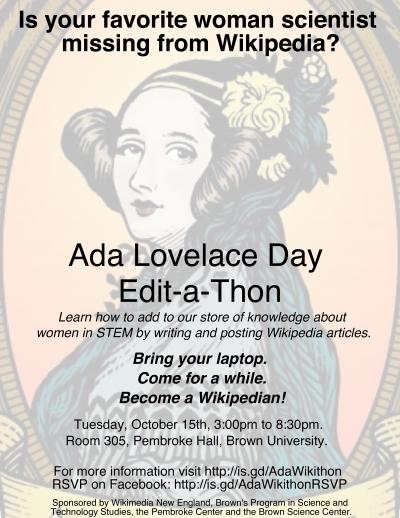
For generations, including this one, women in science have remained underrepresented and underrecognized. On Oct. 15, 2013, from 3 p.m. to 8:30 p.m, people who want to change that can gather at a Wikipedia “edit-a-thon” to increase the representation of women in science and technology. The event marks Ada Lovelace Day, named for the 19th-century female scientist who pioneered computational programming.

Read: Wiki editing session at Brown University recognizes women in science | Brown University News and Events

Ada Lovelace Day Edit-a-Thon

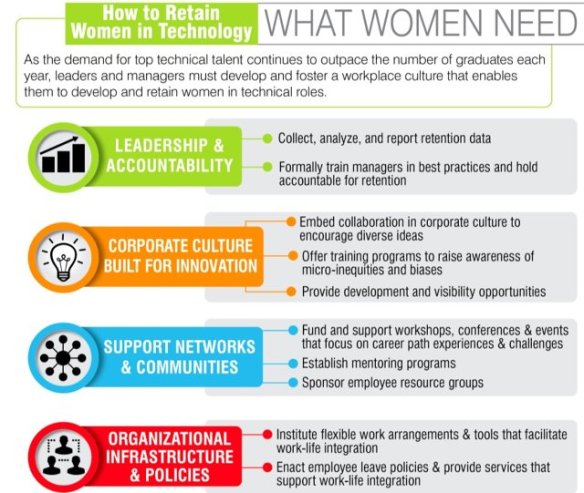
Why Women Leave Tech Companies, And What To Do About It | Co.Exist


[T]oday, women still leave tech companies at double the rate of men. Even the women who make it past all the hurdles of being a female in the field–the lack of role models, sexism, and so on–don’t stay very long.

Women Technologists Count, a new report from the Anita Borg Institute (ABI), examines the reasons why women in mid-level roles tend to leave technical career paths to become managers–or decide to leave the industry altogether. ABI offers up pages upon pages of recommendations on how to keep women in technology, but they boil it down to this:

Why Women Leave Tech Companies, And What To Do About It | Co.Exist | ideas + impact

Read the full story: Why Women Leave Tech Companies, And What To Do About It | Co.Exist | ideas + impact.

These Teenage Girls Are Some Of The Most Promising Scientists Of The Future | Co.Exist


Girls made up more than half of the finalists at Google’s Science Fair, the largest in the world. From turning banana peels into plastic to diagnosing skin cancer, here were a few of our favorite projects.

3 projects are reviewed including producing bioplastic from banana peels, diagnosing melanoma, no human help necessary and a better way to predict the spread of tumors.

Read: These Teenage Girls Are Some Of The Most Promising Scientists Of The Future | Co.Exist | ideas + impact.

This Is Why There Aren’t Enough Women In Tech | ValleyWAG


This Is Why There Aren’t Enough Women In Tech | ValleyWAG
The discussion in the above post includes anecdotal stories of female computer science students and women in technology.

Taking computer science classes as a female post-secondary student, I recall the overwhelming ratio of males to females in classes. There were 5 girls to 45 guys on the first day of Intro to Java, with 2 of the girls dropping the class within a few weeks. When I decided to do a directed study in my final term of my undergrad I had two professors who signed on to guide me. Once of them was a computer science professor and he was never available to help me or provide guidance. That experience was demoralizing and there was a real fear I would not attain a pass for the course and graduate on time. From my experiences since then, I do think it is much harder for women to be hired and advance in technology related careers than men. The issue of culture fit being discussed here begins in university classes. There needs to be more inclusivity and acceptance of women in STEM fields.

You may also like:

Recent HBR Articles Supporting Women as Leaders


Here’s a tip. You have to register at HBR to see the full articles without the registration wall. BUT if you subscribe to the HBR RSS feed  (feeds.harvardbusiness.org/harvardbusiness/) via Feedly or another RSS reader, you will be able to see the full article without the registration requirement, as the full article text will show up in your feed page.