Forgotten Books, Discovered | HuffPost
Pacing through the website of Forgotten Books, an online library with hundreds of thousands of titles, is like walking through the aisles of a favorite bookstore.
The Library Vending Machine | BookRiot
Changing demographics and difficulty securing new funds for new libraries, The Pioneer Library System in Norman, Oklahoma decided to to use technology to meet its patrons needs. So last week, it opened the first 24-hour library vending machine in the United States. Built by EnvisionWare, this fully automated machine will be able to to dispense more than 400 pieces of media (books/DVDs/audiobooks) and store more than 1000 returned items.
Startup Gives Free Stuff to Student Influencers | Mashable Sumpto, a startup that identifies top social-media influencers at colleges across the country, sends students free gifts from brands in hopes that they will tweet, post and share photos of the free swag on their social-media accounts.
Illinois Library Comes Under Fire | American Libraries Magazine
“Sometimes libraries that are doing ‘all the right things’ pay a price for their excellence through uncivil attacks and attempts to dismantle their work,” Barbara Jones, director of ALA’s Office for Intellectual Freedom (OIF), told American Libraries. She is referring to Orland Park (Ill.) Public Library (OPPL) in south suburban Chicago, which has endured several intellectual-freedom challenges over the past few months.
The Library Vending Machine | BookRiot
Changing demographics and difficulty securing new funds for new libraries, The Pioneer Library System in Norman, Oklahoma decided to to use technology to meet its patrons needs. So last week, it opened the first 24-hour library vending machine in the United States. Built by EnvisionWare, this fully automated machine will be able to to dispense more than 400 pieces of media (books/DVDs/audiobooks) and store more than 1000 returned items.
Twitter a news source? Not so much | CNET
A new Pew survey shows only 16 percent of US adults use Twitter and only 8 percent use the social network for news. But these users tend to be young, educated, and wealthy.
The State of Digital Divides
Lee Rainie, Director of the Pew Research Center’s Internet Project, presented the project’s latest findings about who has and doesn’t have access to the internet, broadband, and cell phones. He noted that some of the factors associated with non-use of technology are age, household income, educational attainment, community type, and disability. He also cited findings about why people say they do not use the internet.
Many investors say they invest in people, not ideas. Everyone has great ideas, but not everyone has the right mix of intelligence, resourcefulness and determination to execute the idea.
Enter Pave, an impact-investing site that need not be compared to Kickstarter or Indiegogo. Pave is a platform where individuals can back young people’s careers (the average funding goal is $27,000). The idea isn’t new — patrons and angel investors have been around for a while — but the technological tactics are new, and the platform helps to level the playing for people with big ideas and passion to match. The site launched in December 2012 and has 4,500 prospects and 1,700 backers to date.
Pave prides itself on people, not projects, and the setup enables investors to back someonebased on aligned interests, such as business, education and environment. It’s not a traditional loan, and it’s not a donation — the point isn’t for the prospect to pay the investor back quickly. The financial backing is a way for established individuals to help young, ambitious people build sustainable careers and projects over the next 10 years — and the prospects can spend money how they see fit. Backers earn financial returns for supporting successful prospects, and they often evolve into mentors for the prospect, though that’s not written into the funding agreement.
Kamala Khan isn’t your average teenage Muslim girl. Though she lives in New Jersey and juggles the identity crisis that’s often part-and-parcel of growing up Muslim-American, her shape-shifting is of a literal sort. That’s because Kamala Khan is a superhero, code-named Ms. Marvel.
In February, Marvel Comics will launch a series featuring the shape-shifting Khan, who fights family expectations as well as supervillains, reports The New York Times.
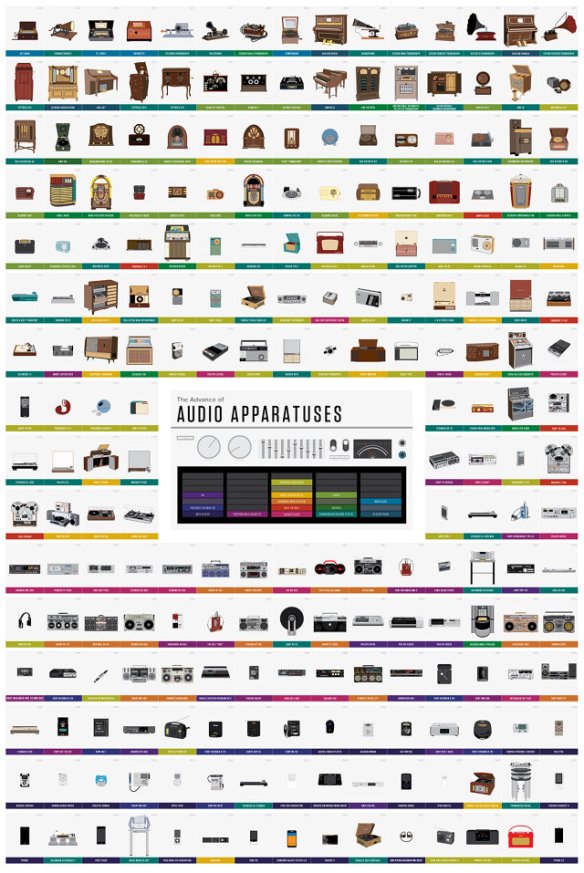
A prominent sci-fi writer once told me that, as prescient as they’d been, he and his peers had missed one big tech trend: Miniaturization. And they really did miss it. Because as you examine Pop Chart Lab’s latest mega print of 219 sonic devices across history, The Advance of Audio Apparatuses, it’s obvious that technology has been getting smaller for a long time.
An electronic ink that can be printed on a laser and then conducts electricity has been developed by scientists.
The graphene-based ink was used to make a small plastic keyboard by researchers at the University of Cambridge, who found the one atom-thick material could be used to make cheap, printed electronics.
It could be used in the future for people who need heart monitors, as they could be embed onto clothes, or for tracking luggage in an airport to ensure it is loaded on to the correct plane.
The graphene-based ink has a number of interesting properties, including flexibility, optical transparency, and electrical conductivity.
SAN FRANCISCO — For Google, the map of the future is taking everything it knows about you and the world and plotting it in real-time as you move through your life.
“We can build a whole new map for every context and every person,” said Bernhard Seefeld, product management director for Google Maps, speaking at the GigaOm Roadmap 2013 conference. “It’s a specific map nobody has seen before, and it’s just there for that moment to visualize the data.”
Like the early days of map making that told stories of discovery and created more of an emotional connection with the unfolding world, Google wants to build what Seefeld called “emotional maps that reflect our real life connections and peek into the future and possibly travel there.”
Google’s context-aware maps will require refining and extending the underlying map data, and combining it with the kind of personal data from applications that powers Google Now, the company’s personal digital assistant technology.


 infophile