What Neuroscience Says About The Link Between Creativity And Madness | Co.Design


The idea that very creative people are also a little crazy has been around since humanity’s earliest days. In ancient Greece, Plato noted the eccentricities of poets and playwrights, and Aristotle saw that some creative types were also depressives. In modern times, that connection has persisted, from Robert Schumann hearing voices guide his music to Sylvia Plath sticking her head in an oven to Van Gogh cutting off his ear to Michael Jackson … being Michael Jackson.

Today the link between creativity and mental illness is firmly embedded in the public conscience. Unlike some supposed cultural wisdoms, however, there’s a good bit of scientific evidence behind this one. Behavioral and brain researchers have found a number of strong if indirect ties between an original mind and a troubled one (many summarized in a recent post by psychologist Scott Barry Kaufman at his Scientific American blog).

Read: What Neuroscience Says About The Link Between Creativity And Madness | Co.Design | business + design.

PS4: Everything you need to know | CNET Reviews


The PlayStation 4 is finally available. Here’s the quick skinny on what you need to know about Sony’s just-released game console.

Read: PS4: Everything you need to know | Reviews – Games and Gear | CNET Reviews.

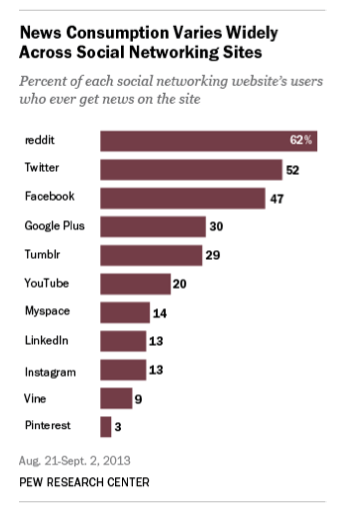
Pew Social Media Study: 30% Of The U.S. Gets News Via Facebook; Reddit Has The Most News-Hungry Regular Users | TechCrunch


The Pew Research Center is today releasing comparative numbers looking at how U.S. adults use social networking sites to read news (a follow-on from earlier research focusing on two specific sites, Facebook and Twitter).

This is significant for a couple of reasons. Social media sites have become a key component of how many news organizations today are looking to reach consumers as old-media forms like printed editions continue to decline. In turn, social media sites are turning news a way of attracting more eyeballs to improve their own ad-based businesses. That is to say, news and social media are dancing partners that are still working out how to move in the same direction without stepping on each other’s feet, and this survey is one indicator of how well the public is receiving that.

Read more and see all the charts: Pew Social Media Study: 30% Of The U.S. Gets News Via Facebook; Reddit Has The Most News-Hungry Regular Users | TechCrunch.

Pew: News Consumption

Why Facebook Would Pay $3 Billion for Snapchat (And Why It Shouldn’t) | Wired.com


Facebook just tried to spend $3 billion on a 20-person company that lets you send disappearing photos. At least, that’s the word from The Wall Street Journal, a rather trustworthy source.

According to the paper, SnapChat rejected the offer. But the amazing thing is that Facebook would offer that much money in the first place. SnapChat has no revenues, and its collection of users — however many there are — is puny when you consider that Facebook reaches over 1.2 billion people around the world. Across the internet, so many people are asking themselves: Why on earth would Facebook offer so much for this tiny company?

Read more: Why Facebook Would Pay $3 Billion for Snapchat (And Why It Shouldn’t) | Wired Business | Wired.com.

8 Years Later, Google’s Book Scanning Crusade Ruled ‘Fair Use’ | Wired.com


Full Post

Eight years after a group of authors and publishers sued Google for scanning more than 20 million library books without the permission of rights holders, a federal judge has ruled that the web giant’s sweeping book project stayed within the bounds of U.S. copyright law.

On Thursday morning, U.S. Circuit Judge Denny Chin dismissed a lawsuit from the Author Guild, ruling that Google’s book scans constituted fair use under the law. Though Google scanned those 20 million books in full and built a web service, Google Books, that lets anyone search the digital texts, users can only view “snippets” of a book if the right holder hasn’t given approval.

“In my view, Google Books provides significant public benefits,” the ruling reads. “It advances the progress of the arts and sciences, while maintaining respectful consideration for the rights of authors and other creative individuals, and without adversely impacting the rights of copyright holders.”

In a statement sent to WIRED, a Google spokesperson said the company was “absolutely delighted” with the ruling. “As we have long said, Google Books is in compliance with copyright law and acts like a card catalog for the digital age giving users the ability to find books to buy or borrow.”

Michael Boni, a partner with Boni & Zack, the law firm representing the Authors Guild, did not immediately respond to a phone message seeking comment. Nor did the Author’s Guild. But the Guild has told other news outlets it will appeal the decision.

“We disagree with and are disappointed by the court’s decision today. This case presents a fundamental challenge to copyright that merits review by a higher court,” reads a statement sent to GigaOm. “Google made unauthorized digital editions of nearly all of the world’s valuable copyright-protected literature and profits from displaying those works. In our view, such mass digitization and exploitation far exceeds the bounds of the fair use defense.”

The ruling comes two years after Judge Chin rejected a $125 million settlement between Google, the Author’s Guild, and the Association of American Publishers, which was also part of the original lawsuit against the web giant. After complaints over the settlement from outside organizations such as the Internet Archive and Google rivals such as Microsoft, Chin ruled the deal would give Google a de facto monopoly over so-called “orphan books,” scanned texts whose rights holders had not come forward to claim their share of the revenues Google would make from its book scanning endeavor.

A year after this ruling, the publishers agreed to another settlement with Google, and this one was not subject to approval from the court. But Chin allowed the case to continue as a class action, but an appeals court reversed this decision and told Chin to rule on the copyright issue.

Though Google limits how much book text you can view online — and though it doesn’t display ads on pages describing books it does not have rights to, the company, as the court explained, can still use its service to draw people to its websites and make money in other ways. But this commercial gain doesn’t necessarily mean copy infringement. Google Books, the judge ruled, doesn’t “negatively impact the market for books.”

On the contrary, Chin said, Google Books feeds the market for books. “A reasonable factfinder could only find that Google Books enhances the sales of books to the benefit of copyright holders,” the ruling reads. “Google Books provides a way for authors’ works to become noticed, much like traditional in-store book displays.”

via 8 Years Later, Google’s Book Scanning Crusade Ruled ‘Fair Use’ | Wired Business | Wired.com.
Infographic: When Will Wearable Tech Really Take Off? | PCMag.com


A few years ago, “wearable technology” meant little more than a clunky 1980s calculator watch or a Bluetooth headset. Now, people are accessorizing with color-coordinated fitness trackers and super-spy-like smartwatches.

According to ShotTracker, wearable tech is “the next megatrend” — changing the way we live, work, and play.

Read more:  Infographic: When Will Wearable Tech Really Take Off? | News & Opinion | PCMag.com.

Wearable Tech Megatrend

Watson Is Going To Be Open For Public Use on the Cloud | Gizmodo


Watson

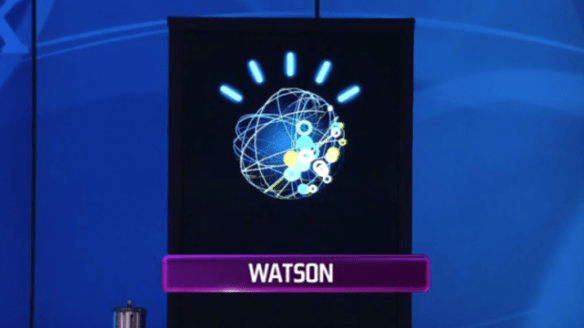
Watson was always going to be more than just a successful game show contestant. Now, the computer is about to take on anything and everything, as it opens itself up to the public on the cloud.

IBM has announced that its supercomputer will be opened up to developers in 2014, using a new, open API that will allow people to write code which can directly take advantage of Watson’s natural language abilities. Developers will be able to ping Watson complex strings of questions and get answers in real time.

Read more: Watson Is Going To Be Open For Public Use on the Cloud | Gizmodo.

Books, libraries, and the changing digital landscape | Pew Research Center


How libraries are dealing with the changing technological environment, as well as the larger context of Americans’ reading and library habits, and what they expect from libraries in the future.

Smithsonian now lets you view artifacts in 3D | CNET News


Smithsonian X 3D

You can now take a 3D peek at several famous historical artifacts thanks to a project from the Smithsonian Institution.

Launched on Wednesday, the Smithsonian X 3D Web site serves up a collection of 3D images of artifacts digitally scanned by the museum through a partnership with Autodesk. You canexplore the artifacts in detail by manipulating their images via mouse on your computer or via finger on a supported touch-screen device.

Read: Smithsonian now lets you view artifacts in 3D | Internet & Media – CNET News.

Related: The Smithsonian Is Uploading Its Lost Treasures to the Internet | Gizmodo

Classrooms Go High-Tech With Google Play for Education | PCMag.com


Google is making it more convenient for schools around the country to integrate tablets and educational apps into the classroom.

The search giant on Wednesday officially launched tablets running Google Play for Education, a version of the Google Play app store specifically designed for K-12 schools in the U.S.

Read: Classrooms Go High-Tech With Google Play for Education | News & Opinion | PCMag.com.