Library Used By Mexicans To Look At Drugs And Food Stamps, Says Racist Councilman | addictinginfo


Racism directed toward library patrons. Read the full story: “Library Used By Mexicans To Look At Drugs And Food Stamps”, Says Racist Councilman | addictinginfo

Originating story: Election 2013: Voters asked to rededicate library funding toward jail | Tri-Parish Times. See commentary in the STATE OF THE LIBRARY SYSTEM section.

Aside from his point that the system collects too much money, Toups does not philosophically agree with the library’s evolving role in the community.

“They’re teaching Mexicans how to speak English,” the council chairman said in reference to Biblioteca Hispana, a Hispanic-language segment of the Golden Meadow library branch. “Let that son of a bitch go back to Mexico. There’s just so many things they’re doing that I don’t agree with. … Them junkies and hippies and food stamps (recipients) and all, they use the library to look at drugs and food stamps (on the Internet). I see them do it.”

Book this librarian | The Hindu


Pushpendra Pandya

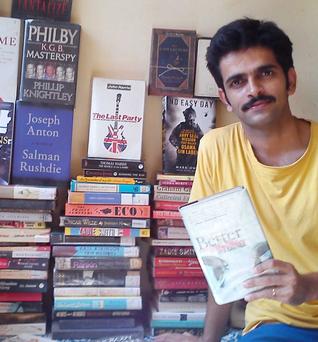
Pushpendra Pandya, a resident of Vasai in Mumbai, works six days a week as a copywriter. On Sundays, though, he hires a cab and travels to different localities in the city, collecting books from those who have either no need for them, or no space to keep them.

Last month he started a crowd-sourced library, and has since built a collection of 1200 titles with help from friends and strangers. The idea for the library came to Pandya in March last year when he started a book sharing arrangement with friends.“Just like we would share notes in college after bunking class to cover up, we started swapping books. I thought it could be taken to a larger audience,” says Pandya, who calls himself an old-fashioned book lover. “In spite of being in such a crowded city, people feel lonely here. You need some company sometimes, and books have been the greatest company for me so far.

Read the rest of the story: Book this librarian | The Hindu.

Mystery of 18th century music book| This Is Guernsey


Mystery book

Full Post

Historians are trying to trace the mysterious author of an 18th century music album that has been discovered in a library archive.

The untitled, leather-bound songbook was found by an archivist sorting through a catalogue of collections in the Watt Library in Greenock, Inverclyde.

The inside cover is signed by a Hugh Cameron and dated 1709 and it also contains poems, a book list and a series of religious writings.

The music, such as A Trumpet Air and Auld Robin Gray, were not written by Cameron but copied from a book of popular Scottish music. Cameron’s book has been described as an early example of a music album – a copy of music that can be performed by the owner at their leisure.

An expert from the Royal Conservatoire of Scotland has studied the unusual find and hopes to find out more about the person who wrote it.

Karen McAulay, music librarian at the Conservatoire, said: “A lot of the pieces in the manuscript have been copied out of one particular book.

“There was a publisher in Glasgow called Aird around that time and they published a series of books with fiddle tunes, mainly from Scotland but some from other countries as well, and when you go through this book you find that quite a lot of the tunes are from that one single volume (of the Aird book).

“These days you can quickly copy down with a photocopier or buy an album, but hundreds of years ago what you did was write your favourite tunes out and that’s exactly what this gentleman has done.”

The book is now going on display in the McLean Museum inside the library alongside other items from the archive, such as the Greenock Autograph Book which contains letters from Charles Dickens and Charles Darwin.

Library archivist Neil Dickson discovered the songbook last month when he was preparing the new display for Inverclyde Council.

He said: “The only reason it was found was because I was cataloguing the records which had previously never been catalogued before. We discovered the songbook and straight away I realised it was something special.

“It’s very unique and I always feel privileged to be doing the job I am and to make discoveries like this, because it’s essentially history that’s been untouched and it’s our job to explore and make it available, and hopefully we can find out more about the book and Hugh Cameron.”

Little else is known about the author and the library hope local people will be interested in the story.

Ms McAulay has researched Mr Cameron but has been unable to pinpoint exactly where he was from.

She said: “My guess is that he was possibly a schoolmaster. I found out that there were several Hugh Camerons who were schoolmasters at that time, one in Perthshire, and it could have been him, but I can’t be sure.

“What I can say is that he wasn’t a Church of Scotland minister because he was not in the minister listings for that time.

“The book is dated 1709 and the handwriting of the signature is very young but the handwriting of the lists of books is more mature so that would have been when the same person was a bit older. It may be something he’s added to over his life or it may be that a relative or someone else also used the book.”

The display is part of a nationwide Explore Your Archive campaign which aims to get people interested in local history.

Mr Dickson said: “Archives are very important, it’s essentially raw history.

“They’re usually the only resources we have for getting a detailed description of people’s life and society from the 17th century onwards.

“By searching through our archives in Inverclyde we’ve found some very, very special items and hopefully they can give people an insight in to the history of the area.”

via Mystery of 18th century music book | This Is Guernsey.

The Most Popular Books of All Time | Visual.ly


The Most Popular Books of All Time

Explore more infographics like this one on the web’s largest information design community – Visually.


‘Flowers In The Attic’ Trailer: Lifetime Takes On V.C. Andrews Novel | HuffPo


‘Flowers In The Attic’ Trailer: Lifetime Takes On V.C. Andrews Novel | HuffPo

Lifetime’s “Flowers In The Attic” has a spooky new trailer.

The hyped adaptation of V.C. Andrews’ classic novel will premiere on Lifetime on January 18. In the preview above, Kiernan Shipka (“Mad Men”) and Mason Dye (“Secret Diary of an American Cheerleader”) star as twins who develop a love affair while trapped in the family attic.

Featuring an all-star cast — Heather Graham plays the twins’ negligent mother and Academy Award-winner, Ellen Burstyn, is completely terrifying as the twins’ abusive grandmother — the trailer promises everything a Lifetime movie should: sex, terror and a whole lot of OMG-moments.

“Flowers in the Attic” premieres on Jan. 18 on Lifetime.

11 Indispensable Life Lessons Every Woman Can Learn From Anne Of Green Gables | HuffPo


Anne of Green Gables

Awesome, super popular post on HuffPo!!

Like all great children’s book heroines, Anne Shirley is just a bit odd. Okay, she’s very odd. Her crazy imagination and flowery diction differentiate her from most children you’re likely to meet, and despite a certain recent edition’s cover art, her hair is defiantly red. But somehow, her kooky adventures have spoken to generations of children, including me. Though in some ways L.M. Montgomery’s lesser-known heroine Emily Starr was more relatable to me as a kid — shy, withdrawn, bookish, and driven by professional ambition — lighthearted Anne is almost universally irresistible.

Anne is fearless. Anne is unpredictable. Anne is funny, though often unintentionally. Anne is smart, but not snobbish. Anne is so warm and caring you can feel it through the page. (And, cards on the table, her love interest Gilbert was my first literary crush.) Watching her grow up, stumbling from adventure to misadventure, was never dull. What’s more, it managed to teach young readers all about life without ever seeming preachy. Anne isn’t a model girl, but she’s figuring it out. Just like we all were at her age. Here are 11 of the most important lessons Anne Shirley taught me about life, love, and growing up.

Read: 11 Indispensable Life Lessons Every Woman Can Learn From Anne Of Green Gables | HuffPo.

8 Years Later, Google’s Book Scanning Crusade Ruled ‘Fair Use’ | Wired.com


Full Post

Eight years after a group of authors and publishers sued Google for scanning more than 20 million library books without the permission of rights holders, a federal judge has ruled that the web giant’s sweeping book project stayed within the bounds of U.S. copyright law.

On Thursday morning, U.S. Circuit Judge Denny Chin dismissed a lawsuit from the Author Guild, ruling that Google’s book scans constituted fair use under the law. Though Google scanned those 20 million books in full and built a web service, Google Books, that lets anyone search the digital texts, users can only view “snippets” of a book if the right holder hasn’t given approval.

“In my view, Google Books provides significant public benefits,” the ruling reads. “It advances the progress of the arts and sciences, while maintaining respectful consideration for the rights of authors and other creative individuals, and without adversely impacting the rights of copyright holders.”

In a statement sent to WIRED, a Google spokesperson said the company was “absolutely delighted” with the ruling. “As we have long said, Google Books is in compliance with copyright law and acts like a card catalog for the digital age giving users the ability to find books to buy or borrow.”

Michael Boni, a partner with Boni & Zack, the law firm representing the Authors Guild, did not immediately respond to a phone message seeking comment. Nor did the Author’s Guild. But the Guild has told other news outlets it will appeal the decision.

“We disagree with and are disappointed by the court’s decision today. This case presents a fundamental challenge to copyright that merits review by a higher court,” reads a statement sent to GigaOm. “Google made unauthorized digital editions of nearly all of the world’s valuable copyright-protected literature and profits from displaying those works. In our view, such mass digitization and exploitation far exceeds the bounds of the fair use defense.”

The ruling comes two years after Judge Chin rejected a $125 million settlement between Google, the Author’s Guild, and the Association of American Publishers, which was also part of the original lawsuit against the web giant. After complaints over the settlement from outside organizations such as the Internet Archive and Google rivals such as Microsoft, Chin ruled the deal would give Google a de facto monopoly over so-called “orphan books,” scanned texts whose rights holders had not come forward to claim their share of the revenues Google would make from its book scanning endeavor.

A year after this ruling, the publishers agreed to another settlement with Google, and this one was not subject to approval from the court. But Chin allowed the case to continue as a class action, but an appeals court reversed this decision and told Chin to rule on the copyright issue.

Though Google limits how much book text you can view online — and though it doesn’t display ads on pages describing books it does not have rights to, the company, as the court explained, can still use its service to draw people to its websites and make money in other ways. But this commercial gain doesn’t necessarily mean copy infringement. Google Books, the judge ruled, doesn’t “negatively impact the market for books.”

On the contrary, Chin said, Google Books feeds the market for books. “A reasonable factfinder could only find that Google Books enhances the sales of books to the benefit of copyright holders,” the ruling reads. “Google Books provides a way for authors’ works to become noticed, much like traditional in-store book displays.”

via 8 Years Later, Google’s Book Scanning Crusade Ruled ‘Fair Use’ | Wired Business | Wired.com.

Books, libraries, and the changing digital landscape | Pew Research Center


How libraries are dealing with the changing technological environment, as well as the larger context of Americans’ reading and library habits, and what they expect from libraries in the future.

Smithsonian now lets you view artifacts in 3D | CNET News


Smithsonian X 3D

You can now take a 3D peek at several famous historical artifacts thanks to a project from the Smithsonian Institution.

Launched on Wednesday, the Smithsonian X 3D Web site serves up a collection of 3D images of artifacts digitally scanned by the museum through a partnership with Autodesk. You canexplore the artifacts in detail by manipulating their images via mouse on your computer or via finger on a supported touch-screen device.

Read: Smithsonian now lets you view artifacts in 3D | Internet & Media – CNET News.

Related: The Smithsonian Is Uploading Its Lost Treasures to the Internet | Gizmodo

Gender in Tech Librarianship | Roy Tennant | The Digital Shift


One of the avenues by which this issue could be improved would be to hire more women into library tech positions in the first place. In my experience there is definitely a barrier to getting hired into these positions, or even interviewed. I was the only graduate in my cohort with a focus in information technology and it was lonely. Whenever I introduce myself to others in my field and I say I specialize in tech, I usually see the same expression, a little confused, a little flabbergasted. Its disheartening. On the flip side, patrons are hugely appreciative of someone they can connect with who can help them with computer literacy and device support.

I’m glad women in librarianship who specialize in tech have professionals in our field like Sarah Houghton and Ellyssa Kroski to, if not wave the banner for our gender, then at least illustrate definitively how intelligent, skilled and multifaceted women can be in library tech. Raising awareness is of utmost importance and this is why I’m lending my own comment to this story. 

Gender in Tech Librarianship | Roy Tennant | The Digital Shift.

Certainly I’ve written about this issue before, and I will keep writing about it until there are no more reasons to do so. But the reason why I’m writing about the issue of gender imbalance in library tech is because I was recently at the Internet Librarian Conference in Monterey, CA, where my esteemed professional colleague and completely famous Sarah Houghton, “Librarian in Black” had organized a panel on this very topic.

The panelists all gave a brief statement from their own experience and perspective (a mix of both women and men), then a microphone was carried around the room for the attendees to provide their own perspectives and stories. And the stories of harassment, put-downs, insults, marginalization, and worse, just rolled right in.

Unfortunately, I was surprised. Surprised because these were not the kind of subtle kinds of discrimination that I knew went on and that I try to prevent or alleviate. For example, packing a speaking panel with men, which happens all to often and a reason for which I have refused to participate at times. No, these stories were much more obvious, egregious, and, in some cases, breathtaking — and not in a good way.

At the end of the program I left depressed. Depressed that such things were happening on a regular basis — not yesterday, not a long time ago, but today. Depressed because since I’d never witnessed anything near what many of the stories related, I was mystified about how I could help prevent them.

But at least getting this out in the open is a start. The unfortunate thing is that those who really needed to be there most likely weren’t, nor will they ever be. So it’s up to us who were in the room, or would have been had they had the chance, to work harder to make all of our workplaces welcoming to all. Until that day arrives, we will soldier on.

At this conference we had the opportunity to have the necessary information sharing. Perhaps at the next one (and ongoing throughout the year in virtual form) we could share some strategies for making things better. That’s a program I could get behind.