Video game studio uses copyright claims to censor bad reviews | The Daily Dot


A video game studio censored negative YouTube reviews of its latest title, using spurious copyright-infringement claims to get its way. And now the gaming world is hoisting its controllers in revolt.

via Video game studio uses copyright claims to censor bad reviews | The Daily Dot

You may also like: Want to Sell Your Game? Don’t Tick Off YouTubers | WIRED

GoodReads Tells Reviewers to Play Nice (Or Else!) | IndieReader


Opinion piece.

In light of both author and reviewer behavior, GoodReads specifically has changed their Wild Wild West style of moderating their site and implemented some new standards. Our question is what does this mean for readers?

Read: GoodReads Tells Reviewers to Play Nice (Or Else!) – IndieReader

Other takes:

As GoodReads grows up, it can’t please everyone. Should it try? | GigaOM

Is GoodReads’ new policy really censorship? | Washington Post


Recent Internet Censorship Stories You May Have Missed


Copyright Takedowns on Twitter Are Up 76 Percent | Gizmodo
Twitter just released its latest transparency report detailing government requests for information requests, content removal requests and copyright takedowns. Not just one or two but all three categories are up in the first half of this year.

The UK wants to filter porn. Here’s how it might hurt the Internet. | Washington Post
Prime Minister David Cameron announced a plan to filter online pornography by default for households in the United Kingdom, saying the initiative is about protecting children and “their innocence.”

U.K. to compel customers to opt-in for internet porn | CBC
British internet providers will begin blocking access to online pornography unless customers specifically opt-in to surf sexually explicit material.

Tim Berners-Lee warns against governments controlling the Web | CNET
“When you make something universal…it can be used for good things or nasty things…we just have to make sure it’s not undercut by any large companies or governments trying to use it and get total control.”

What Internet Freedom Means to Me (and You) | Information Space
For the fourth of July, I thought it would be fitting (and fun) to get people’s ideas on Internet freedom.

Internet porn ‘opt in’ is censorship, say Canadians | Your Community | CBC
All internet pornography should be preemptively blocked in Canada, says Conservative MP Joy Smith of Winnipeg, which would force those who want to access adult content to “opt in” with their internet service provider….Many of those within our comments and on social media say that making citizens opt in to access adult content through their ISP would be a form of censorship.

A Map of the Countries That Censor the Internet | Gizmodo
The classification of censorship depends on political censorship like human rights and government opposition, social censorship, conflict/security censorship and various Internet tool censorship.

The Most Convoluted DMCA Takedown Request of All Time | Gizmodo
Anti-Gay group Straight Pride UK is abusing the DMCA takedown process to censor work by a journalist. No surprise there—the DMCA is twisted for all kinds of dumb purposes. The inexplicable part? The hate group filed a takedown on… its own press release. How dare you say that we said the words that we wrote in a press release.

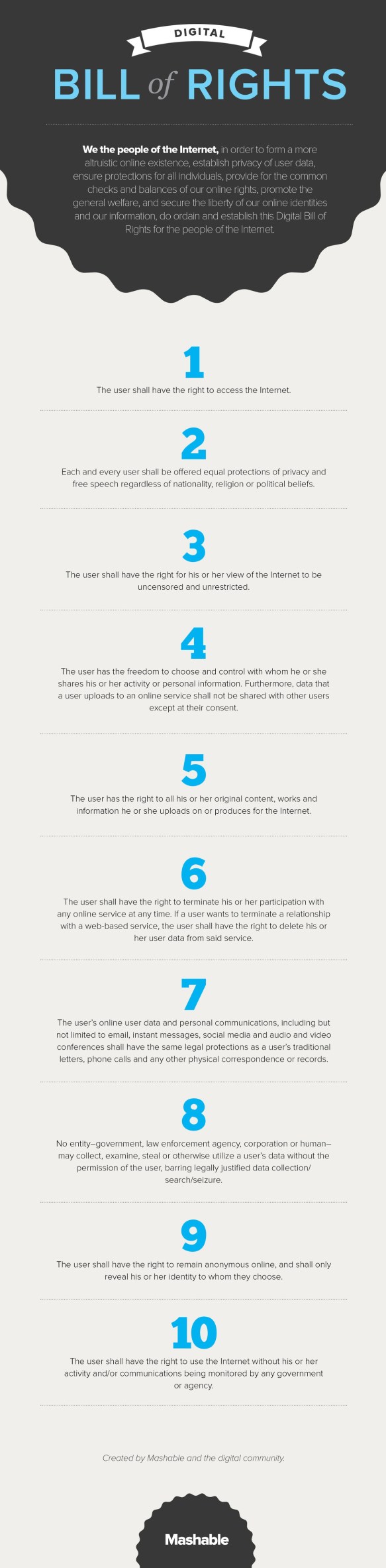
Explore Mashable’s Crowdsourced Digital Bill of Rights


After six weeks of public discussions, document updates and changes, as well as incorporating input from digital rights experts, Mashable is pleased to unveil its first-ever Digital Bill of Rights, made for the Internet, by the Internet.

via Explore Mashable’s Crowdsourced Digital Bill of Rights.

Digital Bill of Rights

LiveJournal Still Rules in Russia | Mashable


Quotable: “Without a better option that combines simple blogging with a strong community feel, it’s likely that LiveJournal will remain Russia’s primary blogging platform — unless, of course, another young idealist builds a brave new platform with free speech, not profit, in mind.”

via LiveJournal Still Rules in Russia | Mashable.

Some comments about censorship in Russia that may be of interest in the article.

Jonathan Zittrain: ‘Digital books are under the control of distributors rather than readers’ (Wired UK)


Digital books and other texts are increasingly coming under the control of distributors and other gatekeepers rather than readers and libraries. Though you can read a book through, say, Google Books, or on a Nook or Kindle, it’s laborious to save what you see to your computer and truly make the book your own. With cloud-based services, one “master” copy of the book is always online, but that makes it vulnerable to manipulation or even deletion.

Quotable: “To meet these challenges, libraries should be given an opportunity to escrow copies of publicly available but still all-too-controllable texts. They can compare their own banked copies with what’s currently on offer to the public, looking for changes to the integrity of texts.”

See the full article: Jonathan Zittrain: ‘Digital books are under the control of distributors rather than readers’ (Wired UK).

Edit Wars Reveal The 10 Most Controversial Topics on Wikipedia | MIT Technology Review


An analysis of the most highly contested articles on Wikipedia reveals the controversies that appear invariant across languages and cultures.

See the full article: Edit Wars Reveal The 10 Most Controversial Topics on Wikipedia | MIT Technology Review. The 10 most controversial topics are:

  1. George W Bush
  2. Anarchism
  3. Muhammad
  4. List of World Wrestling Entertainment, Inc. employees
  5. Global Warming
  6. Circumcision
  7. United States
  8. Jesus
  9. Race and intelligence
  10. Christianity

Burma’s Lucky Bibliophile | The Irrawaddy Magazine


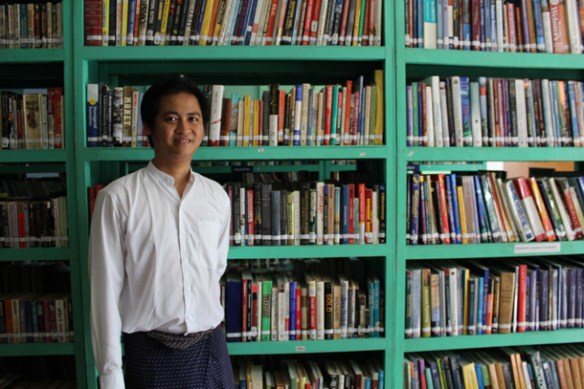
When the Ministry of Information’s director general visited Ye Htet Oo’s library in 2010, it could have been disastrous. Ye Htet Oo, then a recent college graduate, was running his new library in downtown Rangoon on the sly, without approval from the former military regime, and was told he could face three months in jail for every book he lent without permission from the censorship board. Unable to get a library license from the government, which saw libraries as a way to spread subversive ideas, he fronted his operation as a bookshop but kept a collection of unapproved library books hidden in a back room. Then one day, unknown to the young bibliophile, the ministry’s director general—who has since become the deputy minister of information and President Thein Sein’s spokesman—entered the “bookshop” and walked straight into the secret room.

For the full article and Q&A with Ye Htet Oo see:  Burma’s Lucky Bibliophile | The Irrawaddy Magazine.

Burma's Lucky Bibliophile

Liability Issues Will Plague the Future of Social Media | PCMag.com


Liability Issues Will Plague the Future of Social Media | PCMag.com

Egypt Crowdsources Censorship | Fast Company


“The Egyptian government is now crowdsourcing censorship efforts. A new web page created by the country’s National Telecommunications Registry Agency, allows citizens to report blasphemous websites (Arabic-language links). According to Alix Dunn of tech activism blog The Engine Room, the site is designed to help find pages showing a controversial anti-Islam film.”

via Egypt Crowdsources Censorship | Fast Company.