The code:mobile is Ladies Learning Code’s newest and biggest initiative to inspire and educate Canadian girls and boys to become passionate builders — not just consumers of technology. Think: a travelling computer lab on wheels that will make a cross-Canada journey in 2016 teaching 10,000+ kids to code along the way.
But, it’s more than just a truck or a computer lab. It’s a cross-Canada journey that will bring hands-on, interactive technology education to Canadian youth. We believe that computer programming and other technical skills are a tool of empowerment, and it is our mission at Ladies Learning Code to ensure that all Canadians — particularly women and youth — have access to these learning opportunities.
Coding has replaced history and geography in Australia’s new digital technologies curriculum which was endorsed by education ministers on Friday. As The Australian reports, it ensures that 21st century computer coding will be taught in primary schools from Year 5, and programming will be taught from Year 7. READ MORE: Coding to be taught in Australian schools from primary age | Mashable
Only 29% of all employees across the most influential U.S. technology companies—Google, Facebook, Twitter, Microsoft, Apple, Amazon, and Intel—are women. But that includes salespeople, service workers, and communications professionals. Companies that break out gender ratio by role report an an even more drastic disparity. At Twitter, 10% of technical workers are women. At Facebook, it’s 16%.
Computer science programs across the country report a similar dearth of women. As of 2012, the last year for which the National Science Foundation has published data, only about 18% of degrees in the field were obtained by women, the lowest percentage of any STEM discipline. But there is one corner of this pale, male landscape that has less of a gender imbalance than others: coding schools. READ MORE: Where Are The Women In Tech? Coding Bootcamps | Fast Company | Business + Innovation.
Beyond Wearables: New Frontiers in Interactive Tech | WIRED
IN THE FINAL months of 2014, wearable technology sparked significant media and consumer attention – not least thanks to the announcement of the Apple Watch. But as wearables move from the margins into the mainstream, it’s time to consider the next wave of interactive technology.
Programmable Clothes Are Going Commercial | Co.Design
Clothes speak volumes about us, conveying messages about wealth, taste, and personal beliefs. So in this age of ubiquitous screens and social sharing, it’s no surprise that textiles have become another platform for electronic communication. But two new efforts are commercializing the technology, creating consumer fashions that allow the wearer to project any electronic text or image she desires.
Somehow Teen Girls Get the Coolest Wearable Out There | WIRED
JEWELBOTS ARE BRACELETS with programmable plastic flowers made for middle-school girls. They’re also the most interesting wearable I’ve seen this year. Their creators describe them as “friendships bracelets that teach girls to code.”
This Jacket Is a Dream Come True and I Need It Now | Jezebel
The BauBax jacket—which CNN quite accurately refers to as “the Swiss Army knife of
travel wear”—which debuted on Kickstarter last week with a goal of raising $20,000. They have since raised over $600,000 because it is a stunningly good idea. The jacket contains 15 pockets and a slew of built-in doodads.
These Strange Clothes Came Out of a Regular Old 3-D Printer | WIRED
Paired with new cellular structures being devised by 3-D printing re
searchers, the material allowed Peleg to create “lace-like textiles” that she could work with
“just like cloth.” She printed them using a Witbox—a $1,800 machine. [Image: Danit Peleg]
These Mathematical Scarves Are Designed By a Computer Algorithm | Gizmodo It’s still summer, but these mathematical merino scarves designed with a computer algorithm are getting us in the mood for colder temps. They’re called KnitYak: black-and-white merino scarves that each have a snowflake-unique design that’s generated by a computer algorithm.
A Paper-Thin Solar Panel Can Charge Your Phone on the Go | Lifehacker
Solar panels keep getting lighter and tinier—good news for rugged on-the-go types who can charge their devices on the trail with sun-fueled chargers. And this particular solar charger on Kickstarter is so thin, you can slip it in your Lonely Planet while it feeds your phone battery.
Disney’s $1 Billion Bet on a Magical Wristband | WIRED
The MagicBands look like simple, stylish rubber wristbands offered in cheery shades of grey, blue, green, pink, yellow, orange and red. Inside each is an RFID chip and a radio like those in a 2.4-GHz cordless phone. The wristband has enough battery to last two years. It may look unpretentious, but the band connects you to a vast and powerful system of sensors within the park.
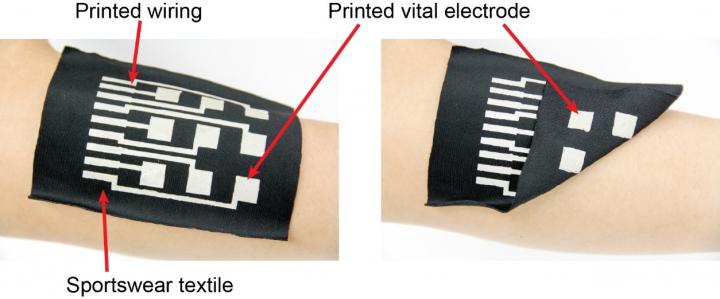
New Process Can Print Stretchy Electronics Onto Your Clothes | TechCrunch
Researchers at the University of Tokyo have created a single-step process to print conductive material on cloth, allowing manufacturers to build stretchable wearables that can test vital signs like heart rate and muscle contraction.
Google’s Project Jacquard Aims To Make “Activewear” A Reality | ReadWriteWeb
What’s really fascinating about Project Jacquard…the clothing itself ought to be an interactive thing. It ought to provide us an opportunity to interact with devices around us. That’s the breakthrough that Project Jacquard is really talking about—now, instead of just passive data collection, your clothing is an opportunity for you to interact with devices.
Sensory Fiction | Felix | VIMEO
Sensory fiction is about new ways of experiencing and creating stories. Traditionally, fiction creates and induces emotions and empathy through words and images. By using a combination of networked sensors and actuators, the Sensory Fiction author is provided with new means of conveying plot, mood, and emotion while still allowing space for the reader’s imagination.
How to Print a Super-Thin Touchscreen Display on Just About Anything | Gizmodo
[T]his award-winning paper is perhaps the coolest we’ve seen: It lays out a new technique for printing cheap, simple touchscreen displays with conventional printers. It’s called PrintScreen, and it’s a system that allows the user to print on nearly a
ny material.
From The Designers Of Fitbit, A Digital Tattoo Implanted Under Your Skin | Co.Design
We asked NewDealDesign, the design consultancy behind projects like the Fitbit line of activity trackers, and Google’s modular Project Ara smartphone, what things might look like when technology and fashion reach beyond the wrist. In response, they created Project Underskin. It’s a concept for a smart digital tattoo which would be implanted in your hand and interact with everything you touch. It can unlock your front door, trade data with a handshake, or even tell you if you have low blood sugar.
DFRobot, a company that has been building robots for the education market since 2008, this week introduced its first attempt at making a robot accessible to all children, with the debut of Vortex – an interactive, programmable robot aimed at kids 6 and up. The Vortex robot pairs with iOS and Android smartphones or tablets over Bluetooth, and lets kids control its movement by tapping the screen in the Vortex app to initiate commands. It also comes four free, pre-programmed games – “bumping fight,” “virtual golf,” “driving,” and “robot soccer,” which can later be customized by the child to create their own play experience. READ MORE: Vortex Is A Toy Robot That Teaches Kids How To Code | TechCrunch.
Parents might be happy to know their kids can get a head start in the competitive slipstream of computer programming by doing something they already enjoy — playing video games.
That’s the goal of Server Design 1, a new online course rolled out Tuesday by Youth Digital, a tech education company that teaches kids to code, develop apps, and design 3D modeling. The company’s new program allows kids to create their own worlds, with their own rules, all while playing the popular video game Minecraft with their friends.
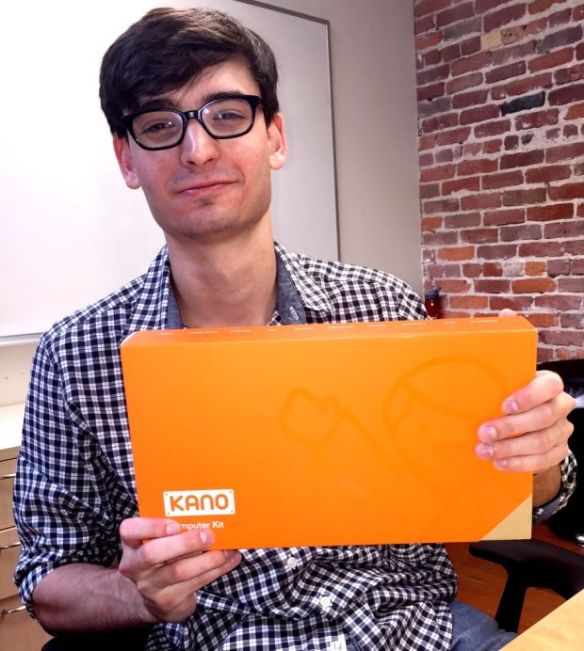
I think its a very smart marketing move for Kano to launch products that are gender and age neutral. I volunteer with my public library’s CoderDojo program, which is for 9 to 17 year olds. One of the participant’s parents has actually stayed to learn as well. Its heartwarming to see parent and child learning new concepts together. Learning to code, makerspaces, hackfests, arduino…these activities are fun and instructive for all ages and can be a family activity too.
Kickstarted into existence in 2013, with a campaign that blasted through its $100,000 goal with $1.5 million in pledges, Kano now makes Raspberry Pi–based computer kits commercially available to children ages 6 to 14. Inspired by those young users, who founder Alex Klein says have created and shared as many as 5 million lines of code, he wants to spread that enthusiasm to a larger audience.
Engineering kits have been popular among kids and a natural fit in the educational space. Likewise, Kano set out following in the footsteps of companies like Little Bits, Adafruit, and Goldie Blox. But Klein now wants to extend Kano’s reach, taking it into grown-up territory. Simply put, he wants to appeal to everyone’s inner “inventor and tinkerer,” he said.
Klein wants to push into the adult maker market by putting out products that are both gender- and age-neutral. The core design, he hopes, speaks to fundamental human impulses: “Everyone has shared urges to look inside,” he said. “Everyone wants to take control. Everyone wants to make and play.”
Kano’s next stage of evolution will involve some fundamental shifts. The company is expanding its line-up with new add-on kits, and plans to open up Kano Blocks—its game-making arena—and online platform Kano World to community development.
All Kano products run on Kano OS, the open source operating system that sits on top of Raspberry Pi. It boasts high computational powers that let it run fast, boot quickly and offer clear graphical rendering. For developers, this means that they will have ample resources to jump on board and quickly create their own projects. Kano World allows for the Kano community to share their creations and add on to existing projects.
Coding is a great skill for kids to learn but it can be a lonely, sedentary endeavor. Hackaball, a new toy created from a partnership between the design agencies MAP and Made By Many, promises to get kids off their butts and playing outside—all while teaching basic coding skills and empowering kids to invent their own kind of play.





 ve seen: It lays out a new technique for printing cheap, simple touchscreen displays with conventional printers. It’s called PrintScreen, and it’s a system that allows the user to print on nearly a

 infophile