Beach Reads: A Library Pops Up In The South Of France | Co.Design


Staring down an expanse of vast and powerful ocean in late summer is guaranteed to make you question two things: your own sense of self-worth, and that of your e-reader. Nothing like the glare, the saltwater, the sunscreened fingers, the sand to recommend a hard-copy book. But the closest thing to literature on pages you can see is the bulk of September Vogue.

Now imagine, dear beach reader, that you’re lying underneath a soft, fabric-covered alcove on a breezy stretch of South of France coastline, the sound of Mediterranean waters lapping at the shore. Behind you is a library with up to 350 books–real-life, paperback books–at your curious disposal.

This is the precisely the dreamy vacation scenario that French industrial designer Matali Crasset fulfilled by creating a mobile library (yes, it actually exists) for the town of Istres. Located on the beach of Romaniquette, the freestanding steel literary haven is open to readers through September. “This project interested me for its relationship with real life,” Crasset tells Co.Design. “It is a dynamic object. I was able to develop a project that meets, in terms of usage scenarios, a logic and a demand that is very present, human, and alive.”

The Bibliotheque de Plage is stocked with titles ranging from classic Jane Austen to works chosen by the designer herself, those that provided inspiration through the course of the project’s execution. It was also essential to Crasset that the temporary beach library was a tribute to the importance of maintaining physical, personally curated collections of books. She collaborated with the town’s municipal library to establish “a comprehensive cultural policy of access to the books.” Her summer structure, she says, “brings books to the population to encourage the practice of not only reading, but of lending.”
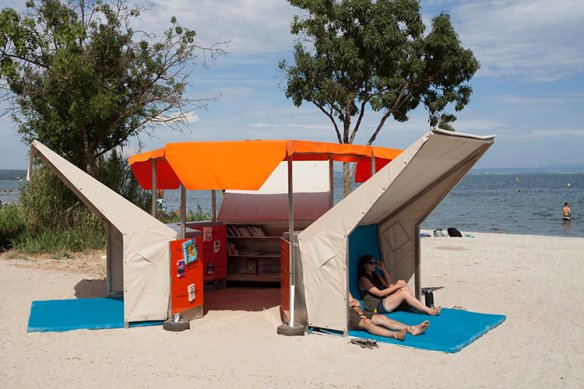
Popup Beach Library

via 1 | Beach Reads: A Library Pops Up In The South Of France | Co.Design: business + innovation + design.

4,000 Years Of Human History Captured In One Retro Chart [Infographic] | Co.Design


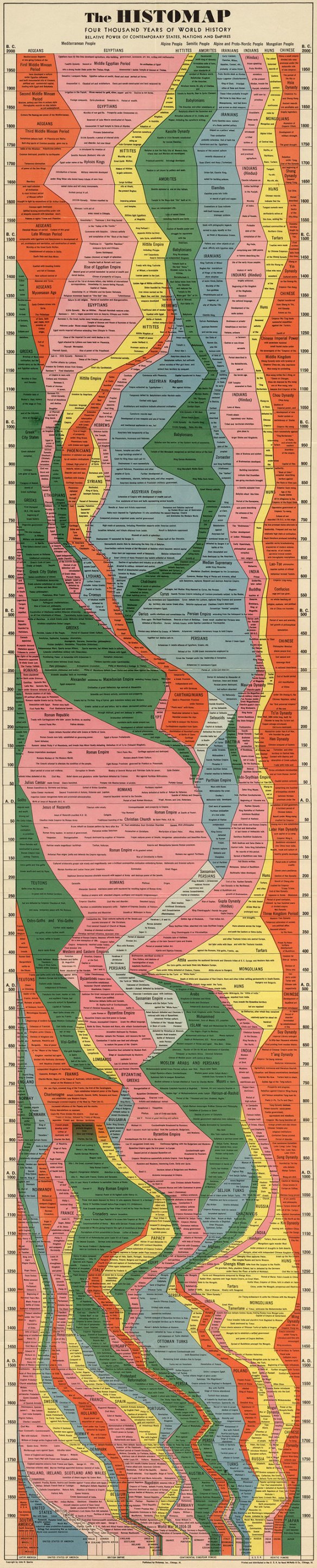
If time is a river, the Histomap, created by John B. Sparks and first published by Rand McNally back in 1931, is a raging Mississippi. In that massive river of time, each of humanity’s great civilizations becomes a confluence that ebbs, wanes, and sometimes ebbs again, each a separate current in a river that inexorably rages down to the mouth of the present day.

Although certainly not modern, the Histomap is still a breathtaking example of good infographic design: A five-foot, roll-up chart that can fit an overview of human history on any wall. 

See the full story: Infographic: 4,000 Years Of Human History Captured In One Retro Chart | Co.Design: business + innovation + design.

The Histomap

Mapping Creative Spaces Around The World | Co.Exist


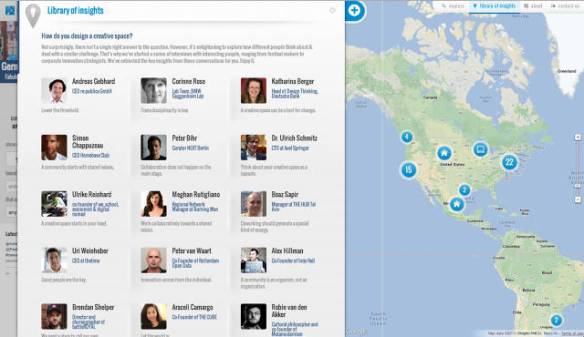
If you’re looking for a creative space–a place to work that truly fosters collaboration, a place to learn new skills, a community of like-minded artists and entrepreneurs–you probably look on Yelp or do a Google search. That won’t yield much. These spaces are scattered across Yelp categories, and a Google search for “creative spaces” shows just a smattering of local spots. That’s what Berlin-based consulting studio ignore gravity discovered while researching creative spaces around the world.

So the studio pulled together data on hundreds of creative spaces and presented them in the Creative Space Explorer, a tool that lets users pinpoint creative spaces on a global map–and add their own. ” We define ‘creative space’ as an enviro that consciously is set up to trigger collaboration in a creative way,'” explains Max Krüger, one of the creators of Creative Space Explorer.

See the full article: Mapping Creative Spaces Around The World | Co.Exist | ideas + impact.

Mapping Creative Spaces Around The World | Co.Exist | ideas + impact

14 Fantastic Free Tools for Design Collaboration | Mashable


There’s a wealth of excellent collaboration tools to make it easier to get feedback and approve artwork in a timely, professional manner. For freelancers or small agencies on a tight budget, these free tools can make sharing design concepts in real time a breeze, without breaking the bank. via 14 Fantastic Free Tools for Design Collaboration | Mashable

The 14 tools reviewed are:

  1. Red Pen
  2. Bounce
  3. Flatsies
  4. Prevue
  5. Marqueed
  6. GoVisually
  7. Invision App
  8. Design Drop
  9. Framebench
  10. Concept Inbox
  11. Skwibl
  12. EasyProof
  13. Apollo
  14. Redmark

How to Gamify Your Library | Michelle Simms


This presentation was given at the School Library Association of New Zealand Aotearoa (SLANZA) conference in 2013. It focusses on what gamification is and how to use game elements to bring fun into the library.

Saki Mafundikwa: Ingenuity and elegance in ancient African alphabets | TED.com


From simple alphabets to secret symbolic languages, graphic designer Saki Mafundikwa celebrates the many forms of written communication across the continent of Africa. He highlights the history and legacy that are embodied in written words and symbols, and urges African designers to draw on these graphic forms for fresh inspiration. It’s summed up in his favorite Ghanaian glyph, Sankofa, which means “return and get it” — or “learn from the past.”

via Saki Mafundikwa: Ingenuity and elegance in ancient African alphabets | Video on TED.com.

Seven Rare Steve Jobs Videos That Show How To “Think Different” ⚙ Co.Labs


Steve Jobs was skilled at many things–technology, marketing, and managing just for starters. But while his talents could be attributed to many factors, one that surely played a role in his success was his ability to consider things from perspectives no one had. Here are seven rare videos which span his career and take us behind the scenes of his famous slogan.

  • Product-Making
  • Intelligence
  • The Concept of Spending Money
  • The Low Periods Of Industry Innovation
  • Asking for Help
  • Animation
  • Marketing

via Seven Rare Steve Jobs Videos That Show How To “Think Different” ⚙ Co.Labs ⚙ code + community.

Crowdsourcing Spiffy New Book Covers For 50 Literary Masterpieces | Co.Design


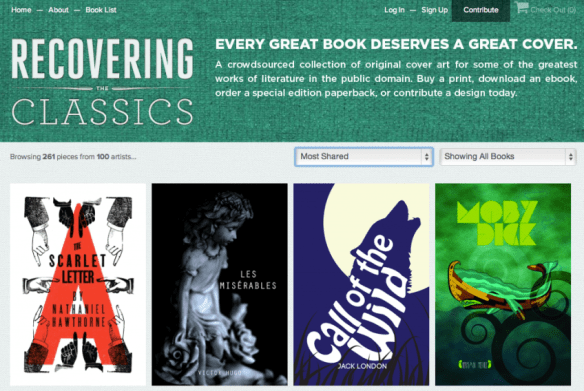
Recovering the Classics is a joint project by the Creative Action Network, DailyLit, and Harvard Bookstore that hopes to attract designers and illustrators–namely, people like you–to crowdsource public domain covers for what they’ve deemed the 50 greatest literary works in public domain history.

Technically, these covers will then enter the public domain for you to use as you see fit. But for ease of distribution, the Harvard Bookstore will print you any public domain book you’d like with any cover you’d like for $15, with profits split between the organizations and cover’s creator. eBooks will be available for $3.

via Crowdsourcing Spiffy New Book Covers For 50 Literary Masterpieces | Co.Design: business + innovation + design.

1 | Crowdsourcing Spiffy New Book Covers For 50 Literary Masterpieces | Co.Design: business + innovation + design

Flexible Screen Displays: The How, When, And Why | Information Space


Quotable: “Flexible and curved screens open up all kinds of interesting design opportunities. Imagine a screen wrapped around a telephone pole, on the outside of a water bottle, or even as a tablecloth, or one covering the seat of a chair. The possibilities are endless.”

via Flexible Screen Displays: The How, When, And Why | Information Space.


14 Pinterest Doppelgängers for Visual Inspiration | Mashable


14 Pinterest Doppelgängers for Visual Inspiration | Mashable

The article reviews:

  1. Foodgawker
  2. Dribble
  3. Notcouture
  4. Svpply
  5. Designspiration
  6. Dwellinggawker
  7. Behance
  8. Liqurious
  9. Notventures
  10. The Book Cover Archive
  11. Editorial Design Served
  12. Fonts in Use
  13. Baubauhaus
  14. siteInspire