
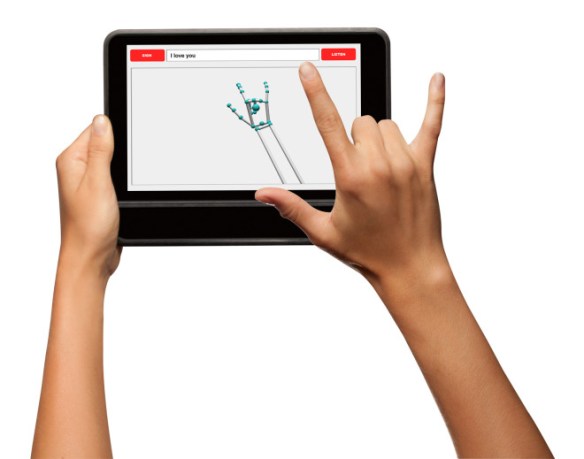
New Tablet Case Recognizes Sign Language and Translates It Into Text | WIRED


When you’re deaf, finding a job isn’t easy. The trickiest part, explains Ryan Hait Campbell, is the interview. “You’re not required to tell an employer you’re deaf until the interview, but sometimes, they’re a little shocked,” says Campbell, who has been deaf since birth. “They don’t know how to handle it.”

Because of things like this, he says, unemployment rates are staggeringly high among the deaf. Hard numbers are tough to come by, but some figures estimate that around half of people with hearing disabilities are unemployed.

But Campbell wants to change this. He’s the co-founder and CEO of MotionSavvy, an Alameda, California-based startup that’s developing a case for tablet computers that can serve as a virtual interpreter for the deaf. Known as UNI, the case uses gesture recognition technology developed by Leap Motion to translate sign language into audible speech.

READ MORE: New Tablet Case Recognizes Sign Language and Translates It Into Text | WIRED.
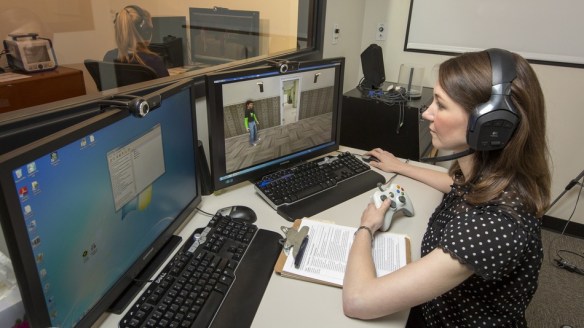
Your Next Psychologist May Prescribe The Legend of Zelda | Mashable


When Carly McCullar, 32, was diagnosed with autism spectrum disorder as an adult, she wanted to improve her social and communication skills before heading into the next stage of her life.

Never having received such help before, she volunteered to participate in a unique treatment program: virtual reality. Sitting at a computer that tracked her facial expressions, the game tested her social cognition and provided feedback, McCullar played through various realistic scenarios, including a job interview, a confrontation with a loud neighbor and even dating.

The program, a collaborative effort from gaming technology experts and health researchers at the Center for BrainHealth at the University of Texas at Dallas, simulates everyday experiences and social situations that are typically difficult for those with autism or anxiety disorders. And its just one example in a growing trend in which video games are forms of therapy. READ MORE: Your Next Psychologist May Prescribe The Legend of Zelda | Mashable

Reuters | New KNFB smartphone app gives sight to the blind | KurzweilAI


The National Federation of the Blind, the nation’s leading advocate for access to print by the blind, has applauded the release of KNFB Reader, a new app for the iPhone and other Apple iOS devices, which uses the phone’s camera and state of the art optical character recognition (OCR) technology to give the blind instant access to the contents of print materials.

Members of the National Federation of the Blind have worked with KNFB Reading Technology, which developed the app along with Sensotec, KNFB Reader is now available in the Apple iTunes app store.

READ MORE: Reuters | New KNFB smartphone app gives sight to the blind | KurzweilAI.

MIT Develops a Phone Screen That Corrects Poor Vision | WIRED


Researchers from MIT and the University of California, Berkeley have created a prototype for a new display technology that can automatically correct for vision defects. Think of it as glasses for your iPad. Or your phone, or your car dashboard or any number of screen-based devices you have in your life. The point being, someday in the not too distant future you won’t need to wear glasses anymore to do certain tasks.

READ MORE: MIT Develops a Phone Screen That Corrects Poor Vision | Design | WIRED.

High-tech gloves can teach you Braille even if you’re distracted | Engadget


It looks like a team of Georgia Tech researchers is in the business of making wondrous, high-tech gloves — their most recent one, for instance, can teach you Braille even if youre doing something else. Similar to the piano-teaching glove they designed years ago, this new pair has vibrating motors on each knuckle that buzz in different patterns to correspond with preset Braille phrases.

Read More: High-tech gloves can teach you Braille even if you’re distracted | Engadget

MIT’s FingerReader Helps The Blind Read With A Swipe Of A Digit | TechCrunch


At MIT’s Media Labs, researchers Roy Shilkrot, Jochen Huber and others are working on the “FingerReader,” a ring-like device that straps itself around your finger and reads printed text out loud with a synthesized voice, thanks to a mounted camera and heavily modified open source software. Read more: MIT’s FingerReader Helps The Blind Read With A Swipe Of A Digit | TechCrunch.

Eye Cells Made with Ink-Jet Printer | MIT Technology Review


The ability to print retinal cells could lead to new therapies for retinal disorders such as macular degeneration…Researchers at the University of Cambridge used a standard ink-jet printer to form layers of two types of cells taken from the retinas of rats, and showed that the process did not compromise the cells’ health or ability to survive and grow in culture. Ink-jet printing has been used to deposit cells before, but this is the first time cells from an adult animal’s central nervous system have been printed.

Read more: Eye Cells Made with Ink-Jet Printer | MIT Technology Review.

How Braille Was Invented | Gizmodo


Braille Alphabte

Braille was invented by a nineteenth century man named Louis Braille, who was completely blind.

Braille’s story starts when he was three years old. He was playing in his father’s shop in Coupvray, France, and somehow managed to injure his eye. Though he was offered the best medical attention available at the time, it wasn’t enough—an infection soon developed and spread to his other eye, rendering him blind in both eyes. While a tragedy for him, had this accident not happened, we wouldn’t have braille today.

There was a system of reading in place for the blind at the time, which consisted of tracing a finger along raised letters. However, this system meant that reading was painfully slow and it was difficult to discerning by touch the relatively complex letters of the alphabet. As a result, many people struggled to master the embossed letter system.

Read the rest of the story: How Braille Was Invented | Gizmodo

Oculus Rift-based virtual reality game could help restore 3D vision | Engadget


Many will tell you that video games are bad for your eyes, but James Blaha doesn’t buy that theory. He’s developing a crowdfunded virtual reality title, Diplopia, that could help restore 3D vision. The Breakout variant trains those with crossed eye problems to coordinate their eyes by manipulating contrast; players score well when their brain merges two images into a complete scene. Regular gameplay could noticeably improve eyesight for adults that previously had little hope of recovering their depth perception, Blaha says. The potential solution is relatively cheap, too — gamers use an Oculus Rift as their display, and they can add a Leap Motion controller for a hands-free experience. If you’re eager to help out, you can pledge $20 to get Diplopia, and $400 will bundle the app with an Oculus Rift headset. Check out a video demo of the therapeutic game after the break.

Read: Oculus Rift-based virtual reality game could help restore 3D vision | Engadget

The Book as App: Multi-Touch Ebooks and Their Future in Libraries | Nicole Hennig